


Getting people to click on articles is becoming increasingly difficult. We’ve been lazily conditioned by big tech’s greed and it shows no sign of slowing.
To combat this, we have to build and own audiences and get better at marketing. Publishers need to work harder to make their content appealing, particularly on the surfaces they control.
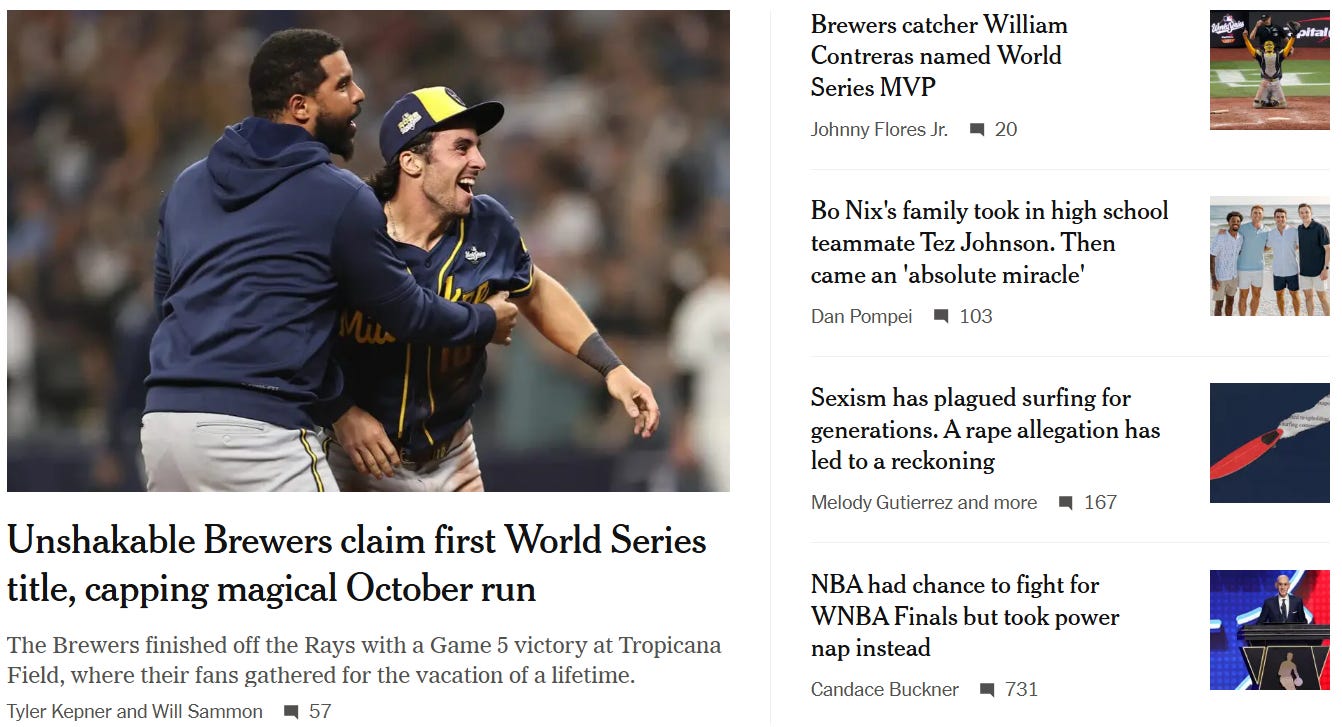
The Athletic does something very simple on its homepage that more publishers should consider: it shows readers how many comments selected articles have generated.
It tells you which content its readers really care about.
If you’d like to work with me, you can find all the details on my consulting website – Tomorrow Consulting.
Now part of the world’s most successful publisher, The Athletic has gone from strength to strength in recent times. In Q2 of 2025, revenue was up one-third to $54M with an adjusted operating profit of $5.8M. Hell, even ad revenue nearly doubled to $14.1M.
Safe to say the NYT, and by extension The Athletic, are publishing’s most profitable case study. They are worth listening to.
Why does this matter?
It tells you, dear apathetic reader, which articles are generating discussion. It’s an extremely simple, clever use of social proof.
1. It encourages clicks
People are naturally drawn to things other people are interested in. And every publisher is trying to create a community. These comment counts signal which articles are generating discussion among its audience. Arguably other like-minded people.
If one article has 500 comments and another has just one, all things being equal, I’m far more likely to click on the former. It has piqued my curiousity. Clickability goes beyond just images and headlines.
It tells me there’s a conversation worth joining. Or, at the very least, something interesting enough to get people talking.
This is particularly valuable if you have a large homepage and direct audience. As traffic continues to drop, you’ve got to make more use of what you have.
2. Engagement signals don’t stop there
Comments are just one measure of engagement. We can be far more rigorous.
Experiment with shares, likes and other signals to identify content that resonates with your audience. Tell your audience, with certainty, which articles are worth reading.
Not every article will generate hundreds of comments, even the more popular ones. Some might be widely shared, others might encourage unusually high levels of engagement relative to your traffic.
The important thing is identifying what your audience values and making that visible. That you prioritise your best-performing content.

3. Use engagement to inform content prominence
Most publishers use composite engagement scores to promote the right behaviours. Almost everyone is de-prioritising traffic and promoting quality engagement - session duration, clicks, scroll depth, comments - because they believe this is the key to building a truly engaged audience.
You could use statistical modelling, potentially supported by AI, to identify articles that are overperforming against expected engagement levels (a Bayesian like approach), then surface them more prominently across homepages, section fronts and topic pages.
Rather than relying exclusively on editorial judgement, you’re combining it with actual audience behaviour.
The result should be a better user experience and more opportunities to generate clicks.
How can I test this?
Keep it really, really simple and set clear KPIs.
Start with comments: Display comment counts on selected homepage articles and test whether they improve CTR.
Expand your signals: Experiment with likes, shares or other engagement indicators. Not all engagement is equal, so establish what encourages truly valuable repeat behaviour.
Identify overperformers: Compare article engagement against relevant benchmarks, rather than promoting whatever has the most traffic.
Improve prominence: Test whether featuring overperforming articles more prominently increases engagement across your owned surfaces.
CTR is not a perfect measure of success. Often, the most clickable content can veer into rage-bait or clickbait. Which is exactly the kind of content you want to avoid.
As referral traffic becomes harder to generate, publishers need to make more of the audiences they already have. This is a simple, almost certainly effective way of doing that.