


AI has been public enemy number one for at least two years. As the early wave of excitement wore off, people realised the content we as SEOs and publishers had spent years flooding the internet with was being used to make the richest even richer.
We cannot deny the open web is changing - AI bot traffic grew 187% from January to December 2025, while human traffic grew just 3.1%. The value exchange for websites - particularly those who have traded on information and clicks - does not exist as it once did. At least not in as sustainable a manner.
Whilst this has been expedited by the arrival of LLMs - answer engines that have restructured the web without partaking in the click-based value exchange - audience habits have been shifting for some time. Generally not positively for publishers.
I consult on all things SEO, discoverability, the future of search, your market positioning and approach to audience targeting. My consulting website is here. If you’d like to discuss anything, you know where to find me.
The erosion of direct relationships
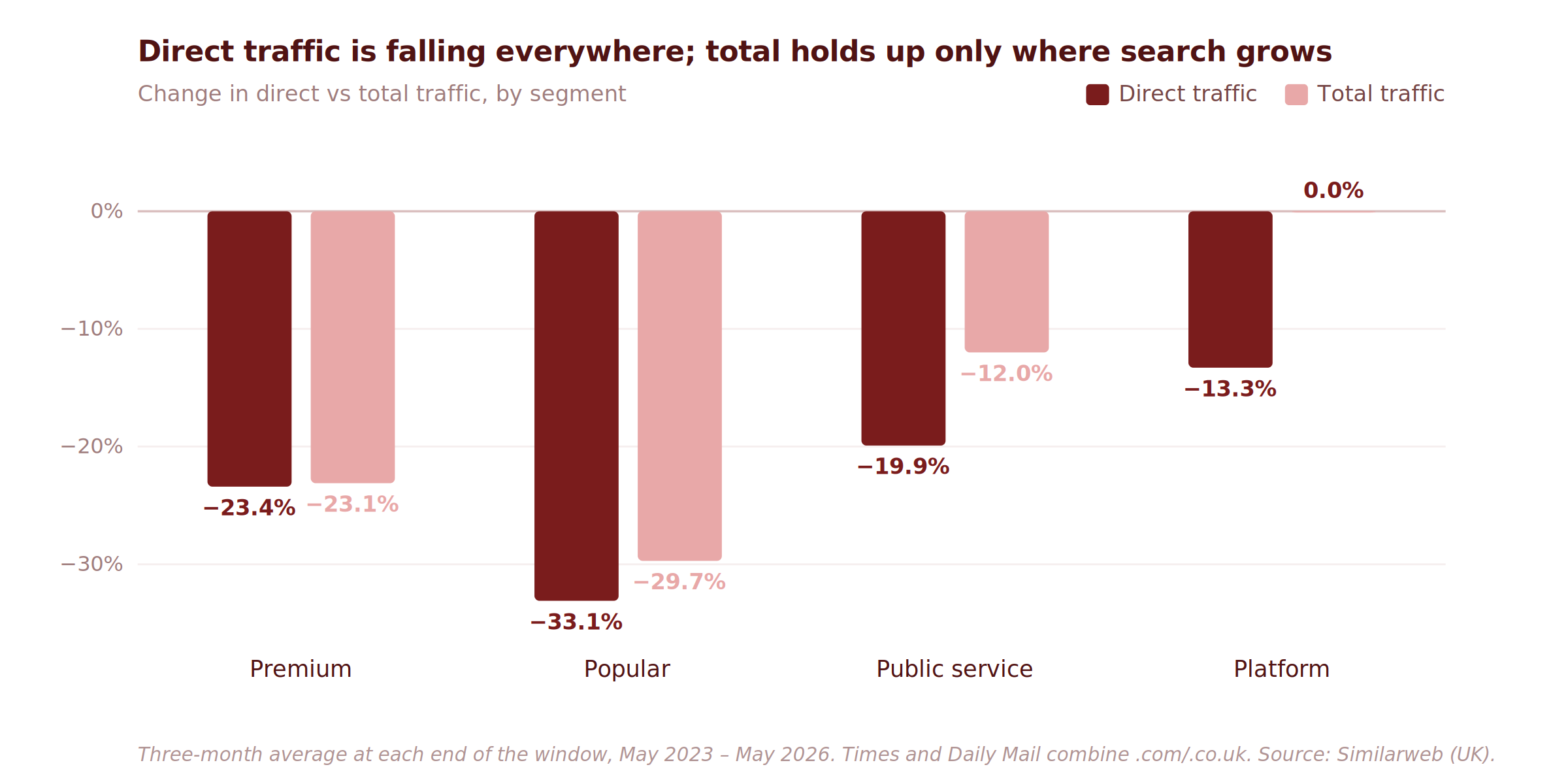
Similarweb data for 15 publishers and four platforms show that direct traffic has declined across every segment over three years:
Popular publishers −33.1%
Premium publishers −23.4%
Public Service publisher(s) −19.9%
The Platform segment also recorded a direct-traffic decline (−13.3%), but offset it through growth in other channels.
But the segment averages don’t tell the full story. The under 35 audience is declining roughly 1/3 faster than the over 35s. - the exact cohort tomorrow’s (hopefully) paying subscribers come from.
Birmingham Mail saw a 54.6% reduction in direct traffic over this timeframe. The Mirror a close second at 52.9%. Conversely The Telegraph lost just 8.9%. Potentially some Premium resilience on show.
The NYT saw growth in the UK market, albeit from a tiny user base, as did GB News - a relatively new proposition in 2023 to the best of my knowledge.
YouTube’s 17.8% loss in direct traffic over this same timeframe drags the Platform segment down. You could argue that this is symptomatic of more direct-to-app-based behaviour. I suppose you could make the same argument for publishers.
All other platforms gained a direct user base over this timeframe. Although worth caveating that Substack and TikTok had a much smaller starting point:
TikTok +56.7%
Substack +248.8%
Reddit +4.7%
Platforms’ total traffic held up so effectively thanks in no small part to Reddit’s extraordinary rise in organic search - up 114% over that same period. Which I’m sure none of you will be surprised by.
This behaviour is mirrored in branded search
It also may not surprise you to know that the loss of habitual audience is not limited to direct traffic. Branded searches - arguably the second or third best proxy of user resonance (alongside online mentions) - have been in similarly stark decline.
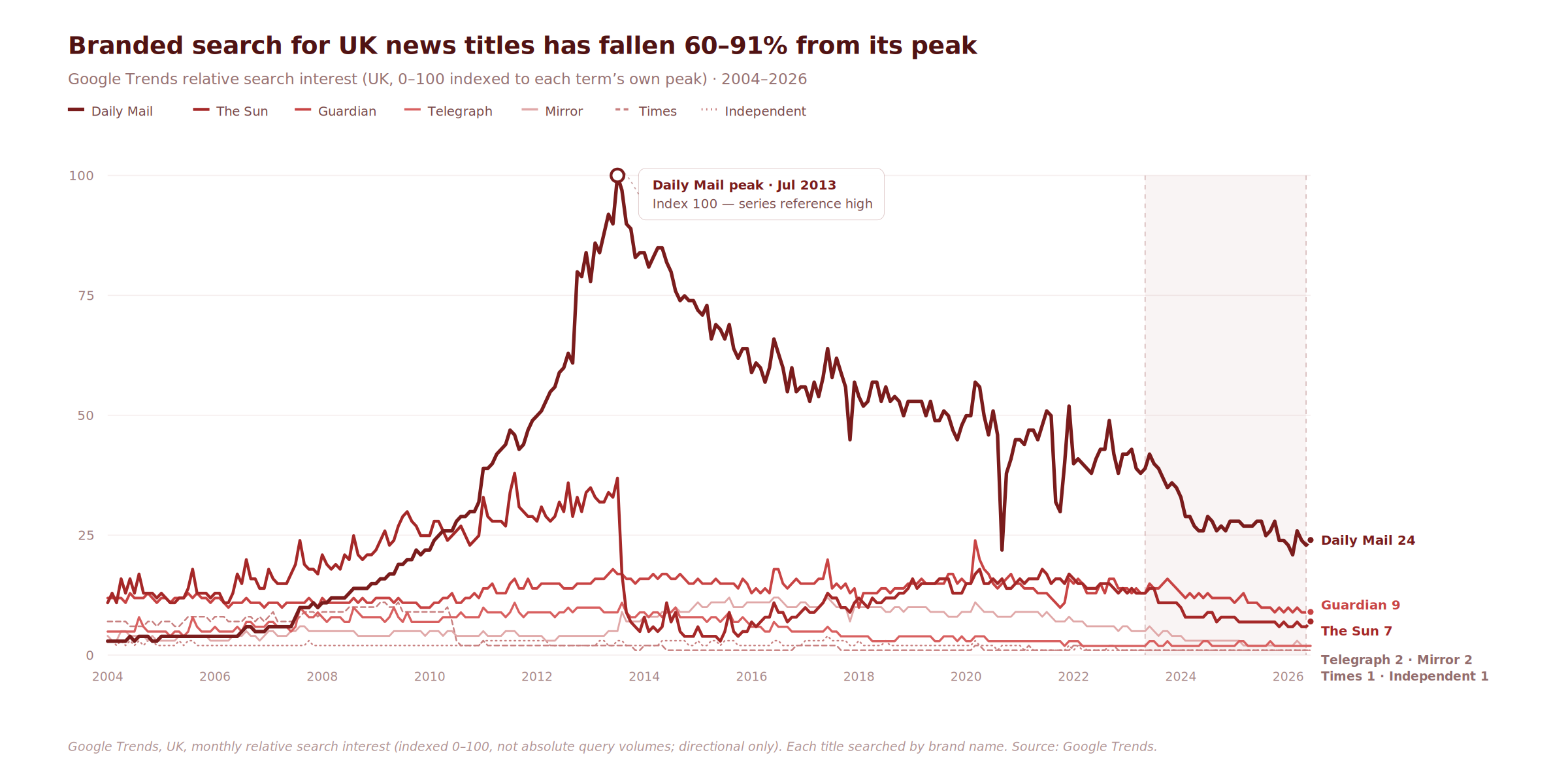
From the Daily Mail’s peak in 2013, the story has been fairly consistent and destructive. Publisher offerings have seemingly become less attractive.
Within the same three Similarweb data window, branded search fell roughly 25–56% across the titles that have measurable signal.
The Daily Mirror has seen a 56% reduction in branded searches. The Sun 54%. The Times and The Independent have seen the smallest drop, but they had already hit the floor before this window arrived.
So what?
Publishers aren’t competing against other publishers. Well, they are, just not exclusively. As the internet and the world evolves, publisher offerings have to follow suit. Branded search fell faster than direct traffic over the same window - two independent measures of the same fading habit, pointing the same way. Down.
So publishers need to become more of a destination and attract younger audiences again.
Develop named voices, and work with creators. Platforms show greater resilience because they leverage the individual. Audiences, particularly younger ones, trust the individual over the brand. Publishers can adopt each within their own brand architecture, by building individual voices, as Wired is doing, and diversifying the product and revenue-base.
Create habit-forming products. A decade of direct and branded-traffic decline can be arrested, but not by repeating what worked before. Audio and video, games, puzzles and other return-driving formats build the engagement that compounds into lifetime value. A user that loves the brand has a total CLV well over 50 times higher than that of a casual or one-time reader according to Ringier.
Invest in product architecture, not just editorial. Closing the engagement gap with platforms takes recommendation systems, personalisation engines, and newsletter and notification infrastructure - the standard younger audiences now expect.
All of this is designed to build resilience in the form of a moat. Use these products and systems to collect first party data. Social referrals have fallen sharply and Google is becoming more of a walled garden, resolving queries on its own platform. Registered, signed-in audiences are the hedge: they compound in commercial value, and without first-party data, quality personalisation is very hard.
That’s it, short and sweet. Until next time!