


The latest Datos x SparkToro State of Search Report is out and it’s something of a doozy. AI is certainly on the rise, search still hasn’t been replaced (it’s not even in the process of) and more people than ever stay in Google’s ecosystem.
Headline findings:
June was a record low for the open web (via Google search)
Just 40% of searches in the US and 40.7% in the EU/UK send a click to the open web
In the US, 17.1% of all searches go to Google owned properties. In the EU/UK, it's up to 20.4%
AI Mode usage has plateaued, maybe even dropped in the US. The EU/UK has more than twice the % of visits to AI Mode (0.29%) than the US (0.13%)
ChatGPT's share of desktop users has fallen in the EU/UK by 4PP or more
Knowledge and AI-websites gained in popularity, Google dropped out of the top 15 (in the US)
Rather than read it in its entirety, you can watch or listen to me talk about it here:
Nothing hugely surprising of course, however there are a couple of points that piqued my interest without making it into the headline findings.
Paid clicks are decreasing
Given the extraordinarily good state of Google’s revenues, I’m surprised to see such a significant reduction in paid clicks between Mar - June 2026. In the US they dropped from 2.3% to 1.3% and in the EU/UK, 2.4% to 1.4%.
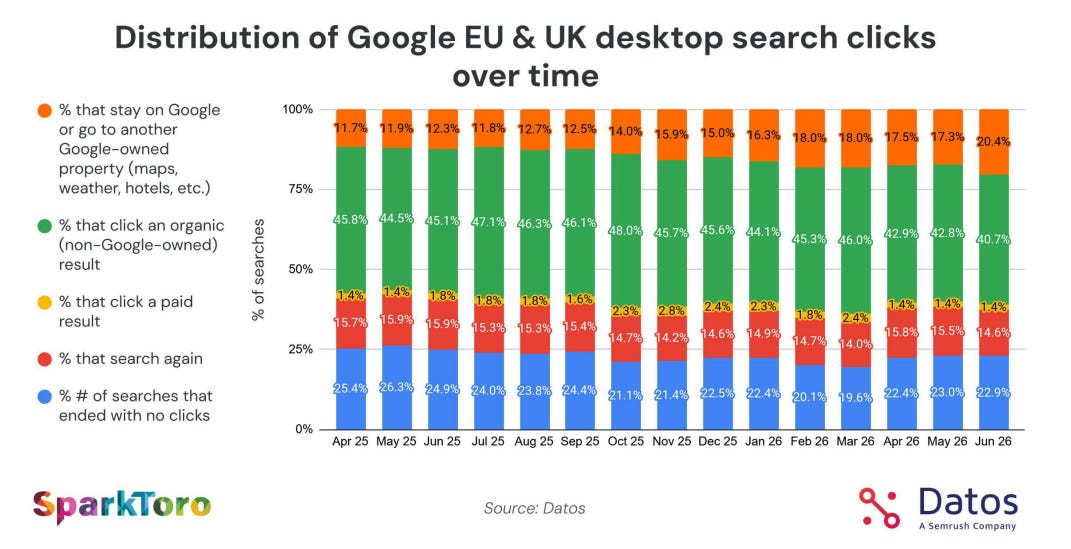
Maybe Google has decided now’s the time to try something novel given how strong their advertising revenue base is. This does also coincide with record levels of users that stay on Google, or click through to another Google-owned property:
US: 17.1%
EU/UK: 20.4% (up from 17.1% in the previous month)
Maybe they have expanded AIOs in more territories recently (French rollout took place in July 2026), or given AI Mode a more significant push. We know these surfaces do not monetise as well advertising-wise as traditional interfaces.
This data corroborates in the EU/UK, but not in the US. One to hypothesise over.
Wikipedia is on the rise
In Europe, Wikipedia went from being the seventh most visited domain from search in Q2 2025 to the third most visited in Q2 2026.
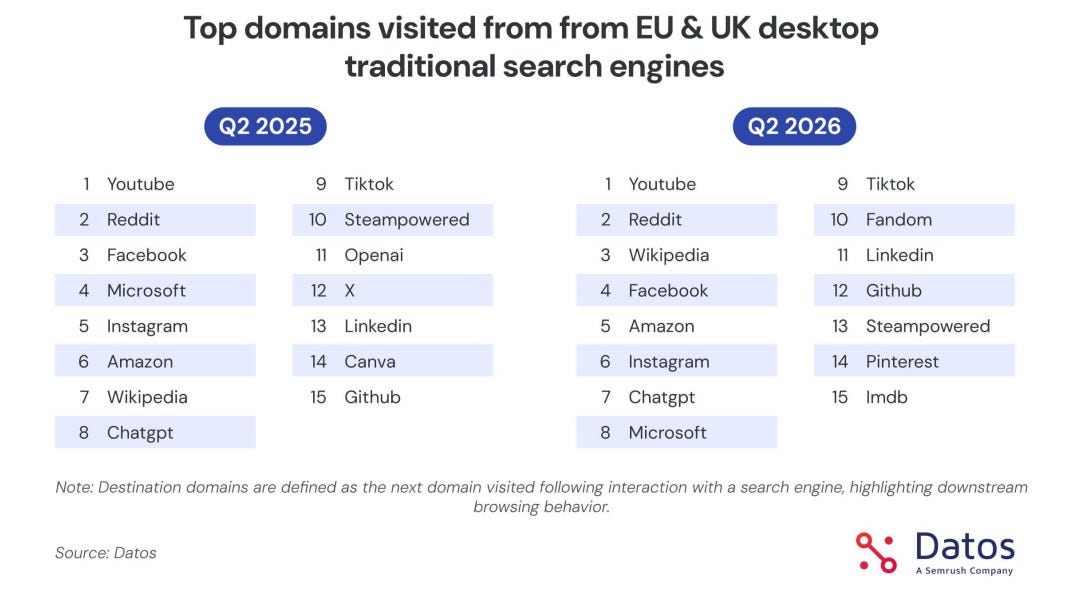
This feels like the antithesis of what we’d expect to see - who visits websites anymore?
Some people obviously, which is encouraging. My only slight hunch is that users are looking for ways to corroborate the information they are ingesting at a furious rate from less reliable sources.
Or, I suppose, Wikipedia may be ranking more effectively.
Navigational searches fell, but informational search rose
Navigational searches fell hardest on smaller engines - Yahoo, DuckDuckGo, Bing et al - all saw more significant drops in navigational searches than Google’s 22.9% - 16.4% in the US market.
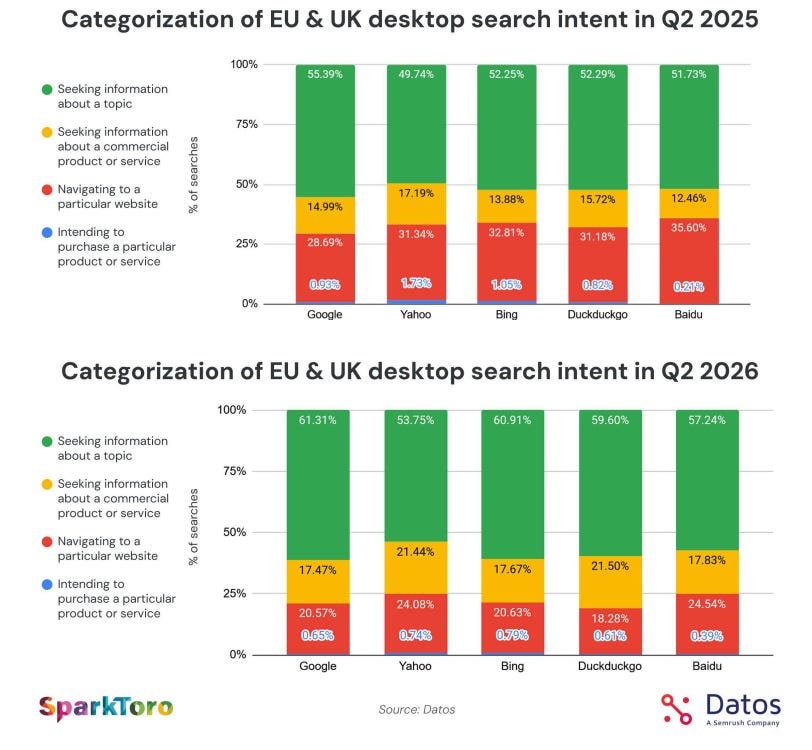
But informational searches rose significantly. In the US market, informational searches accounted for 59.69% in Q2 2025 compared to 65.12% in Q2 2026. The EU/UK saw a comparable rise over that same time period - 55.39% to 61.31%.
I’m not a statistician, but if this is based on share of search alone, then the ‘drop’ in navigational searches could be down to the far more significant rise in informational searches.
We know that AI visibility has measurable downstream impact and that AI excels in the research phase. While search is becoming less valuable here, AI usage may be increasing subsequent informational searches in Google.
There is, of course, far more in the report around desktop usage, searches per user, query length to name but a few. But to me, these are the headlines.
Other good bits
SEO vs GEO is the wrong question - Jono Alderson
What’s an LLM? - WTF is SEO
How to fix non-indexed page issues - Daniel Foley-Carter