


I wrote a Linkedin post on this very topic a while ago and people seemed at least reasonably interested. So I thought I’d expand on it a little.
It is, IMO, a very good way of framing how you can generate real value from trends.
The value of our traditional (if we’re being fair, fucking beige) utility content is on the way out. We had a good run, but the 2,000 word ‘what time is x’ posts are, thankfully, done with.
Or at least should be.
We’re entering an era of SEO where we have to be better at marketing. Where we have to think more critically about the value of our content and how it will be found.
TL;DR
If you’re the first on the scene, cover the story effectively and quickly. Start the wave.
Assess whether covering a trend with a straight news line is enough, or whether you should be ‘steering’ the demand.
Evergreen content isn’t dead by any means, but it requires more effort.
You should be looking to create demand for your content and for your brand (personal or otherwise) by using this method.
Value is not what it was
It’s fair to say the value we were able to generate a few years ago is dwindling. Particularly for more informational or comparison-type queries.
As of December 2025, AI Overviews reduce the organic click-through rate for position one content by 58%
If you’re still targeting queries easily answered and synthesised by AI platforms and content with no unique value or offering, you’re probably doomed.
But, Google Zero is a load of old arse.
It is still the biggest and most valuable platform for a huge percentage of brands. Well, in terms of direct value. People may not discover you via search, but when they come for you, you better be ready.
You better be doing something really fucking good and different. Something with a bit of pizzazz.

Is evergreen content doomed?
No. It just needs an overhaul. None of us need to see another ultimate guide unless the creator(s) go the extra mile. Then it’s a question of value and prioritisation.
Does the extra effort still generate value. Real revenue?
I’ve seen some brilliant pieces of work recently where publishers have invested time and effort into creating something stand-out. I don’t want to blow more smoke up the NYT’s arse, but there are a couple of really standout pieces of work that prioritise expertise, uniqueness and depth.
Things that add real value to a type of content lots of people will tell you is doomed.
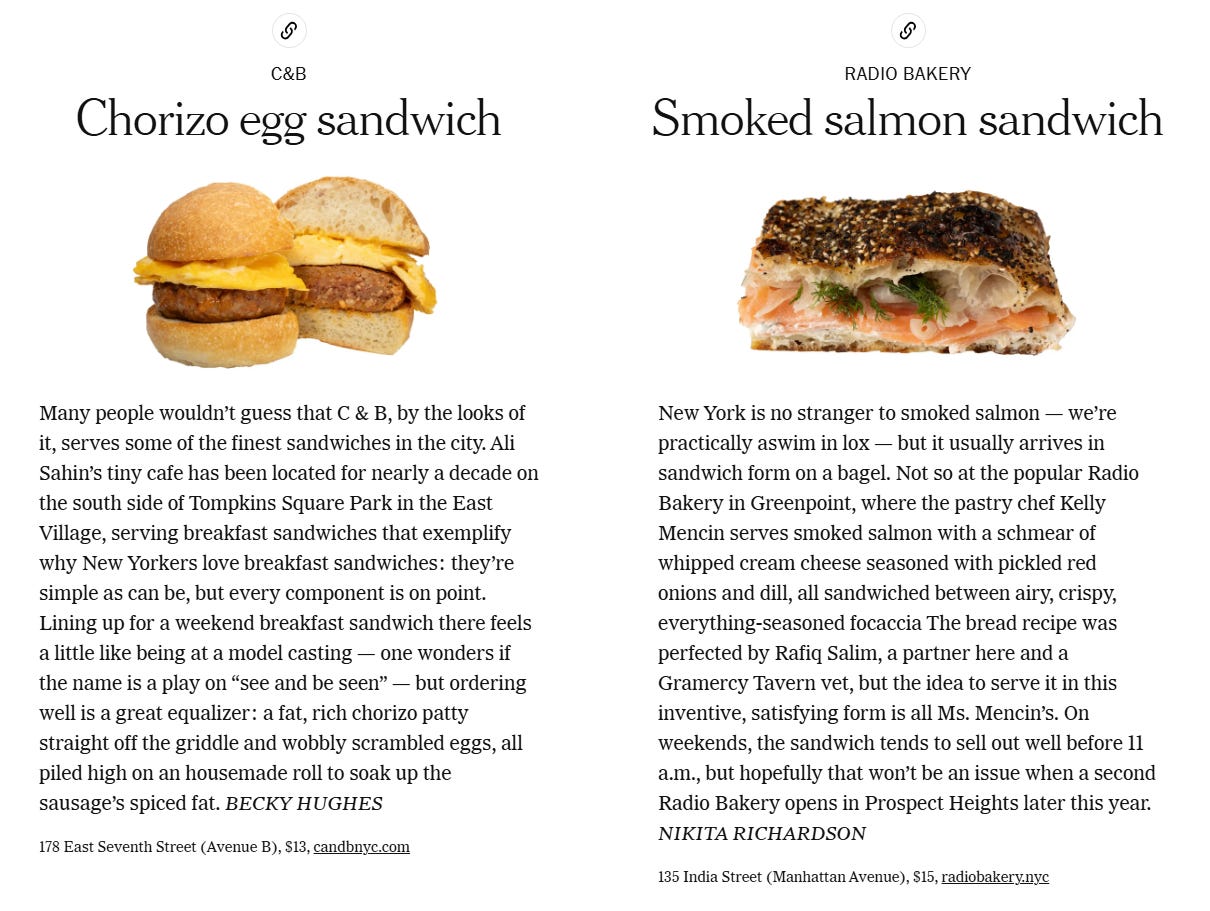
The 57 best sandwiches in NYC (The NYT)
You can’t beat a good sandwich from the world’s greatest city. Certainly for food. For something that prominent, that meaningful, you need standout content. Particularly if a huge part of your offering is the cooking section.
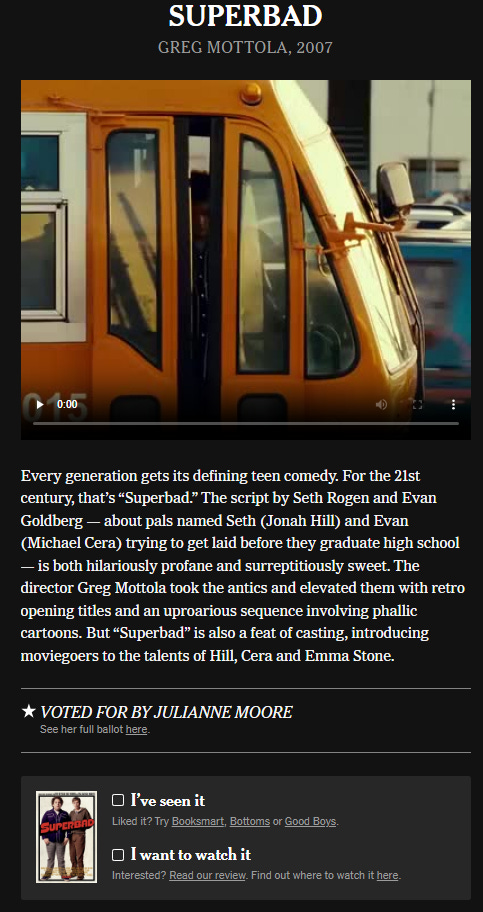
The 100 best movies of all time (The NYT)
Real, legitimate experts. Video. User engagement. Creating something that gets people coming back. Using the opinions of bona fide experts. Evergreen lifestyle content taken to a level very few people are able to operate at.
However… Straight explainers are, broadly, a difficult sell. I’m not sure they’ve been a great idea for audiences for some time, but there you are. Unless you’re creating something better than what’s out there, I’d really consider it.
These FAQ-type pieces may have done numbers a couple of years ago, but we can and should do better. They can be massively upgraded with a bit of unique imagery. Data. Video. Something that can add value on and off-site. Something that humanises your brand and the people within it.
The majority of people still need a jumping off point into complex topics. Global conflicts (of which there are a fucking lot) still need some fundamental analysis to help people understand what’s really going on.
Capturing the wave of demand
This is all about understanding the current state of play. If you aren’t first on the scene with something breaking, you need to be cannier.
As far as I see it, you have three options;
You start the wave. Your competitors haven’t cottoned onto this emerging ‘trend’ and you can be the early bird.
You steer the wave. Stories have been published on the topic. In a news sense, the basics have been covered, but the story could still be spun. You can create a new angle.
The wave has crashed. Demand has begun to stall. Drop even. This is the point to figure out whether you can still add (and generate) any value
In all of these scenarios, it’s still better to be right than first.
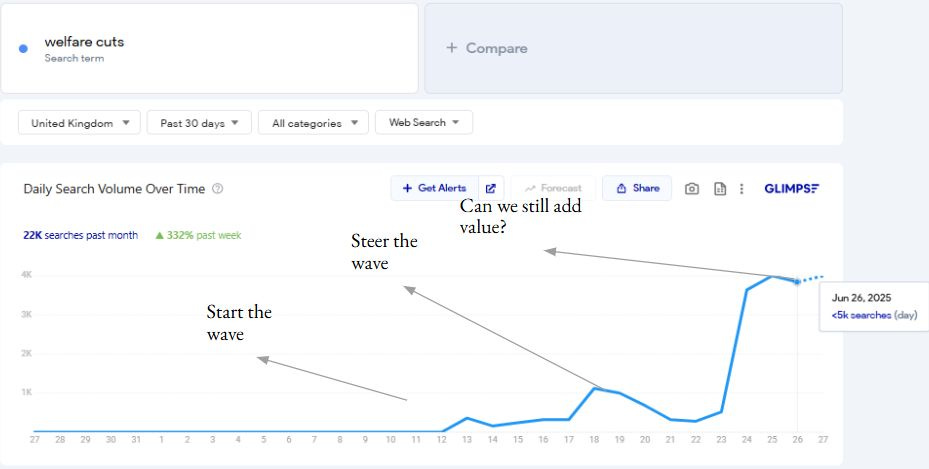
In this scenario there are a few things you need;
Access to Google Trends
Glimpse (there’s a free version too)
Some vague level of critical thinking
For those of you concerned, I think two of the three are probably fine.
You can also add in either Keywords Everywhere’s new emerging trends tool (free) or Exploding Topics (I think there’s also a free version). These are great for understanding the long-term demand for a category or keyword as opposed to the near real-time view you get from Google Trends.
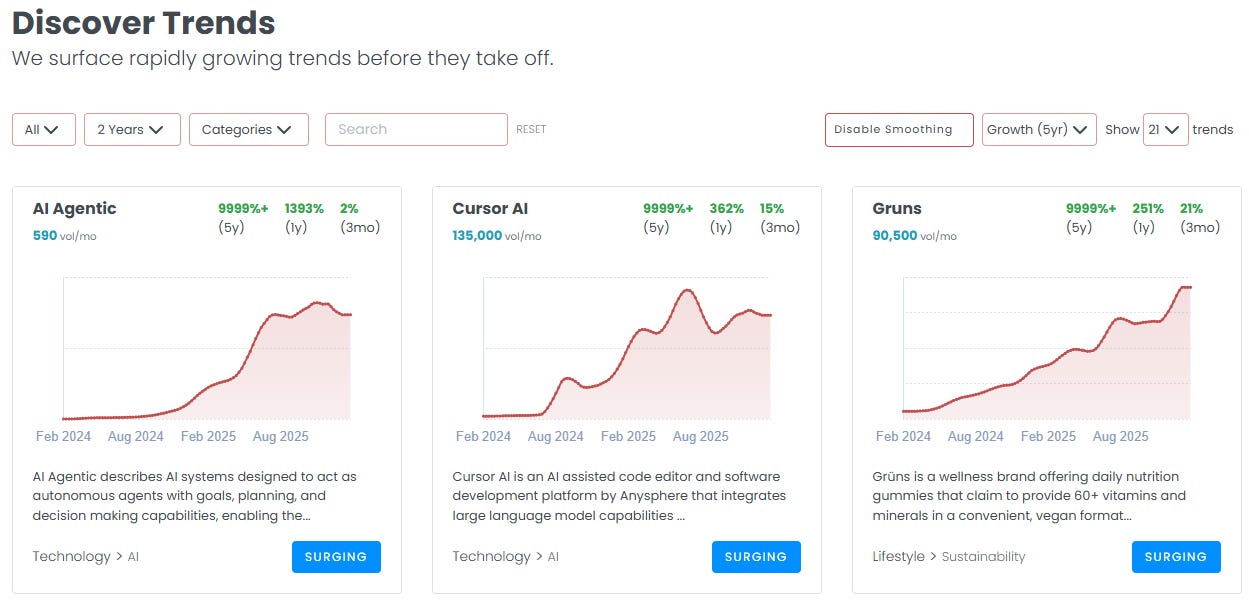
Glimpse integrates directly with Google trends and whilst it has its limitations, it’s really useful to see search volume in the platforms. Ditto Keywords Everywhere.
Not sponsored, just useful tools.
A practical example
Alright, let’s see how I would actually do this. Let’s use everyone’s favourite rage baiting, cigar stubbing shithouse as an example.
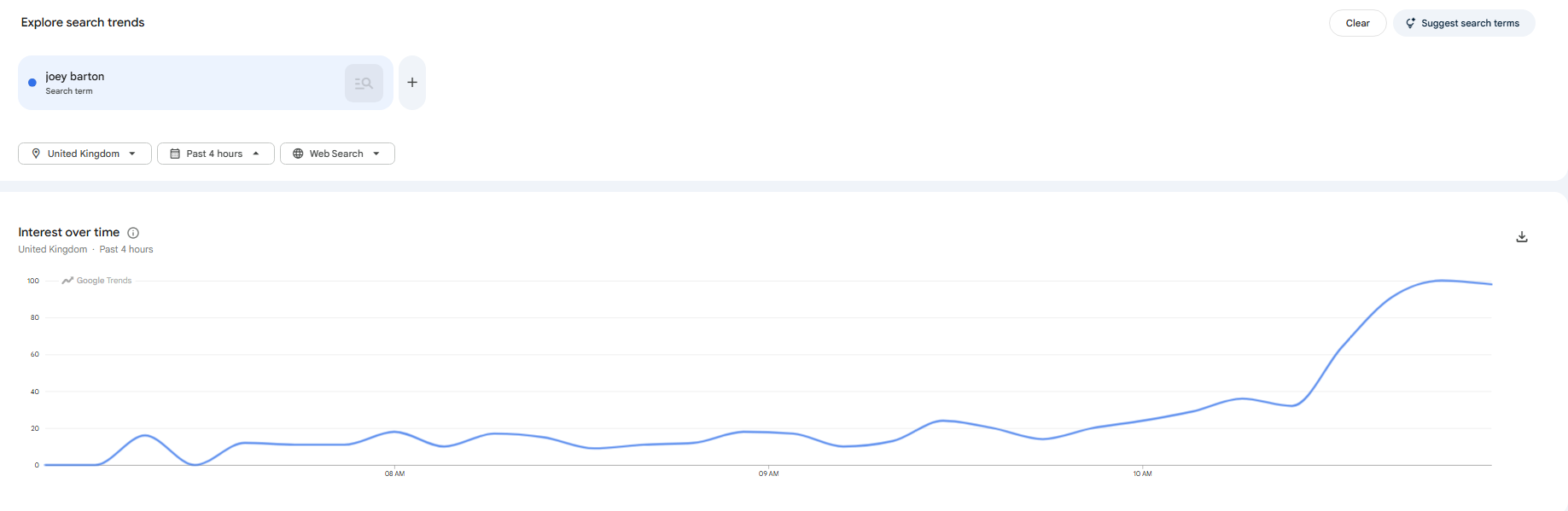
Joey Barton is currently trending because he’s been arrested. Again. Over the last four hours the trend has skyrocketed and the straight story has been covered by multiple, very large outlets.
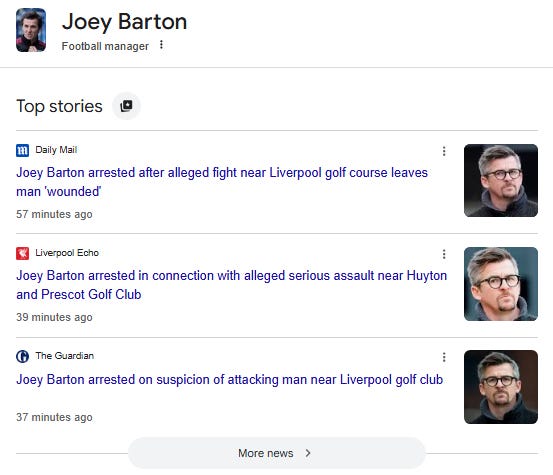
There’s a Top Stories box. The demand is high. But now the story has been covered, it’s not about starting the wave. It’s about steering it. Understanding whether there’s value in your version of the story.
Will your audience care?
In this scenario, I would think of stories like;
Joey Barton’s history of arrests in images
Analysis: Joey Barton’s criminal record makes for grim reading
Why giving thugs like Joey Barton a voice is dangerous for our society
An interview with someone who knows the real Barton (not the headline)
All of these stories take advantage of the trend. They could and should still do well in search and Discover. Crucially they are different. They position you as a leader of sorts. They are news-adjacent.
If you’re a paywalled publisher, this is critical to future success.
If your audience is interested and you should cover it, you can still create a straight news story. I’d still try to establish some level of information gain, but if you should cover it, then you should cover it.
If you think the story and interest has peaked, will this story positively matter to your bottom line?
Why this matters now
Google is a navigational engine. That means people need to search for you, your brand and/or your services. With informational content harder to generate a click from, we work smarter than years gone by.
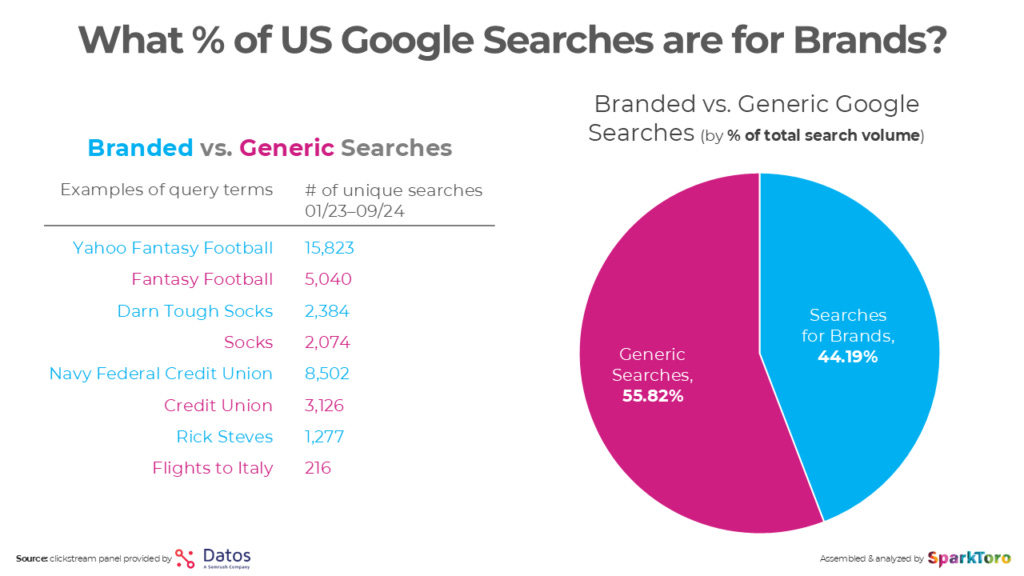
So you’ve got to get out there and create the demand.
Figure out what your moat is
Put your stuff out there
Fail in public (it’s not that bad)
Try new things, experiment
Build relationships with people in the industry (people will share your content, as long as it’s not shit)
Stand out
This is, broadly, how tech companies work. Hook you in and shut up shop when you need them.

An excellent Ahrefs example
The Ahrefs team shared a very good example of this. They created demand.
Our ability to do well as marketers and SEOs will rely on this skillset more and more over the next few years.
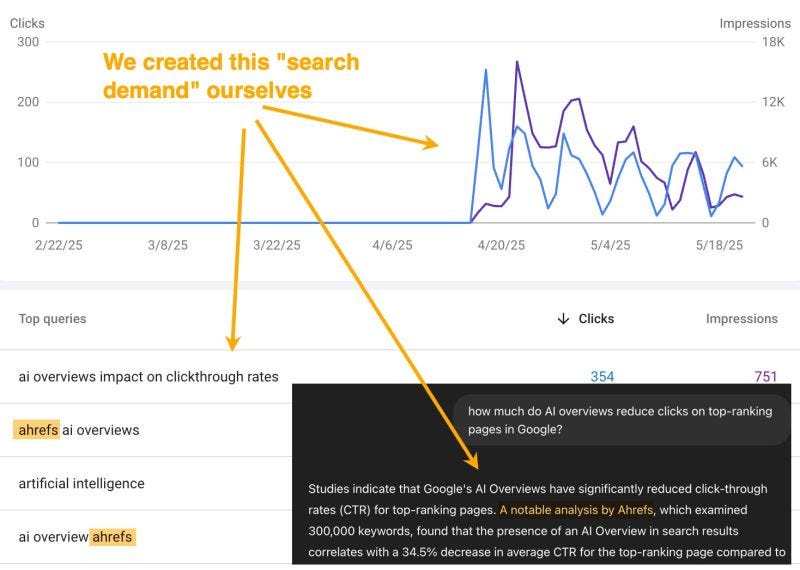
They saw AI Overviews were trending. Big fucking news.
So Ahrefs created news-adjacent content around them. They used their incredible moat (big data) to create demand for the topic.
But they didn’t stop there. They pushed it out there. They have built personal brands that have a halo effect on the entire company. Tim Soulo, Ryan Law, Louise Linehan et al. I don’t pay attention to the main Ahrefs account(s), but I do follow and interact with these guys.
Then people started searching directly for their research. They have become a legitimate authority on the topic. In traditional search and AI platforms.
They steered a wave. They made it navigational. They became legitimate experts. Happy, halcyon days.