


Right now, most publishers block AI bots. According to Vince Nero’s excellent research, 79% of top news sites block AI training bots via robots.txt. Only 18% block no AI crawlers at all.
Not a perfect science as the robots.txt is so easily circumvented, but still.
No one is playing nice anymore.
Multiple publisher x AI company lawsuits and threats to block Google from very serious publishers. USA Today, Reuters and Politico. Even Reddit is considering walking away from the Google AI deal. A marketplace or micro-conversion model where publishers are paid when their content is used cannot come soon enough.
All of this after Google just posted its most valuable quarter ever. The almost non-existent value exchange doesn’t look like changing anytime soon.
TL;DR
Visibility has measurable downstream impact. Users visit a brands’ website at 2.5 times the normal rate post AI visibility
A brand’s inclusion in the training data is central to inclusion in the future selection process. Publishers have real value here.
But with probabilistic tracking and with many bad actors in play, marketing yourself as a brand of influence requires true expertise.
As with any type of commercial proposition of this nature there are risks to be aware of.
Visibility has measurable influence
Thanks to Similarweb’s fantastic study on The Impact of Downstream Visibility, we know that:
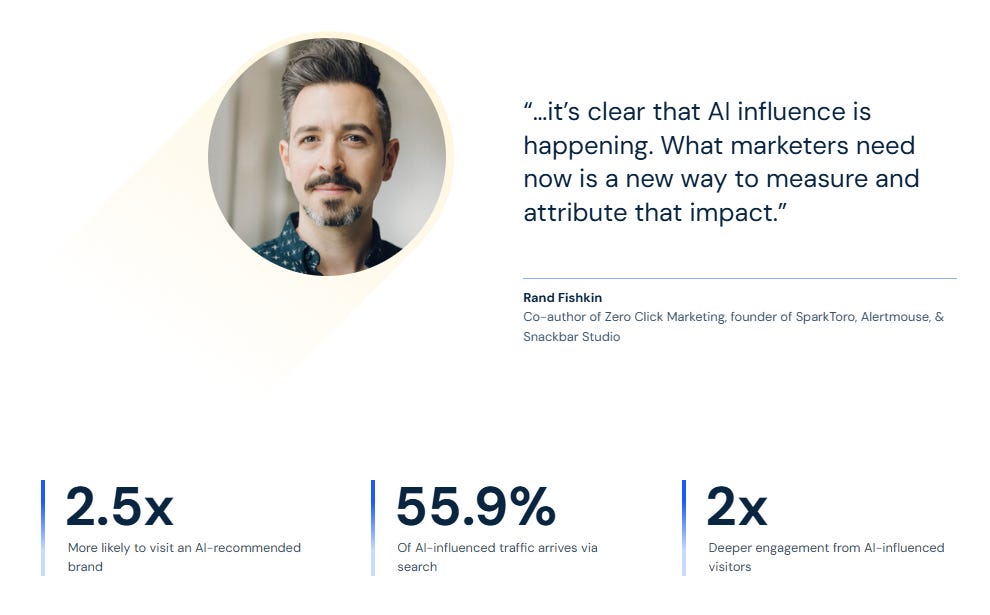
Users that see a brand in an LLM are 2.5x more likely to visit that brand’s website in the following seven days
These users are twice as engaged as traditional users
AI dominates the early stage of the journey, but search and AI come close to parity as the user nears the point of conversion
That 55.9% of AI-influenced traffic arrives via search
LLMs have restructured the web in a manner more convenient for users. Because we are so explicably lazy, we almost always take the easy route. This reorganisation of the web reduces the cognitive load of finding the answer yourself.
The majority won’t click unless forced into it.
But whilst AI sends very little traffic, the traffic it does send is twice as engaged. Users find out about a brand, person or product via social, audio, video and now, AI. Once the user knows about an entity, they search for it. This is how search has functioned - as a navigational channel - for some time. We Google things we have found out from other channels.
This is why search has always done so well when it comes to last click attribution.
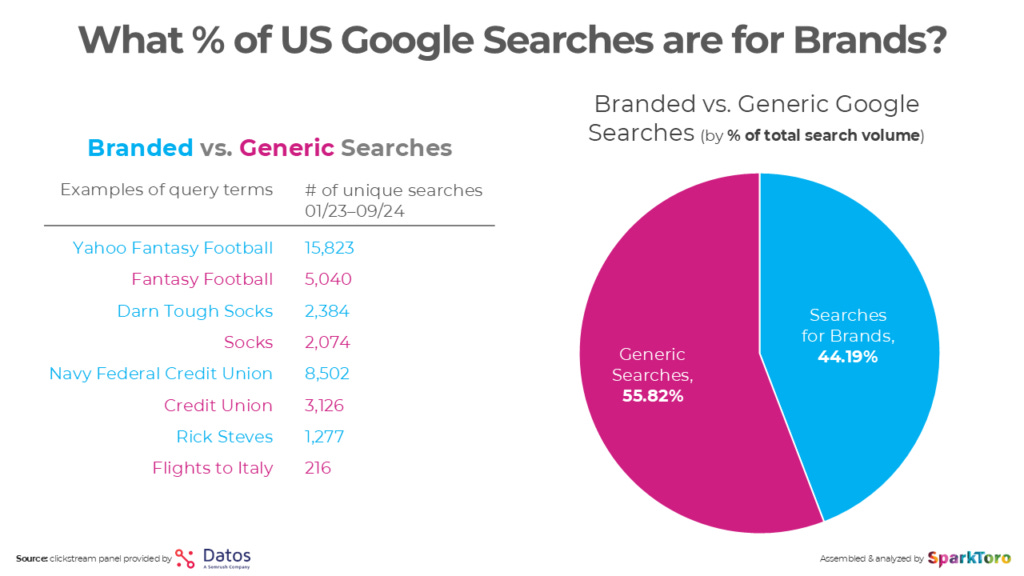
Being visible really matters to brands who sell products. It is not a soft brand metric. It is a performance channel too.
AI will never send traffic directly to websites. But it is a crucial discovery channel for brands. People discover the brand via AI visibility and search for said brand further down the funnel. Via search.
There’s almost certainly a strong correlation between increasing gen-AI traffic, branded search, direct traffic and positive AI-visibility.

How do you become visible?
Certainly not with listicles or cheap GEO hacks. At least not sustainably.
You need to understand the foundations of LLM information retrieval:
Fundamentally, these bots are trained on vast swathes of data. A brand’s inclusion in the right place at the right time helps an LLM build a picture of this brand and its ‘closeness’ to relevant entities and products in its database.
Your inclusion in the training data is the bedrock of your success.
LLMs have a training data cutoff. You are essentially optimising for the next evolution of the bot when it comes to training data inclusion. But without this, your selection as part of the grounding process will be suppressed, because you do not feature prominently enough in the training data to be considered.
Brand strength + marketing + consistency. You own what you can control and you boost your name recognition in the right place, ensuring you are well-positioned in search for real-time retrieval.
Publishers are still an extremely valuable proposition in this space.
The generative-AI landscape
Similarweb’s second excellent report shows just how enormous this sector has become. 2.7 billion gen AI app downloads worldwide in 12 months (a 134% increase) and almost 10 billion monthly website visits (a 70% increase).
It examines how the leading AI platforms are growing, how user behaviour is changing, where referral traffic is flowing and how brands are earning visibility. I think it’s the best resource on the internet.
Headline findings
🔎 Search grew by 2% last year
🗽 >40% Of US searches now trigger an AI Overview
🌐 2.5x Increased Chance of Site Visit after AI Mention
👶 6% Decline in Gen Z's (18-24) share of AI chatbot usage since 2024
🧒 50% of gen AI users are between 18-34
📈 ~180% Claude's Unique Visitors growth H2 vs H1
📊 Users arriving from LLMs are twice as engaged as traditional users
We know that younger audiences have been moving away from more traditional mechanics of information consumption. Video and audio are booming, younger audiences trust the individual over the brand and, clearly, gen AI’s ultra convenient approach is a huge hit.
It doesn’t look like AI is replacing search. Both are growing. Gen AI is so proficient in the research phase that changes to the information retrieval ecosystem are significant. For brands that sell tangible products, both search and LLM ‘visibility’ are immensely valuable.
Ensuring you’re present in the research phase of the journey for the subsequent search is key to profitability.
According to Similarweb data, generative AI users have almost exactly the same audience profile as YouTube. Even younger, in fact. YouTube has a 49.1% share of 18-34 year olds as its audience.
What does this mean for publishers?
I think there is a burgeoning influence marketplace here. Despite publishers best efforts to block anything resembling a bot, they are still some of the most influential platforms on the internet.
Publishers have to understand and crucially prove where they carry real influence. If you can prove you are the most influential brand in the UK market (or in London) for technology > TVs, you become a more valuable proposition overnight. Even with probabilistic data.
This is incredibly high-value marketing collateral for commercial teams.
Particularly when we consider the apparent overstatement of Reddit’s influence in LLMs. According to Dan Petrovic’s always impeccable research, Reddit is the most rejected website in their entire dataset. Reddit is filtered out more than any other site.
It is always a candidate for selection in the fan out process, but more rarely used than any other site in the dataset.
I talk about what I think this means here and how we could consider creating a new revenue line (for those who prefer watching or listening):
How can we do this?
The data can only be probabilistic for now. Prompt tracking has obvious faults, but run at a large enough scale it can give a reasonable measurement. Without deterministic data this is imperfect - but even with deterministic data, prompts are so unique this raises its own challenges.
In Rand’s study, across 142 responses, there were barely two prompts that could be considered similar. This is the natural shift that comes with significantly longer queries. Greater diversity.
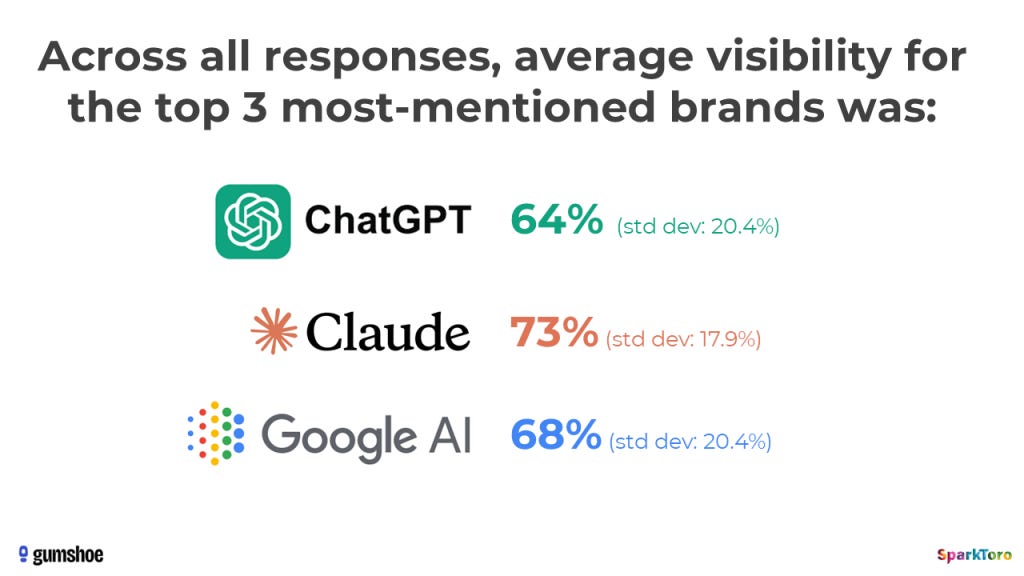
But it’s not useless. Average visibility for the top three brands was, comparatively, quite high. So with scale and sensible, consistent, scaled prompting, you can get to a reasonable, sellable outcome.
My advice is:
Utilise your server logs to establish LLM ‘demand’
Review your website by commercial topic
Set up relevant prompt tracking for each relevant topic to assess your market position
Create marketing and sales collateral based on your influence
This shouldn’t be done lightly. If you would like help here, please do get in touch - LinkedIn, on Substack or via our consulting practice.
Bot-blocking creates an obvious break in the chain here. If you have very strict bot-blocking policies, this might be something to consider for the future, or to consider unblocking specific sections of your site.
Be careful; you have been warned
I know some publishers are already attempting to cash in on this market. The temptation to make a fast buck has never been higher and I urge caution.
There is no shortage of sites chasing AI visibility that have been absolutely nuked in search thanks to advice from the GEO specialists who espoused the value of listicles. This falls under the same bracket.
Listicles, I should add, that greatly benefit your competitors. Mentions are the currency of the web. Almost certainly more so than links at this point. Continuously mentioning your competition means you’re doing their marketing for you.
The very content format Google has semi-removed from the web with their stringent product review guidelines, parasite SEO shenanigans and the Helpful Content Update.
Paid for listicles dominated the internet for 10 years. I’m sure their lack of rigour and obvious bias spurred Google into action. Lily Ray has excellent research on this and according to her, almost every website engaging with programmatic SEO and AI slop is being nerfed out of search.
“I've now identified over *70 companies* impacted by Google's January 20th update, where this exact situation played out: many using highly similar SEO/GEO-driven content approaches. When Google can spot a footprint like that at scale, it becomes very easy for them to demote dozens of companies using the same tools and techniques to drive self-promoting SEO and GEO visibility.”
The very mechanism that drives (or at least did drive) so much visibility in LLMs.
Be wary who you listen to. We’re all working this out as we go.
That’s it
That’s it for this week. Some other good stuff:
Reach is moving away from volume - Press Gazette
Topic led journalism - Dmitry Shiskin
Implementations from Croatia SEO - Another Concept