


Hello! Happy Monday. I’ve put jumpers on for the first time in nearly six months, so time is still moving linearly. Anyway, back to more important manners.
SEO has been the most profitable channel by some margin for the last 15 years.
We can debate about the rights and (broadly) wrongs of last-click attribution until the cows come home, but SEO has been the money channel. The channel the execs have leapt at.
But now, the days of traffic for old rope are gone. Audience journeys have become more complicated than ever and some of the shine has been taken off search.
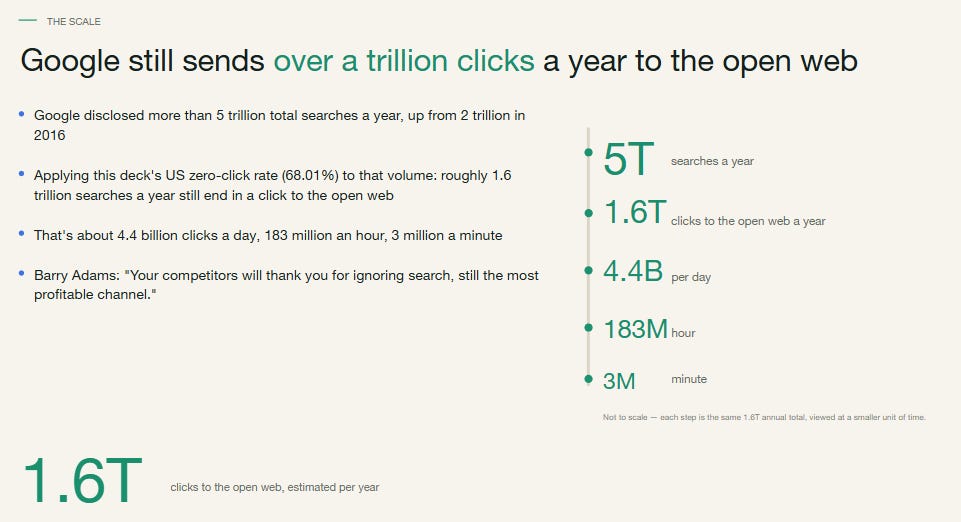
Whilst it was always over-buffed, you’d be a fool to forget Google. According to all of the clickstream data I’ve seen, the majority of user journeys - regardless of whether it’s AI-led - use Google at some stage. Particularly when they’re close to the point of purchase.
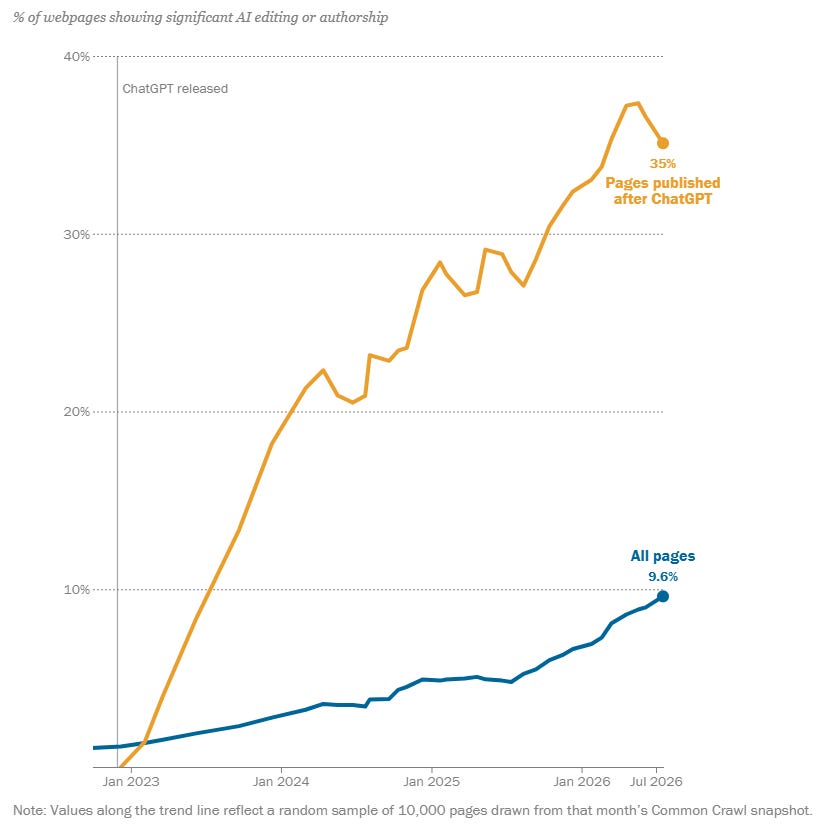
But you cannot build a brand through Search anymore. If you’re an SME, it’s very tough to break into. These aren’t bad things. It’s so lucrative it should be hard. We need better spam policies from Google and we need them to figure out how to combat the slew of slop AI has turned the internet into.
We need brands that have real presence, heft, quality control and an audience before they start to crack the Search code. Google knows they have a quality problem. They’ve been very slow to act, but I hope that’s about to change.
If you need help with SEO and discoverability consulting, Google Discover, technical SEO or competitor and market intelligence, my consultancy - Tomorrow Consulting - is up and running. And premium members still get access to some damn useful spreadsheets and skills.
TL;DR
Last-click attribution made search look like the hero, and plenty of businesses were built on traffic that was only ever borrowed
Google has been purging SEO-first sites since the Helpful Content Update. If search was your only presence, you were (and still are) exposed
Google’s algorithm is a proxy for trust. And people trust people. Creators, social profiles, Reddit and video now sit inside Search and Discover by design
Google is building a loyalty ecosystem. Preferred Sources, follows, profiles and subscription linking all reward one thing: having an audience
As always, read, listen, watch - the choice is yours!
It started with the Helpful Content Update
The Helpful Content update was, let’s say, interesting. Interesting in the brands that got nuked by it at least. In the way it was handled. In the subsequent handling of the Site Reputation Abuse update.
And you’re talking to someone who had a small content and price comparison site destroyed by the HCU. And I think they were right to do so. Well, broadly.
Why you ask?
Because Google cannot have SEOs ruling the web. Not if they want to create a loyalty ecosystem. The HCU was a clear attempt to purge SEO-first sites. Sites with no wider presence - built by people who were extremely competent at SEO - were exposed.
With some fairly wide-reaching collateral damage.
Content created for search engines was decimated. We’re now seeing something closer to Google’s dream. Where you only rank if you have a profile outside of the search ecosystem and over-optimised content isn’t necessarily a good thing. Worth noting that their dream is very ad and AIO heavy. Make of that what you will.
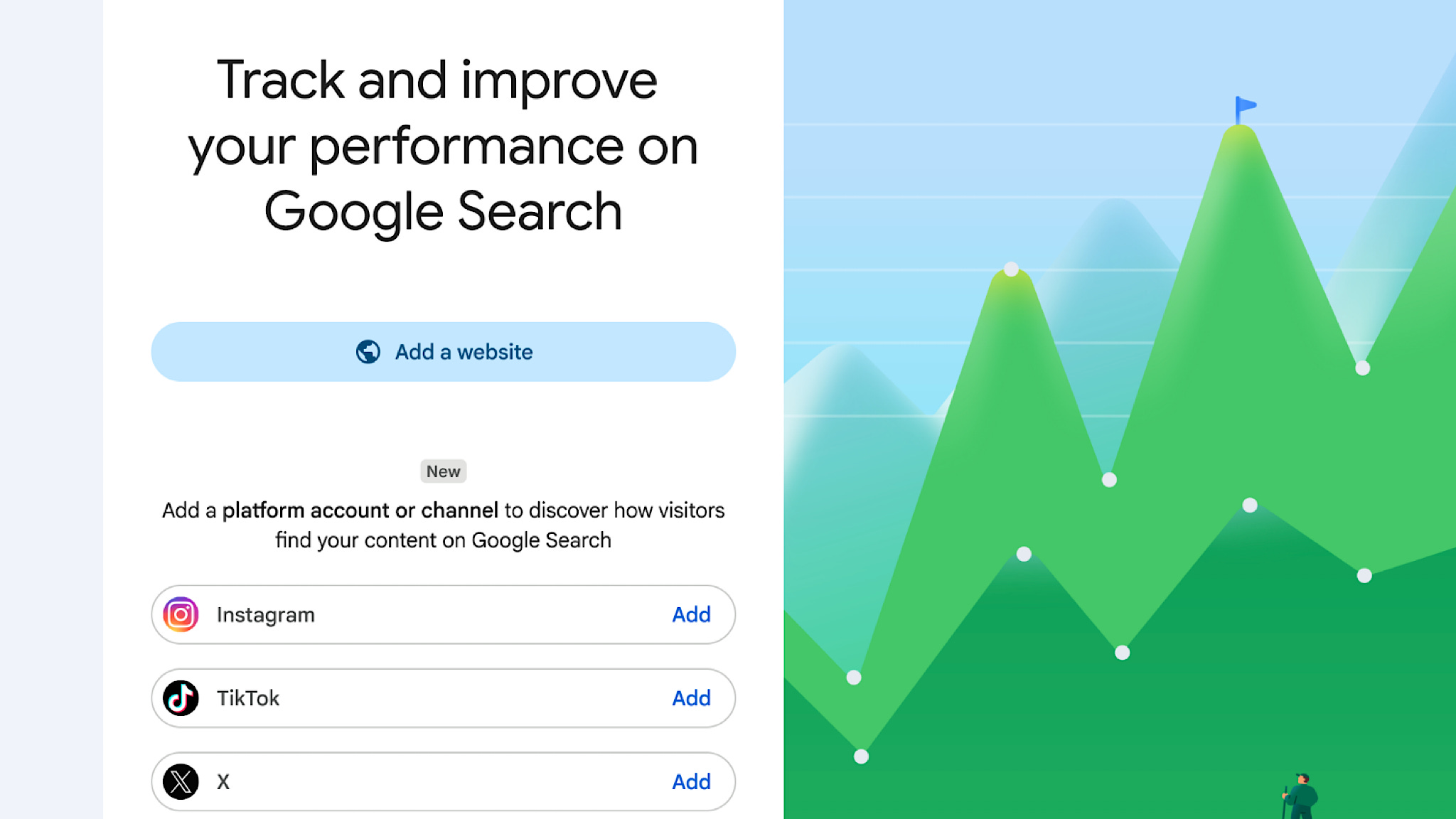
The fact Search Console now shows you how your social content performs in Search is about as clear a sign as we ever get.
Google’s entire algorithm is a proxy for trust. And what do people trust? People. Which historically has been problematic…
Remember HouseFresh?
HouseFresh was, or rather is, an independent air-quality review site. According to their own guidelines:
“Every product you read about on HouseFresh has been tested in our home… 130+ products reviewed… 0 sponsored product reviews”
First-hand, expert, original: the content Google’s guidelines ask for.
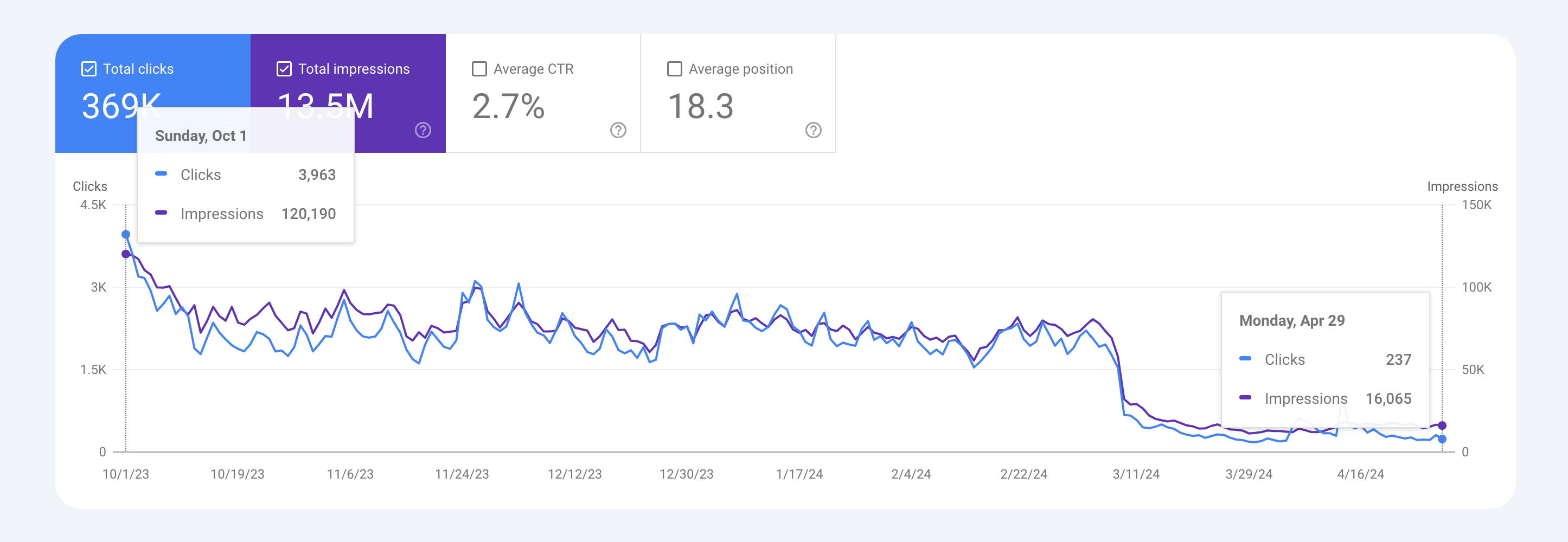
By their own admission, the HCU took away >90% of their traffic from Search. From over 4,000 daily visitors in September in 2023 to just 200 in early 2024. HouseFresh stated that Google’s March 2024 update finished the job, with spammed Reddit threads and old Quora posts outranking its reviews.
Now, obviously I can’t tell you if HouseFresh were doing all of the right things. Nor do I have the inclination to look. But there was a dirty little pattern that emerged and niche sites bore the brunt of it.
Over this period, Retro Dodo lost 85% of its organic traffic, while Reddit surged by 190% almost directly after signing a deal with Google - albeit one for data-licensing. You could absolutely argue that Reddit became Google’s bastion of first-hand experience - but big sites and publishers were far more resilient.
Other big publishers saw record levels of affiliate revenue.
Even if those publishers showed very little first-hand experience or EEAT that Google so keenly espoused. Really that’s where the crux of the argument lies - Google clearly favoured big brands.
Like people do.
The internet needed a change. Whilst this was handled with a level of empathy now synonymous with Silicon Valley (or ICE for that matter), something needed to happen.
Worth noting that HouseFresh has made a strong recovery in Search over the last year or two.
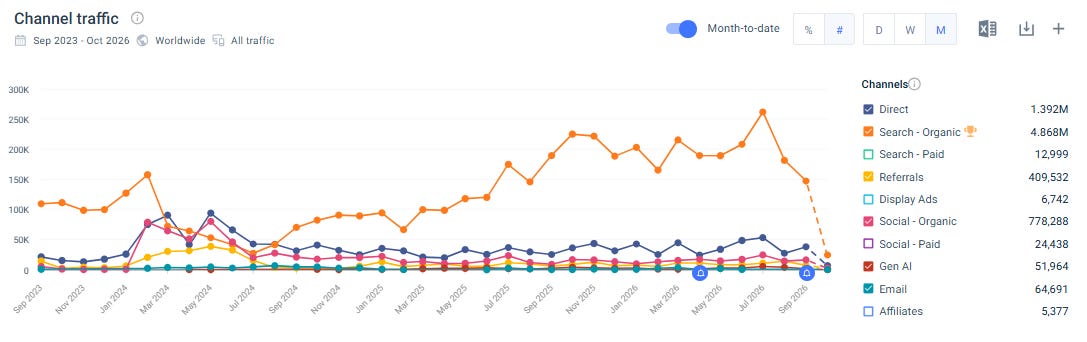
But they’re extremely reliant on Search and that’s not where you want to be. I am sure this level of search reliance would’ve been part of the original HCU.
There’s an excellent nugget of information here. Since their recovery, HouseFresh have built a near 30k YouTube channel. Much needed diversification that has, ironically, coincided with an uptick in Search.
The Site Reputation Abuse Mess
While sitewide demotions were algorithmically applied to niche sites, the Site Reputation Abuse Update was handled in a much more considered manner.
If the HCU was dealt with with an iron fist, the Site Reputation Abuse Update was a velvet glove. Instead of sitewide demotions, Google used manual actions to remove larger sections of publisher sites from its search results - particularly voucher codes and betting.
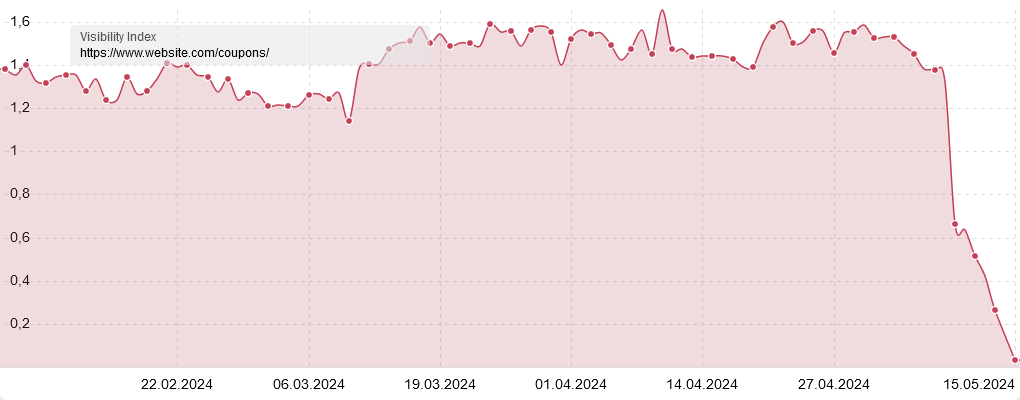
I would argue the quality of their results diminished significantly when they did this.
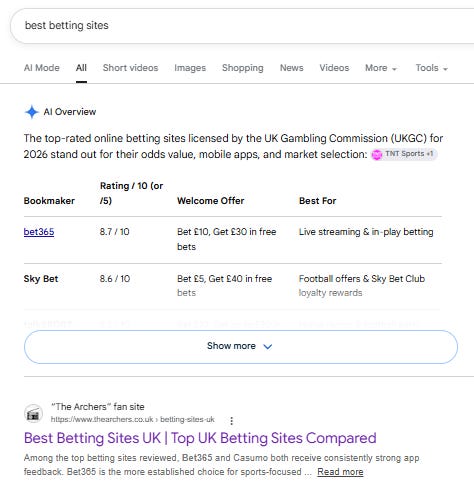
You could say Google had learned from their mistakes and handled this far more gracefully. With an element of precision. You could also say that Google was protecting its financial interests by taking bigger brands who contribute far more significantly to its advertising ecosystem.
So what does this mean for me?
An excellent question my self-interested friend.
I think this is foundational to how you position yourself as an SEO and how you become more valuable in the market. But giving legitimate business advice.
Right now I think these things apply across all disciplines:
Having a personal brand and an audience is always a good thing
People who understand people and invest in knowing how to create brilliant content are in demand. In all formats
Distribution is everything. SEO is marketing.
You need to know how to drive actual value
Don’t rely on Google to find your audience for you. Piece together the loyalty signals they’re putting in place to better understand what the next few years will value.
Here’s what I would keep in mind:
You need trust to succeed in Search
To be a player in search, a strong brand has always helped. Now more so than ever I think. Personal or otherwise. You need robust direct and branded traffic, strong engagement metrics and third party factors that corroborate you are who or what you say you are.
Faking it is becoming more and difficult. With longevity at least. It is much easier to be successful if people in the owned phase of discovery share your content for you. You have to appear in the right places and build a platform.
The final form of EEAT is social proof, corroborated on and off-site.
Entities Are The Foundation of Modern SEO

I wrote an article about auditing publisher websites last week and it took a little piece of my soul. Like a horcrux, but without me being a spectacularly evil wizard hellbent on world domination. Allegedly.
Google is still the world’s largest active discovery engine
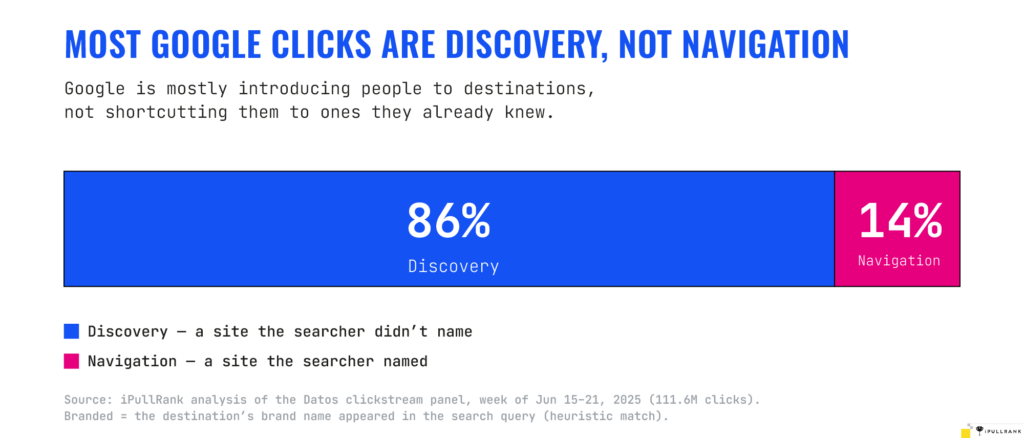
86% of Google clicks go to a site the searcher didn’t name. That means only 14% are navigational - of the 5 trillion + searches Google processes each year, that’s a sizeable opportunity to reach people.
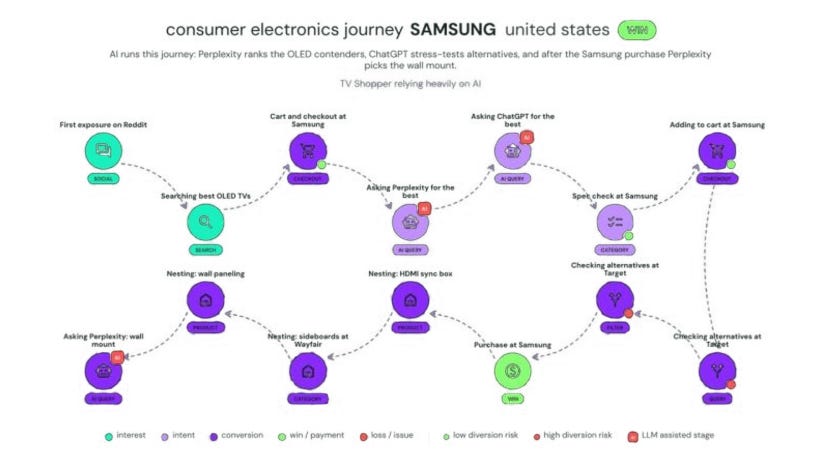
Attribution is broken
In last click attribution, SEO always looks like the hero. But that completely excludes the credit other channels in the top and middle of the funnel warranted.
As the journey is now so complicated, you have to measure incremental uplift. That means, if you run a specific campaign, you need to see how conversion and audience activity changes over the coming weeks and months to assess the impact.
I think that’s a) easier and b) makes for a far more creative ecosystem.
Your audience is unique (ish)
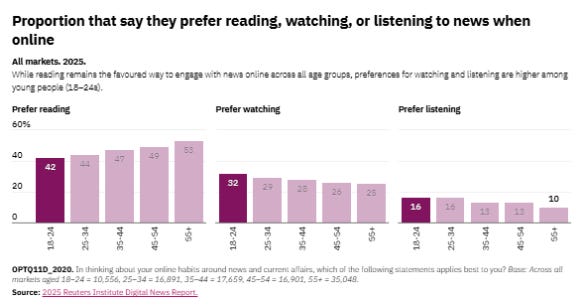
48% of 18–24s prefer to watch (32%) or listen (16%) to news online. 42% prefer to read. The opposite is true of the over 55s. If you have a more defined audience, this is easier to manage. If you’re trying to satisfy a broad sweep of the population, you’re going to have to invest in multimodal content to really cut through.
That applies to search too. Video and creator-led content are booming in popularity, particularly in Google Discover. Whilst Discover may appear to be less-publisher friendly, if publishers invested more seriously in video and building individuals, this wouldn’t be a problem.
Younger audiences don’t seek out news sites or publisher apps. Social is their first touchpoint. The creator wields the power.
According to iPullRank’s latest report, 52.3% of searches by 18–24s end without a click, against 42.7% for 55–64s. 55-64 year olds are 7x more likely to click an advert than the 18-24 cohort.
People don’t care about brands
Particularly younger audiences.
No one spends time on Google. It is an entirely functional transaction. I need a thing, I am going to find the thing. That is not the case with social channels. Or people. people trust people. They don’t trust brands.
The younger you are, the more these statements resonate.
But there’s an opportunity here. Brands and creators have audiences. They both have different types of trust. Part of your job may be figuring out how to tie these two things together. Leveraging the best part of a creator can be incredibly valuable for a brand and vice versa.
Google knew all of this was coming
Google has more data about how people interact with the internet than any of us can possibly imagine. They also buy more data than anyone.
They’re not surprised by this change.
The rise of video. Social accounts on Discover and in traditional search. The prominence of Reddit. These are by design. Google has been trying to give rise to real people and opinions so the platform continues to satiate a new, hungry audience.
Google knows trust has moved from mastheads to people.
“Discover will make it easier to “find, follow and engage with creators”.
X, Instagram and YouTube Shorts are already in, with “more platforms to come”.”
If you need more proof, just look at how prominent YouTube and X are in the Discover feed. Google’s attempt to create their own social network of sorts is in full swing.

That’s why they’re focusing on loyalty
They don’t want to reward sites where the experience is purely transactional. We’ll show you x for a sneak peak at y. That’s why they’ve launched:
Preferred sources
Follow a brand or creator
Reward subscribers
Discover profiles
Some publisher traffic was always borrowed. If you built an advertising-led ecosystem based on traffic volume, time is running out. Kick off times, channels, bank holidays - straight facts without stories (outside of breaking news) are not a viable solution anymore.
And that’s a good thing for Search. The ecosystem I mean - we need the quality of results to improve. And the advertising and blatant theft of content to reduce, but that’s another matter entirely.
So what should you do about it?
As an SEO. As a marketer. As a creator. Whichever. You should:
Focus on loyalty, not traffic: make your primary KPIs loyalty and engagement-led. Devalue traffic. Reverse engineer the behaviour associated with a subscription and target that.
Measure incremental uplift: attribution is broken. But you can still measure significant uplift or decline off the back of specific campaigns.
Be present on surfaces relevant to your audience: figure out where your audience is influenced and build a profile there. No fucking snake oil either. Brilliance costs time, but has longevity. By adding actual value to the industry.
Build habits - become a part of your audience’s life: understand their day-to-day and figure out how you can add value to it.
Market your product - tell people about the changes you’re making and why: this isn’t specific to publishers, but most product marketing is awful. If you make positive changes to the product, fucking tell people about them.
Build distribution - distribution is a moat. It removes you from the perils of big tech. It increases the chance every post will perform. Engagement data raises the bar.
To do all of these things, you need to be better at marketing. Understanding people, not AI. LLMs will continue to change because they are, for want of a better word, fucking basic.
If you focus your time becoming better at writing, data analysis, visualisation, video production - literally anything - you will be a more valuable SEO and you will understand the business side of things far more effectively.
Think of publishing as the start of the lifecycle
We’ve got very used to Google doing the heavy lifting for us. That era is declining and whilst it might still be profitable enough for now, you have to a) build better distribution and b) force your way into Google’s result.
There’s no better way of doing that than by outperforming your expected engagement. And you won’t do that without purposeful distribution.
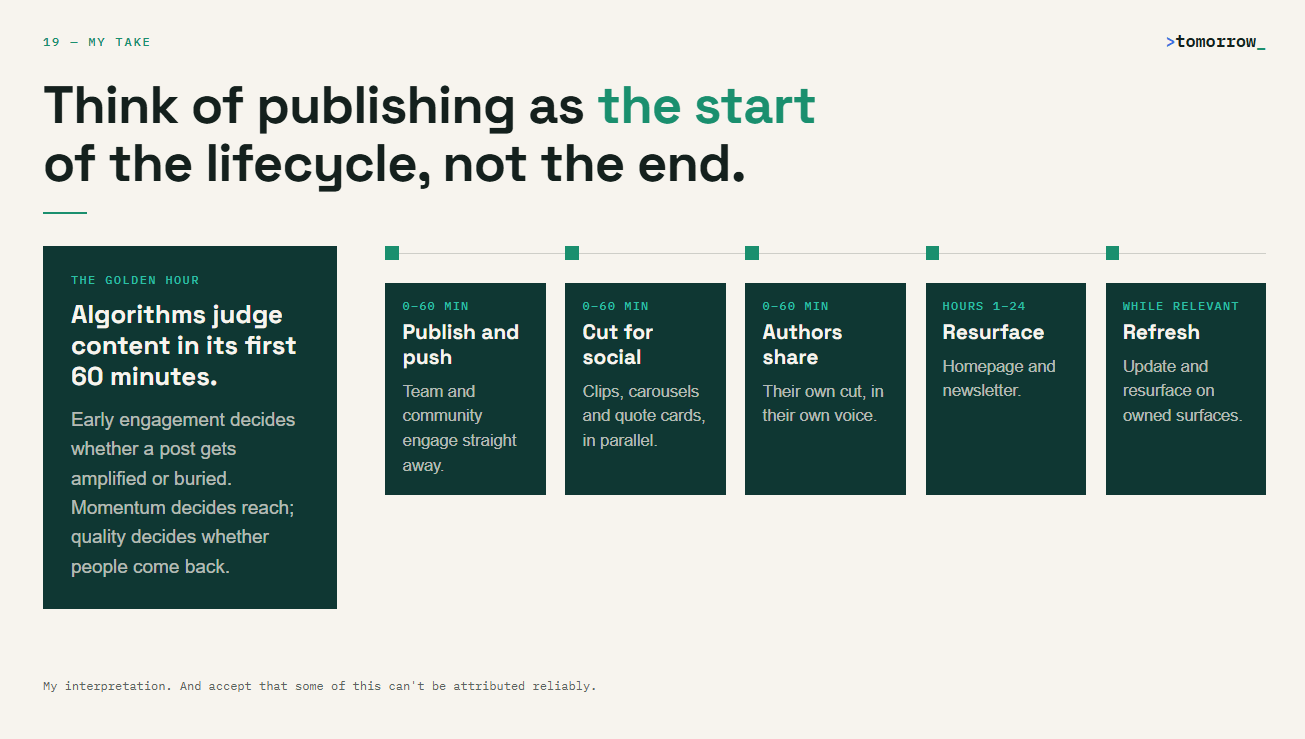
The Golden Hour rule is one of my favourite marketing fundamentals. Not because it guarantees success or can save your mediocre content. But because it forces you to think about distribution early. Beyond the homepage.
Thinking about purposeful distribution takes you out of SEO and into the realm of, you know, actual marketing.
That’s it
SEO isn’t enough. You need to be a better marketer. Know your audience and where they spend their time. Do cool stuff. Be interesting. Measure incremental uplift, not last click. Build habits, not sessions. And distribute everything you publish.