


Google’s recent definition of commodity vs non-commodity content is a bit meh. Meh if I’m being kind. Downright useless if I’m being more reasonable.
Complete and utter shite if I’ve had a drink.
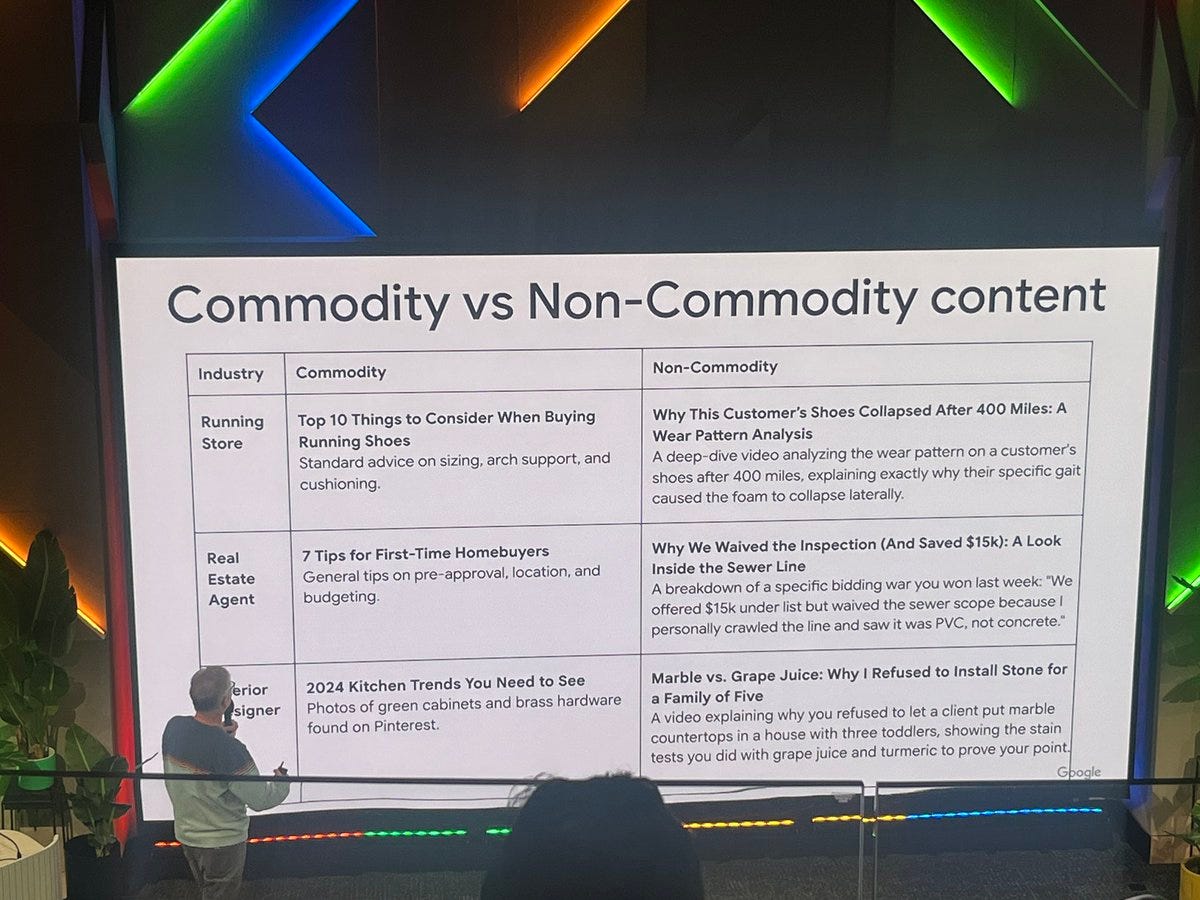
They all read like headlines you’d see in Discover and scroll past very fucking quickly.
Maybe in a few years that’ll be all that’s left and that’s what Googlers are prepping us for. Personally I think it’s far more likely their idea of quality, interesting content is a just a bit rubbish.
Marble vs grape juice - what a stupid title. Although interesting that they specify this is a video. Don’t hate the shoe one. No idea how that will make money for anyone however… Doesn’t matter to Google.
Anyway, here’s how I think you can create unique, interesting content that still drives actual value to your business. (Hint: it’s not about grape juice).

TL;DR
Commodity content is doomed for two reasons - it is easily summarised (because it has been done to death) and it doesn’t make (as much) money in a zero click world
If you are creating content just for SEO and have nothing unique to offer, stop. You are throwing money down the drain
Be more than an SEO. Help other teams structure their workflows to generate the maximum value from all channels with things like demand analysis
Google calculates and compares the uniqueness of a document using a custom ‘information gain’ score at a query and document level
Why commodity content is doomed
People are like water. We take the easiest possible route. One that really doesn’t include clicking to find an answer, even if said answer is riddled with bullshit.
Commodity content - content that has been the bedrock of evergreen search strategies for years - can be very effectively summarised and synthesised by answer engines. So effectively, that people will be satisfied with said clickless search.
Direct from the greedy horses’ mouth.
“Focus on making unique, non-commodity content that visitors from Search and your own readers will find helpful and satisfying. Then you’re on the right path for success with our AI search experiences, where users are asking longer and more specific questions — as well as follow-up questions to dig even deeper.”
This means we have to focus our efforts elsewhere.
We have to focus our time and efforts on content more likely to drive legitimate value. Content that cannot easily be summarised by AI, adds something of real value to the user and hasn’t already been thrashed to death by savvy SEO teams.
If you’re unsure whether to create content or not, ask yourself two questions;
Are we creating this just for SEO?
Are we adding anything unique to the existing corpus of information?
If you answered 1) yes and 2) no, throw it straight in the bin.
You do not have the time, money or resource anymore to spend time on content that doesn’t drive value. Value is everything when understanding and auditing publisher websites.
Does this mean things like search volume are useless?
At an individual keyword level, search volume has been declining in value for a long time. We just can’t generate the value we once could and it isn’t coming back.
But search volume just indicates demand. If you’re savvy and use monthly data, you can help content, social, paid marketing and editorial teams understand when users really care about a topic.
In this capacity, your job is to help teams understand when to create or update content, what that content should cover and crucially, why it’s spiking in search at this particular time.
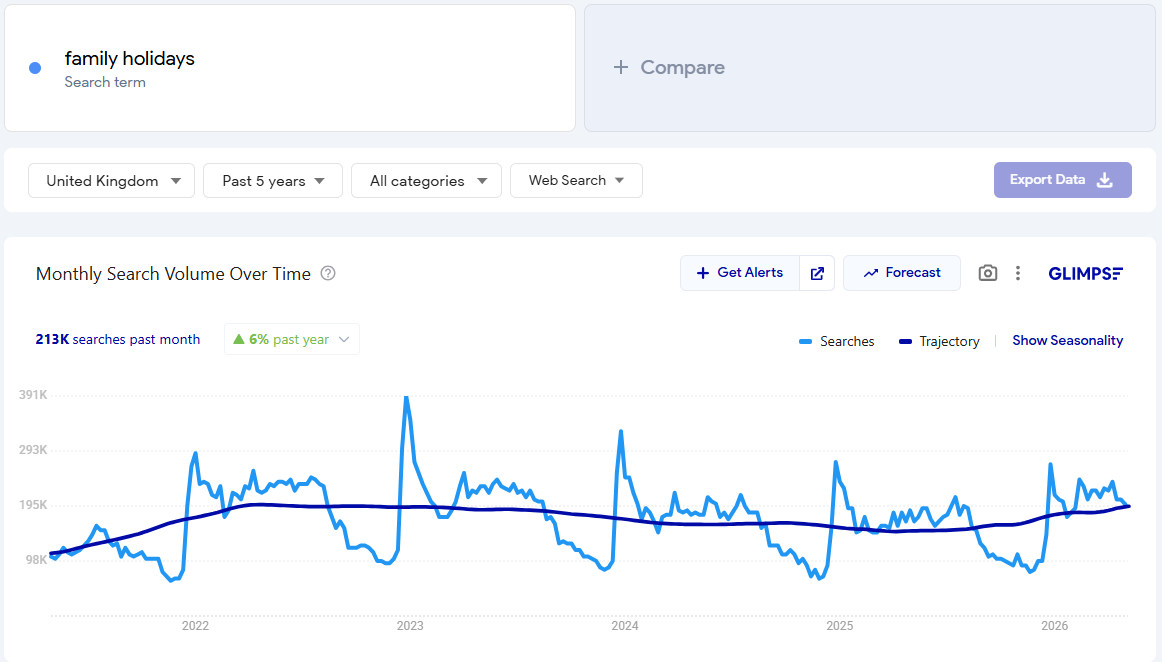
If we take searches for family holidays in Google Trends as an example, there is clear and obvious consistency. Searches spike every January as people plan their family holidays for the year ahead in the bleak midwinter.
So you should still get your core family holiday content ready for January. But as we shouldn’t operate in a silo, you should share this with social and travel teams so they know what time of year this type of content will generate the most value.
Planning and structure take centre stage.
It is no longer about create x, get y. That click-based marketing is dead.
You can listen or watch me talk about evergreen and commodity content here:
I consult on all things SEO, discoverability, the future of search, your market positioning and approach to audience targeting. My consulting website is here. If you’d like to discuss anything, you know where to find me.
Commodity or not commodity
Loosely this header was a Shakespearean-based to be or not to be joke, which is a) clunky and b) outside of my wheelhouse.
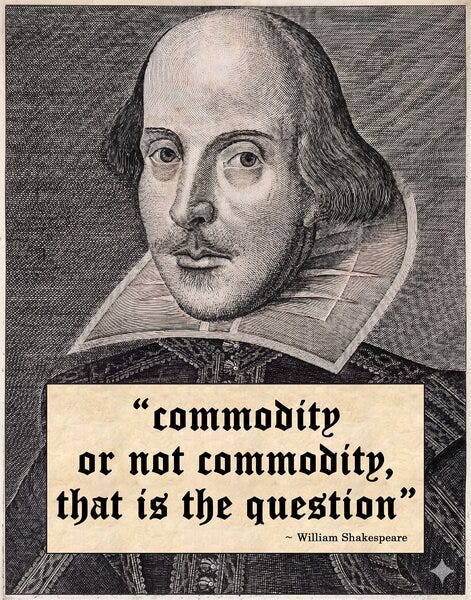
Now I’ve had to explain it.
I wrote about this in how to do evergreen content in 2026 and beyond. Which is, ironically, quite a commodity topic. But it has evolved. There’s new shit to share. You can make commodity, non-commodity.
But you need to have a level of understanding and expertise that can really elevate a topic. That requires experience, a level of uniqueness and a platform. Your content needs to be found and what we have always done in search is unlikely to be anywhere near as valuable.
The pillars of non-commodity content
Uniqueness
E-E-A-T
Engagement
Structure
Uniqueness
Uniqueness is the bedrock of everything when it comes to content that will continue to drive value. Without uniqueness, there’s no E-E-A-T. You won’t generate any shares, likes, comments or links. Certainly not any good ones.
You can make this as fancy as you like.
If you’re lucky enough to have access to high-quality data sources like Similarweb, you can create some truly brilliant proprietary metrics that elevate your content above and beyond.
Let me give you an example.
Similarweb give excellent engagement data at a site level. App-level too. If I was to combine these three metrics (pages per session, session duration and bounce rate) I have a composite engagement score.
Something no one else has.
If I took that engagement score and correlated it with third party traffic data or something like branded search/backlinks, I could correlate engagement data with traffic from search over time.
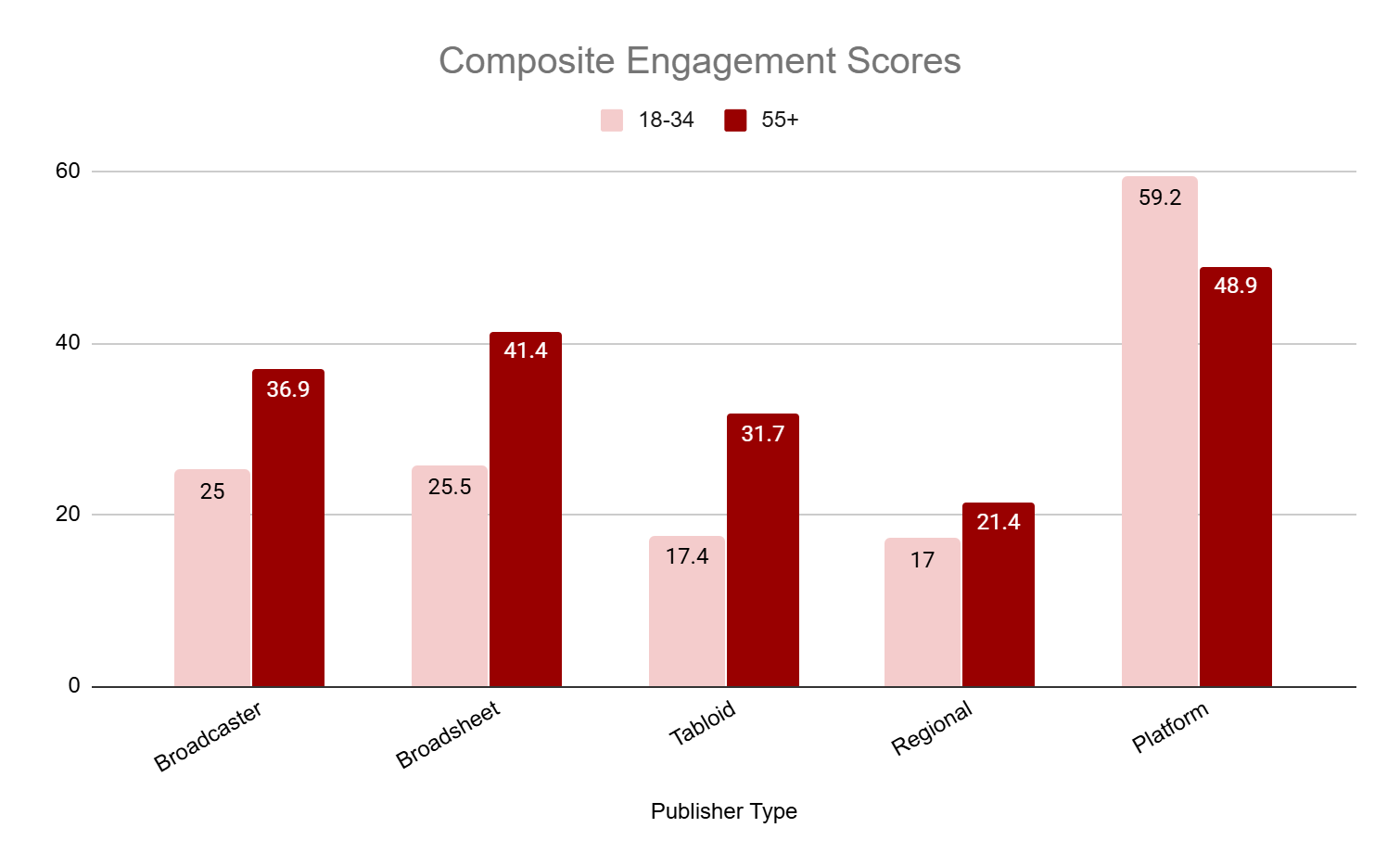
This is what stands out. This is what audiences will read, share and crucially, remember. It requires more effort.
And as we know from the Google Leak (this brilliant warehouse from Daniel Foley Carter is superb), effort is quite literally estimated and scored by Google. Things that are difficult to replicate are rewarded.
Unless they’re absolutely insane. Then probably the opposite.
You don’t get good at this overnight. But Google has been prepping us for this for some time. If you look at the declining youth engagement in the above graph, maybe people have too.
Not everyone is fortunate enough to have access to Similarweb data. But that doesn’t matter. Creativity and quality research is more important (and more readily available) than ever.
There are so many quality free data sources - Google Trends (combined with Glimpse), Keyword Planner, some free plans on tools like Ahrefs or Similarweb etc. You just need to identify metrics and combine them to make something bigger and better.
Google attempts to quantify information gain
Google has a patent (US20200349181A1) called Contextual estimation of link information gain that shows how the search giant may score the added value each document provides when compared to other similar documents.
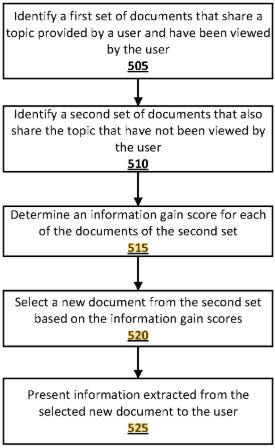
“In some implementations, information gain scores may be determined for one or more documents by applying data indicative of the documents, such as their entire contents, salient extracted information, a semantic representation across a machine learning model to generate an information gain score.”
Patents aren’t absolute. Just because a patent is present, it doesn’t mean it is always in use. If they’re frequently cited, recently updated and have worldwide applications, that’s usually a very good sign they have a level of importance.
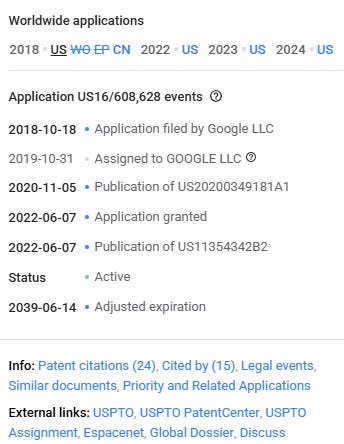
But ‘ranking factors’ aren’t absolute either. SERPs and topics are vastly different. It’s why we have subtopics like local SEO, YMYL et al.
What matters for one term or topic may not matter as much, if at all, for another. It’s the nuance of the job and why trial and error is so important.
You don’t know until you know.
Consider the Four E’s
Your content needs a purpose.
Yes it needs to convert. That is a business purpose. But it needs a purpose for people. Is it designed to entertain? Educate? As audiences turn away from news (and probably more widely commodity content), this matters more than ever.
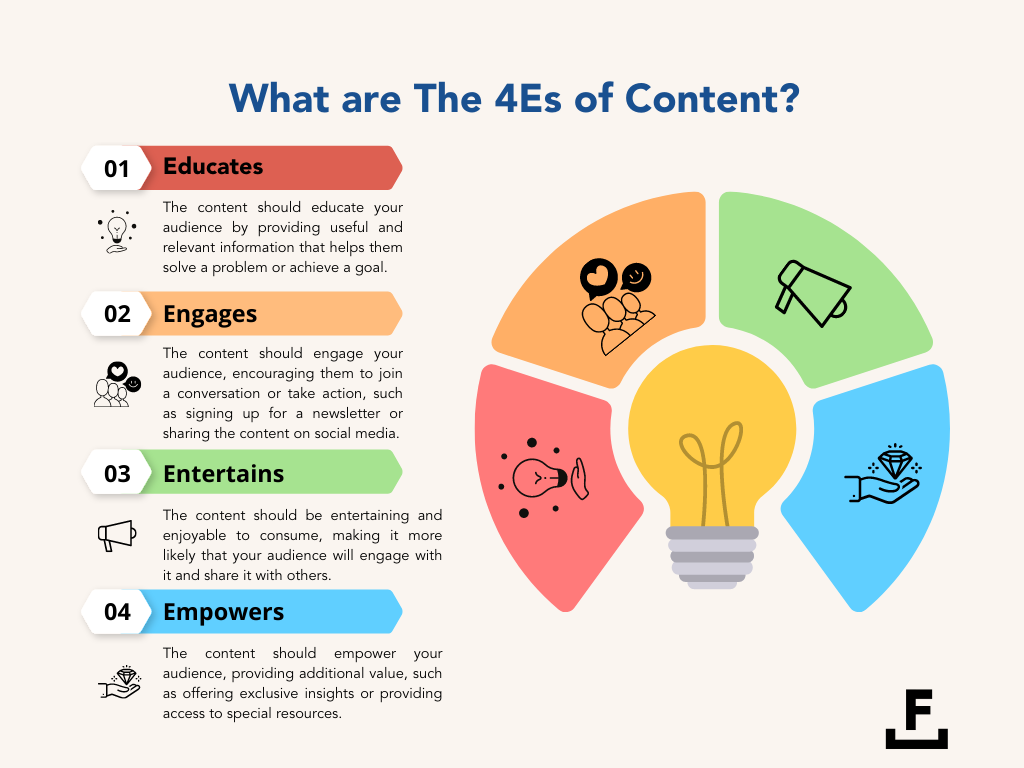
What we now term as commodity content was never designed to do any of the above. It was just designed to make money. Over the years, anything shit propped up by Google just to make money has died.
This is the next cab of the rank.
E-E-A-T
E-E-A-T has taken a bit of a kicking recently. Not without reason.
The premise is sound. Not unreasonable for readers to expect the author to be, you know, a real person, who knows something and has some kind of online presence. And Google absolutely does track authorship and entities. Plenty of evidence of that.
Google has built and maintained its Knowledge Graph for decades and entities have been the bedrock of news SEO for years. But E-E-A-T requires you to join the dots. To remove ambiguity - something we call disambiguation.

Doesn’t mean doing this is incredibly valuable, but it’s foundational. Particularly in this modern day iteration of the internet.
Remember, E-E-A-T projects have to add value
The problem with the whole - use experts, showcase expertise, prove you test everything, create video, make an effort in the industry etc - is now twofold;
It’s fucking expensive.
And less valuable than ever.
Having that person build some kind of profile in the industry. A platform that their content can be shared from and that reduces reliance on search can only be a good thing.
A moat if you will.
If they’re a legitimate expert on the topic, know how to structure great content and effectively showcase expertise, then you’re onto a bloody winner.
Which is why commodity content is doomed. Because people don’t care about it and now it doesn’t drive value.
We need to find ways to make non-commodity content truly valuable to the business. If it isn’t driving some kind of trackable value, ignore it. Move on.
Be ruthless, brave and interesting.
Content just for SEO has diminishing returns. It’s almost certainly a bad idea IF you do it the same way you have been for the last 10 years.
Engagement
I have always felt that links should be a happy byproduct of creating and sharing brilliant stuff.
I’ve never made an effort to build links. I have just made an effort to write stuff I think is interesting, made some semi-libellous jokes and got out there in the industry.
That is, more or less the Google definition of link building. In their world of sunshine and sweet smelling farts, links are just earnt by doing beautiful things. I am, in this scenario, the poster boy for white hat SEO.
The problem is, people need to make money and links still drive rankings. So there’s a market there. And if you’re a student of the scriptures like I am, you’ll know the buying and selling of links is the oldest recorded job.
Or was that prostitution?
Either way my inbox is full.
Anyway, your content has to fulfill a need. We’re moving away from straight laced content being able to do that for you as a publisher. Traditional ad revenue and the volume model sucks and you sure as hell aren’t going to drive any subscriptions with what time is x or how to tie your shoes.
I really hope this is a good thing for SEOs and publishers. I want us to focus on content that really makes a difference to people’s lives. Content that makes them smile or think.
Content that makes people angry has been a big hit when it comes to numbers for a long time. But I don’t think anger is the emotion you should shoot for.
Measurement
You need to measure quality engagement, on and off-site. That means;
On-site
No need to overcomplicate it for now.
Session duration
Bounce rate
Link clicks
Pages per session
Comments
Read time
Off-site
Very much depends on the platform and the purpose, but I would focus on;
Links
Shares
Comments
Saves
Watch time
You need to track metrics that tell you clearly whether people truly care about what you are creating. Clicks are dying, so I’d rather be measured against something a) more valuable and b) less miserable.
Create a composite metric(s) that gives you and your creators something to clearly focus on. Make their job easy by guiding their content with simple, straightforward metrics. Metrics that don’t just chase page views.
Structure
Structure’s not sexy. Let’s be honest.
But it matters. If for some reason you think LLMs are the zenith of society and content consumption, then you should know that models are more likely to cite or reference content from the top or bottom of the page, thanks to their inability to properly follow an argument.
This is known as the lost in the middle effect.
Unless of course, the entity and topic is repeatedly referenced throughout.
I shouldn’t have to tell you that this is a shit idea and your content will become unreadable to living, breathing people.
But maybe you don’t care about that anymore.
Proper structure really matters. People have expectations (and accessibility needs). In more traditional commodity content they want their question answered immediately. If you satisfy that - and the intro to your article isn’t abysmal - you might generate a longer session, a click or hell maybe even a conversion.
Theoretically, non-commodity content accessed via search should still be intent-driven. Possibly more so if we’re to believe the more qualified users with longer tail queries theory Google espouses.
So you still need to follow a similar, highly coherent page structure;
Answer the fucking question
Some form of TL;DR article summary
Argument
Concluding thoughts
Coherent FAQs (if applicable)
One that logically answers queries in the appropriate format - text, video, image, list etc - and is highly consumable.
The argument section is where LLMs tend to lose their ability to accurately and appropriately cite and reference content. Which is not at all dissimilar to people.
I am not saying you need to continually refresh and restate the entity in question. That may be construed as keyword stuffing. It needs to read well for people. But you need to be clear, concise and accurate to make consuming your content simple.
Don’t people consume content in different ways?
You’re absolutely right my pedantic friend, they do. Broadly, I think there are four types of consumption;
Scanners - The vast majority. Too lazy or illiterate to read the whole thing, but will be satisfied from a headline, bold text, bullet points, and headers. They treat a page like a map, not a story.
Answer seekers - They find what they want and leave. But still leave satisfied.
Visual/audio consumers - A cohort that either refuse to or cannot read, but will stare at a pretty picture for 60 seconds.
Deep readers - A small cohort, but a deeply engaged one, desperate for you to get something wrong.
I suspect these groups cover >90% of people. There are also fact-checkers - who skip the narrative and head straight for the citations, data points, or the “About Us” section before deciding if the content is worth their time.
And community-readers, who scroll to the bottom of the article to see the community reaction before deciding whether the content is worth their time. This is (obviously) more of a social trait. Particularly from younger audiences.
Your content can and should satisfy all of these people. It must;
Answer the question
Be highly scannable
Broken up with clear, distinct headers
Form a concise, easy to follow narrative
Be highly scannable
Easy to share
Visually appealing (audio and video options available)
Cite sources and clearly explain your methodology if appropriate
You might think it’s beneath you, but if you don't optimise for scanners and answer-seekers, you risk losing up to c. 80% or more of your potential audience within the first few seconds.
This is why front-loading (putting the most important info at the top) and using clear hierarchies is so vital in modern writing.
Anyway, that’s it. Thanks for reading as always!
Other good stuff
Some good stuff I’ve enjoyed recently;