


Discoverability has changed. That is, I think, undeniable. Passive, off-platform discovery dominates the early stage journey, but your website is your brand’s home.
Chris Green talked about SEO becoming more akin to feed management in the future, which I like. As an analogy I mean, less so as a concept.
But Google still sends over a trillion clicks a year to the open web and up to 86% of clicks are discovery-led. Websites and the wider internet feed answer engines and whilst we’re in the midst of change, it won’t be overnight.
Your website still needs to be good. It needs to rank. It needs to be crawled, rendered, indexed and cited. Particularly if your content and on-site (or app) experience is your golden ticket.
Here’s how I suggest approaching SEO and discoverability auditing for publisher sites. If I can help, you know where to find me.
The governing questions are the same
An SEO audit has not become less important as discovery has shifted. Its purpose has changed: it still establishes whether a site can rank, now it establishes whether a brand ranks, can be retrieved, resolved and cited anywhere.
For as long as I’ve worked in SEO, the foundations have been the same:
Can machines reach and retrieve your content?
Is it worth surfacing (and retaining)?
Can they tell (and trust) who made it?
Can they tell who and what you are?
The last two (EEAT and entity relationships) are more recent additions and quality standards play a more prominent role in indexation. But the evolution of SEO - and SEO auditing - should be discoverability-led.
Tying together Googlebot, AI crawlers, answer engines, recommendation feeds and social discovery surfaces. The four questions don’t change.
We may not have direct control over social channels or all of the on-site content. But no one is better placed than SEOs to guide publishers and websites into making business decisions that drive value and effectively improve discoverability - through the passive, active and owned sections.
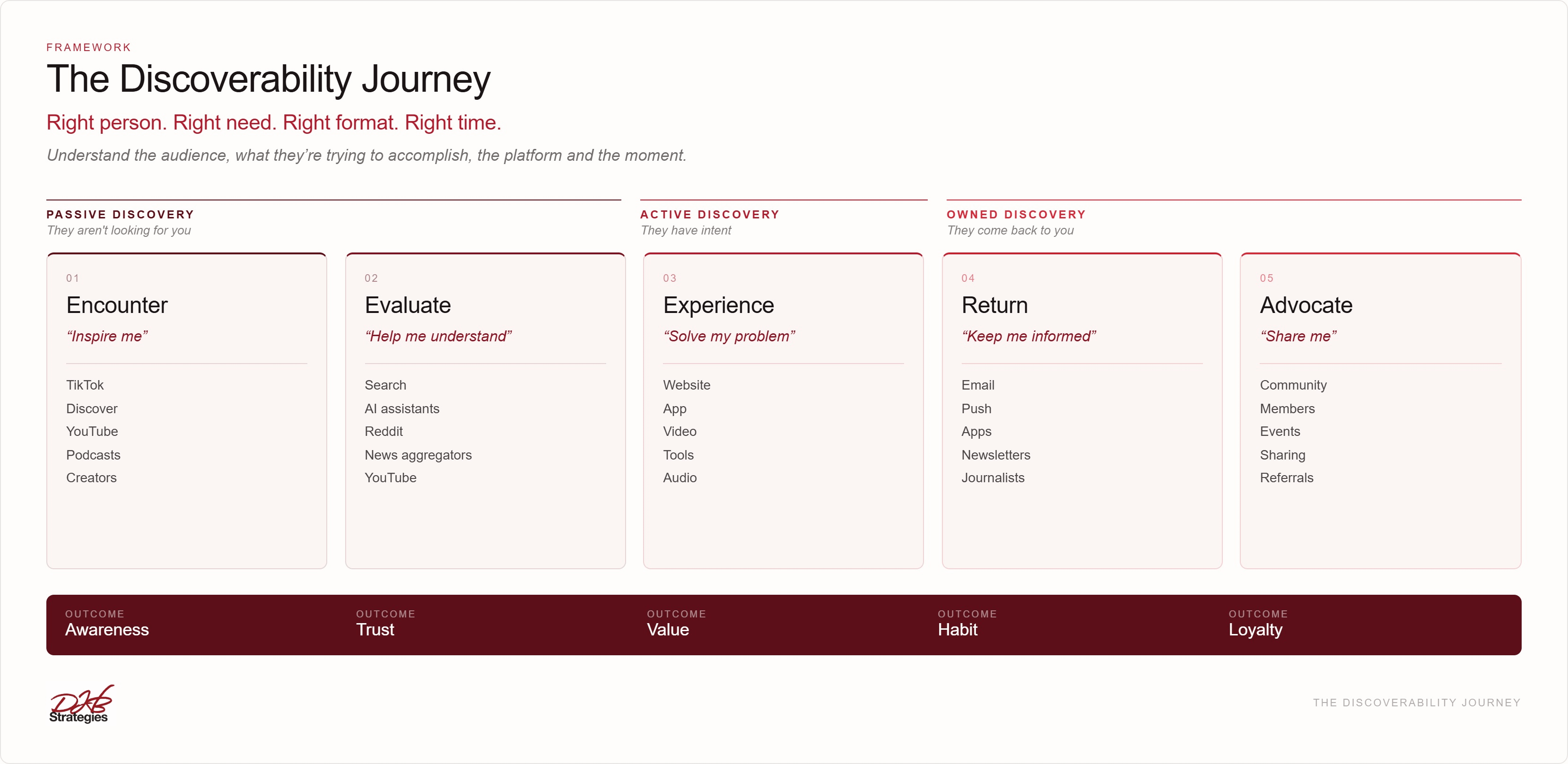
Every owned off-site signal needs to corroborate the information on-site. Encouraging individuals to disclose information and share content is a brilliant thing. But it needs to be accurate and consistent.
A person or team need(s) to own this.
Should you be so inclined, you can watch or listen to my dulcet tones instead of reading:
I consult on all things SEO, discoverability, the future of search, your market positioning and approach to audience targeting. My consulting website is here. If you’d like to discuss anything, you know where to find me.
What an SEO audit should do now
Everything it used to do and more.
Search remains the most valuable last-click channel for most publishers; contrary to popular belief we need it and Google needs us - although they have an extremely unusual way of showing it.
Saccharine sweet whispers about how much they care about the content ecosystem flies in the face of their actions.
The four primary pillars for auditing in 2026 are:
Technical SEO
Content and on-page SEO
EEAT
Entity (brand) consistency
At least in my opinion. We’re trying to create efficient, reachable websites, with brilliant content that people and bots implicitly trust. These four are non-negotiables - although you can cut them however you wish.
AI readiness is baked into these four areas, but for most publishers, LLMs have questionable value. Make sure you assess a site’s blocking protocols and whether they’re solely relying on the robots.txt.
Yes, links and mentions are still crucial. But not everyone needs to invest in them. I have bundled them under EEAT, but if they’re hugely important to your brand, then consider running a more detailed audit of them in future.
The most important thing: value
You’re not driving traffic or rankings or visibility. You’re driving value. Or maybe just trying to stop the rot.
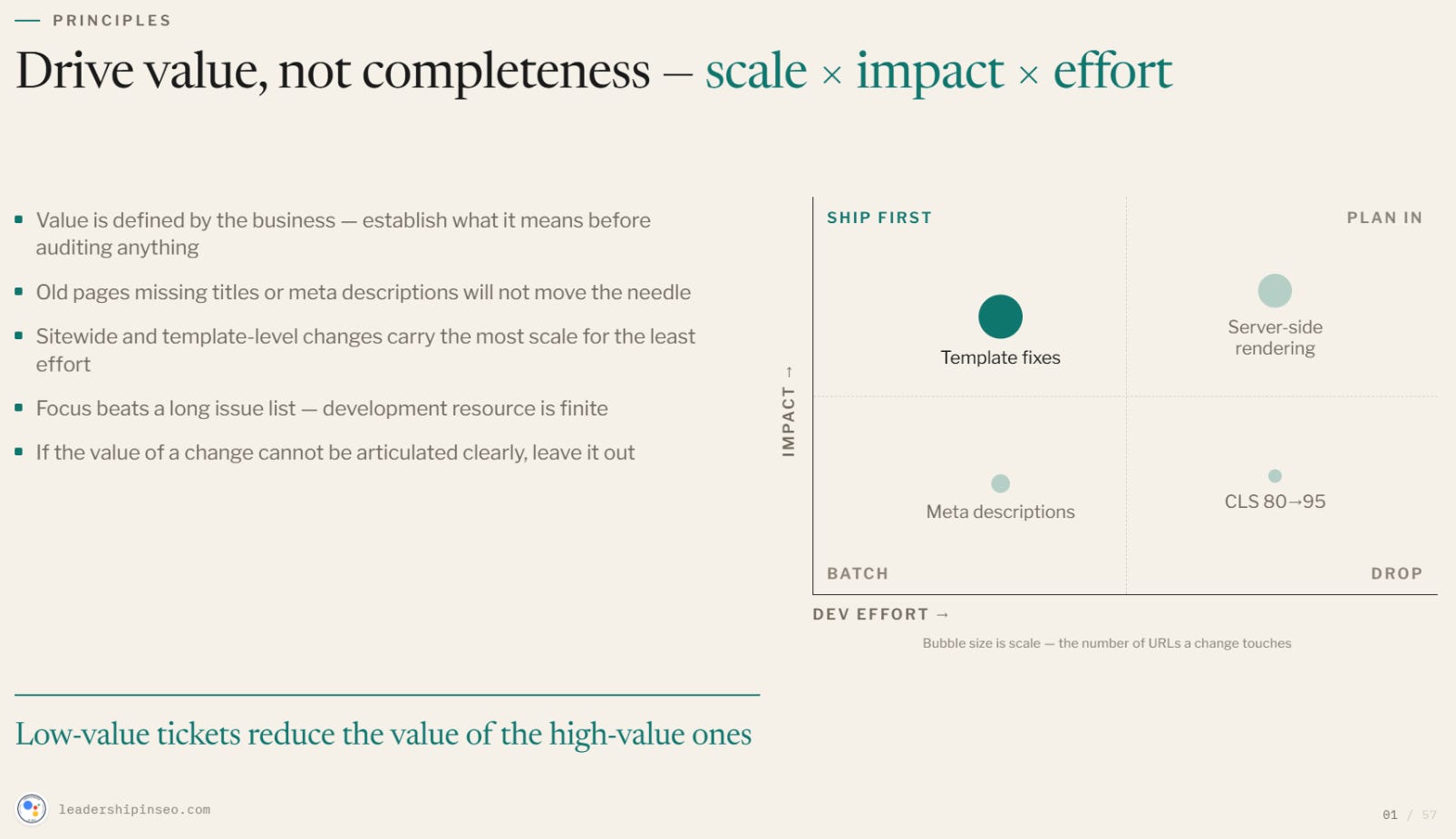
Yes value is defined by the business’ goals. Whether you’re trying to increase ARPU, subscriptions or affiliate revenue, don’t just blindly jump in. Try to align your work with tangible business goals that make your stakeholders look good!
I suggest creating a longer-list of issues, aligning them on the scale x impact x effort scale and creating a quadrant to show you a) understand how this business works and b) avoid a long list of issues.
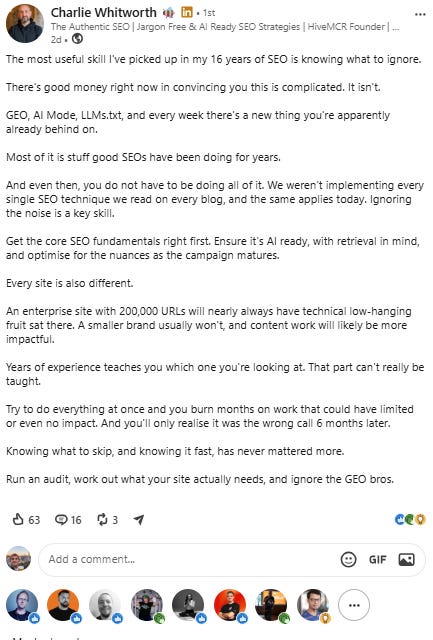
Not everything needs fixing. As Charlie puts it, knowing what to ignore is as important as knowing what needs attention.
Sitewide and template-level changes tend to have the largest scale. Recommendations that directly relate to key business goals tend to have the highest impact.
Make sure you can articulate the benefit of each suggestion to prevent yourself looking or sounding stupid - none of us know everything.
How do I know where to start?
This excellent graphic from Aleyda and Mark Williams-Cook should give you a good indication.
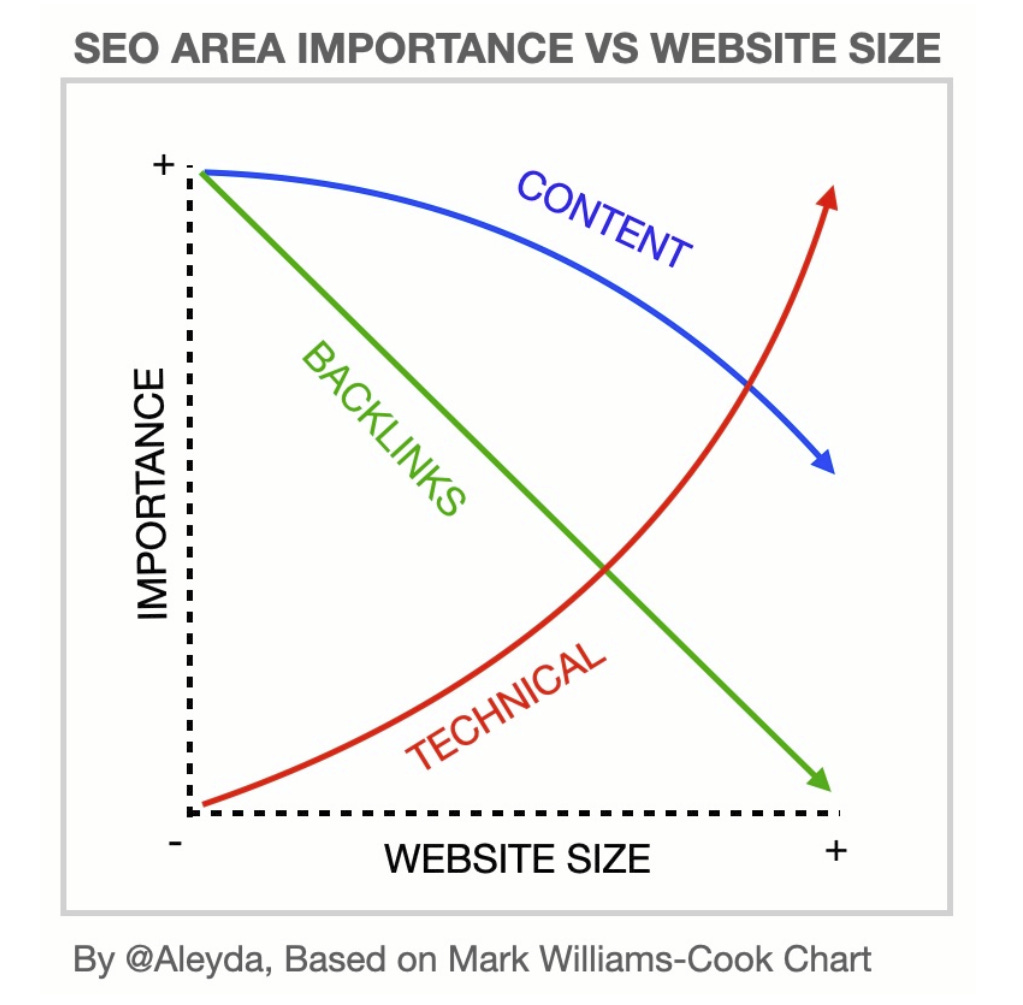
Larger sites typically have more to gain from technical SEO improvements. The majority of medium to large publishers sit on the right-hand side of this graph. Smaller to medium sized publishers typically need more brand presence and awareness in the right places - digital PR, link building and entity SEO.
It makes sense to run phased audits. Box off a week or two of time. Don’t overstep the mark here. The initial audit is to identify any opportunities or fires that need attention.
If there aren’t any, happy days. We either part ways as satisfied SEOs and clients, or move onto agreed upon phase two pieces of work like competitor analysis or specific content drilldowns, possibly with some monthly retainer agreed.
Pre-Auditing Essentials
This cannot be exhaustive, however, here are some non-negotiable questions:
What are your company goals and KPIs? What do you need from SEO?
How do you generate value (subscriptions, advertising, affiliate revenue)?
What page templates do you have? How can we identify them? (Typically you can use custom extraction to identify content at a page template level)
How large is the site and how much do you publish each day?
Who are the key stakeholders?
How much development resource is available?
Who are your key competitors and what countries matter most?
Is this a single language or location site?
Are there any obvious issues to be aware of or any previous migrations we should know about?
All of this is designed to help you understand the business and suggest initiatives that drive value before you dive headfirst into the shallow end.
Technical SEO Auditing
Technical SEO still presents a real opportunity for publishers.
Good tech SEO raises the ceiling. Excellent content can be suppressed by a slow, inefficient website that makes crawlers (and users) work harder than they should have to.
Crawling, rendering and indexing costs money and Google has made it very clear that unless your content adds value, it’s not going to stay in the index. Famously, Google really, really likes money.
Reached
Can bots crawl, render and index (in Google’s case) your content?
Barry Adams, as ever, has some excellent advice on how Google crawls your website. In my opinion, the most important concepts to understand are:
Have you blocked any important content via the robots.txt file? (And is any of it still indexed?)
How Google crawls and renders content
Why client-side Javascript is something you generally want to avoid (for important on page content)
Why pages drop in and out of the index
How to measure and assess the crawl stats and page indexation report
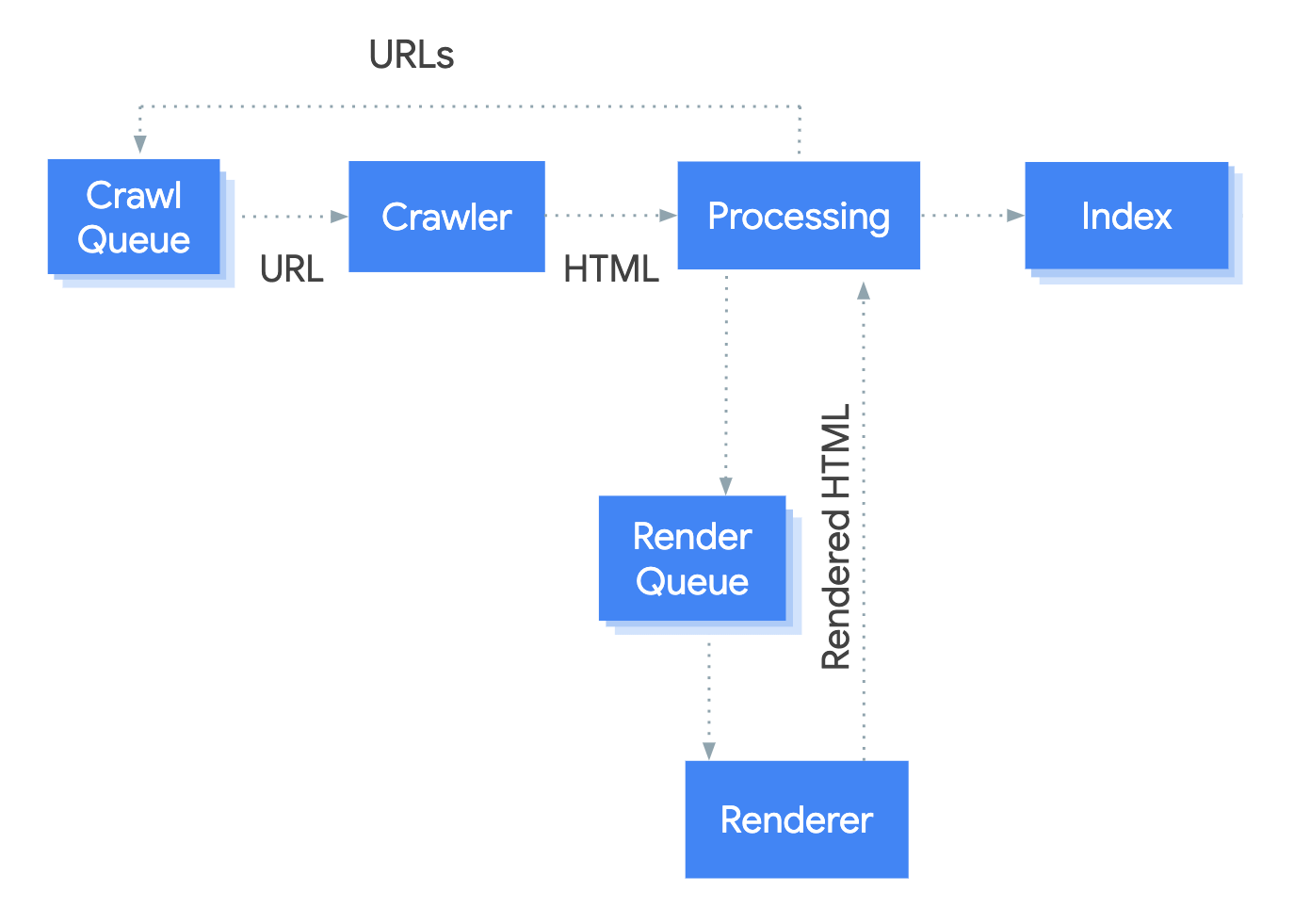
Generally I would think of it like this: indexation is partly on Google’s ability to reach your content and content quality - led by engagement metrics. Does your content meet the quality thresholds to stay in the index, or does it flicker between indexed or crawled/discovered - currently not indexed?
SEO is all about patterns.
Whilst the page indexation report has limitations (1,000 rows is never comprehensive for a publisher), you can get around this by creating multiple Search Console accounts, or with a tool like Indexing Insight.
PSA: Daniel Foley Carter’s guide to solving non-indexable pages is superb.
Crawl budget is an enormous topic in itself and ties in very closely with the crawl stats and indexation reports. Whilst I can’t cover everything here, some of the most common issues with publishers are:
Site search pages are being indexed
A high number of indexable parameter URLs (MarTech will tell you these are important. They aren’t).
Inefficient caching policies or unnecessary versioning of files
Site speed, brand strength etc etc.
Take this example from a crawl stats report:
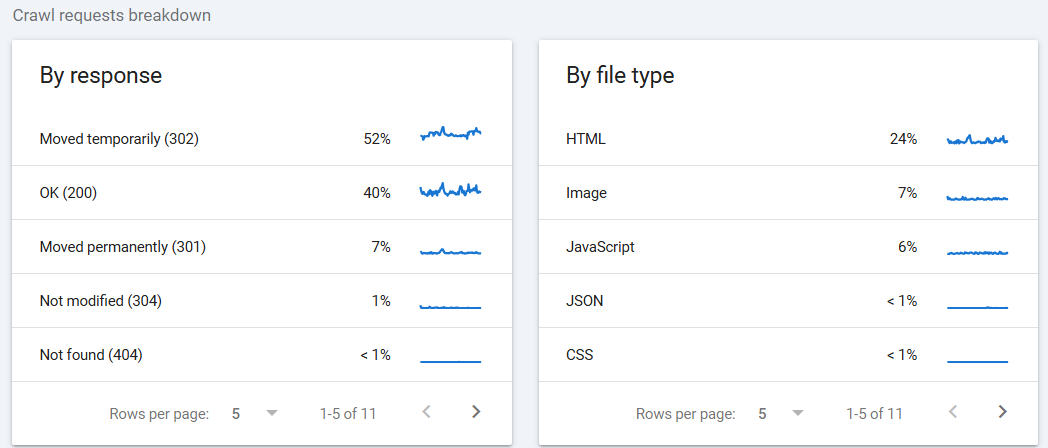
Underneath the main property, you get a breakdown of where Googlebot spends its time. Here you can see 52% of the bot’s resources are going on temporarily moved (302) files. That’s a very high number and one that would require further investigation.
On larger websites, this is exactly the kind of technical debt that can move the needle.
News articles (outside of live blogs) may be crawled once and not again for hours such is the volume and pressure associated with news and Top Stories.
If important content requires client-side JS, it may never get picked up by Google until after the event. When it is essentially redundant.
Understood
Semantic HTML and nested subheadings are the foundations of accessibility and an easy to crawl and ‘understand’ page. You may be writing content for humans, but you are structuring it for bots - now more so than ever.
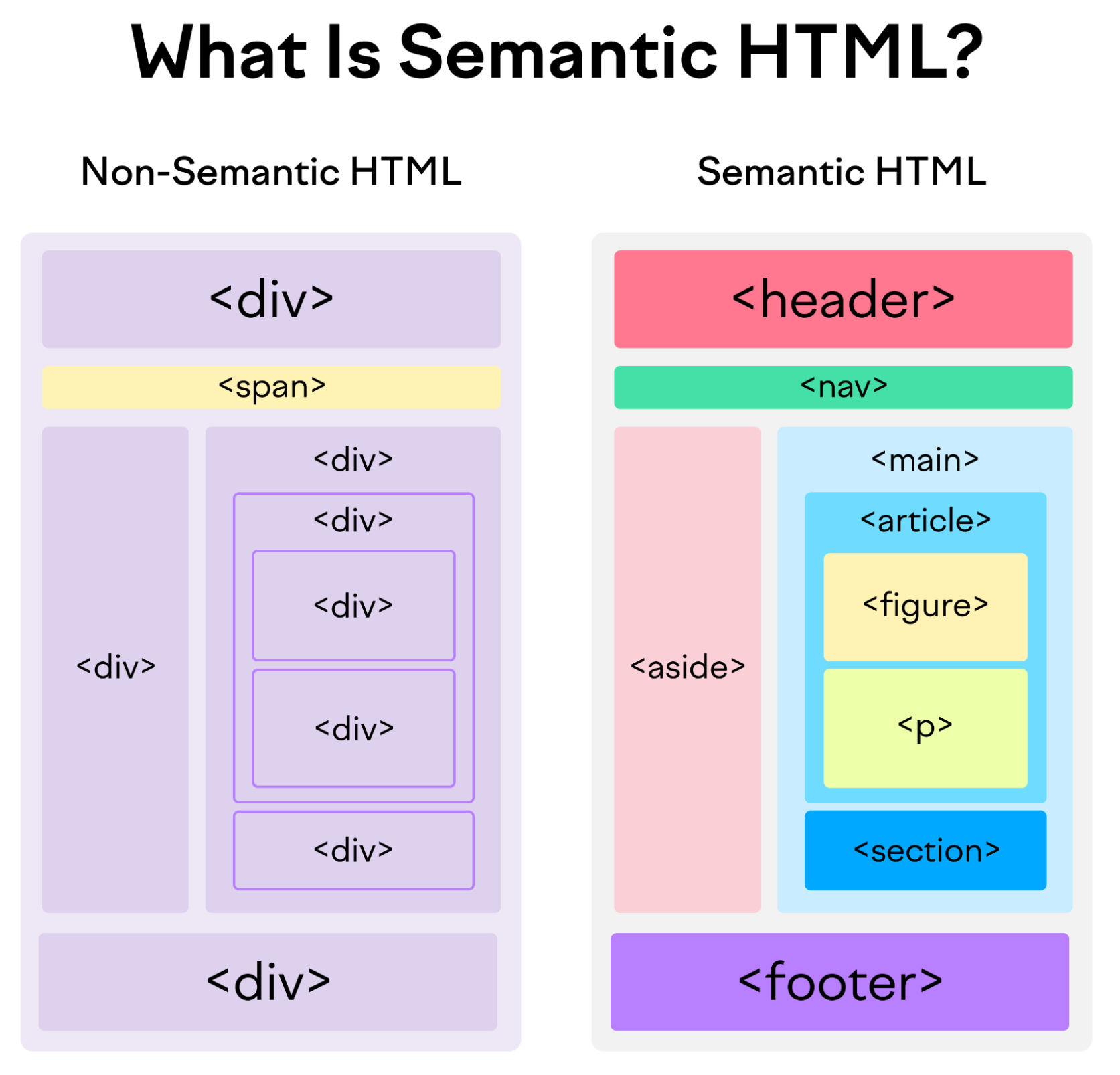
The irrepressibly great Jono Alderson has a really brilliant article on why semantic HTML still matters. Search engines, accessibility tools, AI agents, and task-based systems all rely on structural signals - markdown is a cheap workaround to avoid fixing the mess we created.
“HTML isn’t just how we place elements on a page. It’s a language – with a vocabulary that expresses meaning
Tags like <article>, <nav> and <section> aren’t decorative. They express intent. They signal hierarchy. They tell machines what your content is, and how it relates to everything else.”
I appreciate this can be a little complicated, but it’s the foundations of accessibility too - for bots and humans. So it is important. Fortunately there are some very good tools you can use here:
And this is an excellent way of approaching a semantic HTML audit.
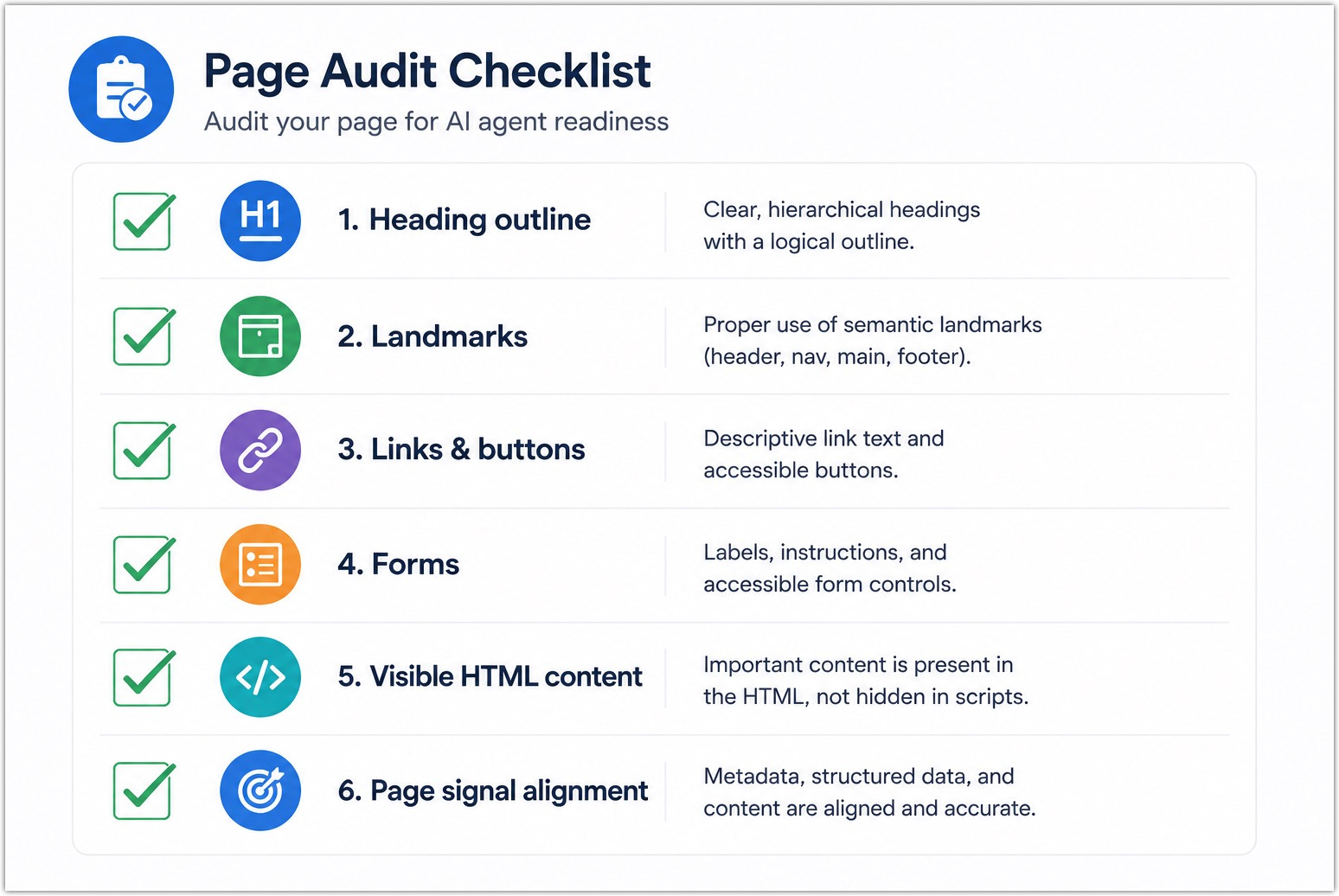
You can run the HTML through Claude Code with very rigorous instructions to corroborate and contrast the findings too. As ever, you don’t need to fix everything. Just the most egregious errors - which are colloquially known as div soup.
Fake heading (part of a div soup page): <div class=”h2”>Plan includes</div>
Real heading: <h2>Plan includes</h2>
Consistent, accurate and all-encompassing structured data support the disambiguation of your article. Whilst structured data may not have direct merit for AI systems (and is treated simply as raw text in the page), it still has tremendous merit in the reduction of ambiguity. I recommend reviewing structured data at a page template level and compare your structured data setup to some of the best in the business - The NYT always spring to mind.
This has real benefits for brands and people as entities and for trust as a construct of EEAT. Which we will come onto.
Then you are looking to remove any other inaccuracies - consistency of on and off-page dates is a classic publisher problem that only technical SEO can solve. Understanding is a combination of accuracy, accessibility consistency and disambiguation.
To really dive deeper on accessibility and agent readiness, this article by Jon McAlpin on Accessibility Tree Use Cases is better than anything I can produce. Complete with an accessibility tester too.
Linking
You cannot perfectly assess the internal linking of an enormous enterprise publisher. Things move too quickly, there’s too much noise and there will almost certainly be articles present from the inception of the internet.
But I think you can do a few simple things to assess quality and set the publisher up for future success:
Does your site have an egregious number of broken links and redirect chains or loops? Almost all publisher sites do, just make sure you fix the worst offenders. Broken or redirecting links in the menu or at a template level, redirect chains with five or more in the sequence.
Does the navigation allow for easy accessibility for users and bots?
Is the important content within easily navigable from the homepage?
Is important evergreen content prioritised (at a topic and article level)?
Do news articles effectively link to said important evergreen content and topic pages?
Are assets like tools, products and revenue driving sections given suitable visibility?
Is pagination appropriately crawlable?
Are links generally in an
<a>HTML element (also known as anchor element) with anhrefattribute? Most links in other formats won't be parsed and extracted by Google's crawlers.
Once you’ve done this, I suggest putting some future processes in place that ensure news content effectively spreads link equity (and traffic) across the site via well placed internal links.
As a rough standard, aim for a link to a topic page and a relevant evergreen or news article in the first couple of paragraphs.
In an ideal world, you can automate or semi-automate quality internal linking. If you have a Google News Sitemap, you can scrape the content of each page and identify appropriate links to relevant topic and evergreen pages using an LLM’s API and some form of NLP to disambiguate.
Served
OK, so now the content has been reached, understood, linked - now it needs to be served effectively and efficiently. This means it needs to load quickly.
Page load speed has significant connotations for how effectively bots consume your content. A faster, more efficient site will be crawled to greater depth over the same time period than a clunky one.
We don’t have to be site speed experts to understand if there’s a problem. I think the most applicable approach is to audit speed at a template-level in three passes (one of these is on the client):
Field data: The Search Console Core Web Vitals report is entirely made up of Google’s field data and categorised by issue. Whilst this may not align with your template setup, there’s a very good chance it does.
Lab data: Dev Tools and Lighthouse reports use lab data. You can download the Devtools MCP and use it with Claude Code to help you identify and assess issues and to build up a picture at a template and sitewide level.
RUM data: This one’s on the client. Real User Monitoring data is essential to see how users from different places, on different connections and devices interact with your site. You need to see measurable improvements over time if you make these changes and this is the most reliable way to do that.
Essentially you’re using field data to highlight issues. Lab data to identify how those issues manifest and RUM data to monitor real people and whether the changes have a positive effect. When using Devtools MCP, you can use the lab data to review the difference between cold and consented user experiences on page.
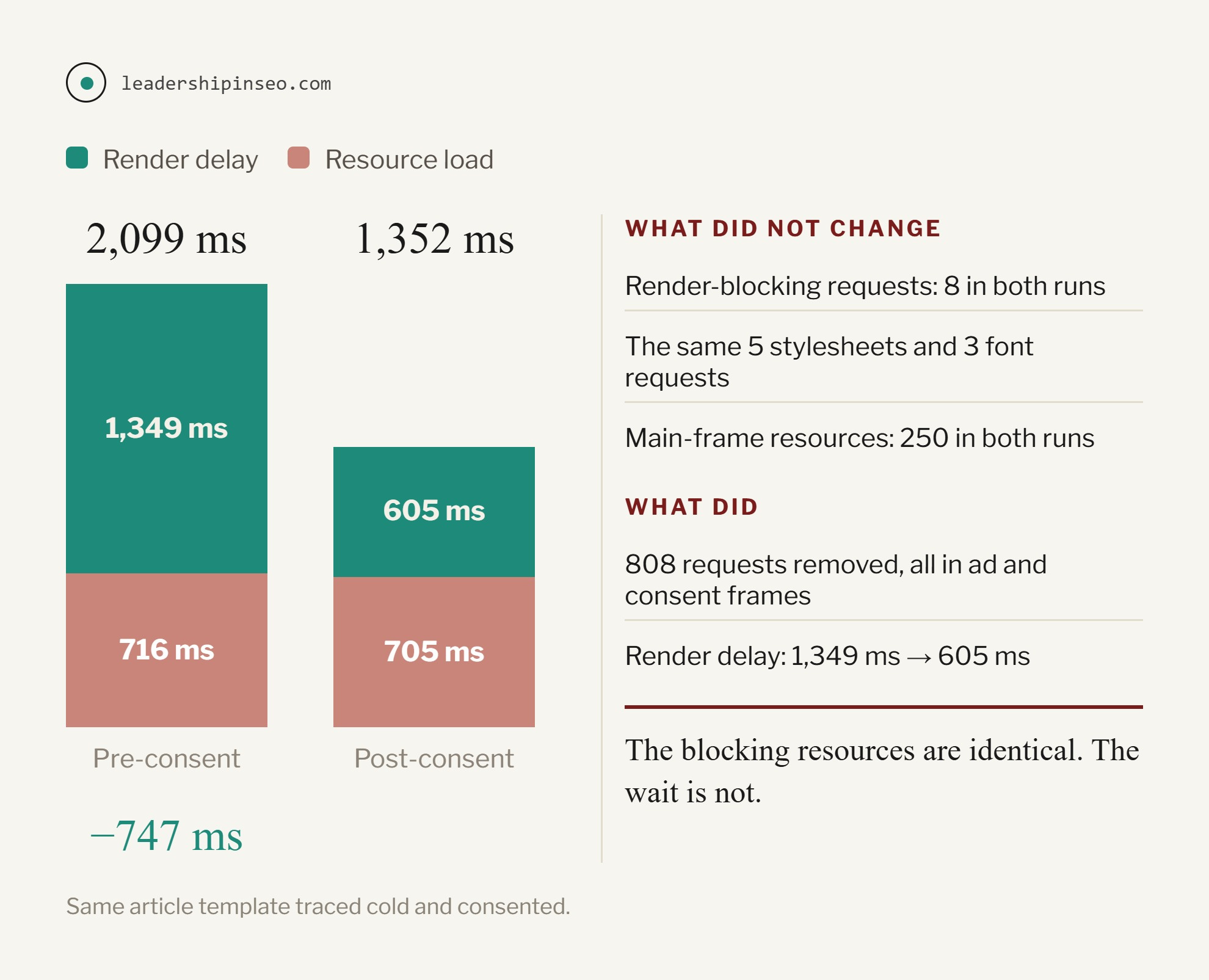
This is important to understand, because a first time user will almost always have a slower experience. Not every visitor has the same experience, so you want to optimise for the majority of your user base first. Or the ones receiving the worst experience.
There are very good alternatives here. A PageSpeed Insights report includes both field data and lab data. Field data shows real-world user experiences from the Chrome User Experience Report (CrUX), while lab data shows simulated performance tests run by Lighthouse in a controlled environment.
I would highly recommend using CrUX Vis to compare your site’s loading against the competition in search. Speed is largely engagement related. Slower sites burn through users. If your competition have a faster loading template, you’re already on the backfoot.
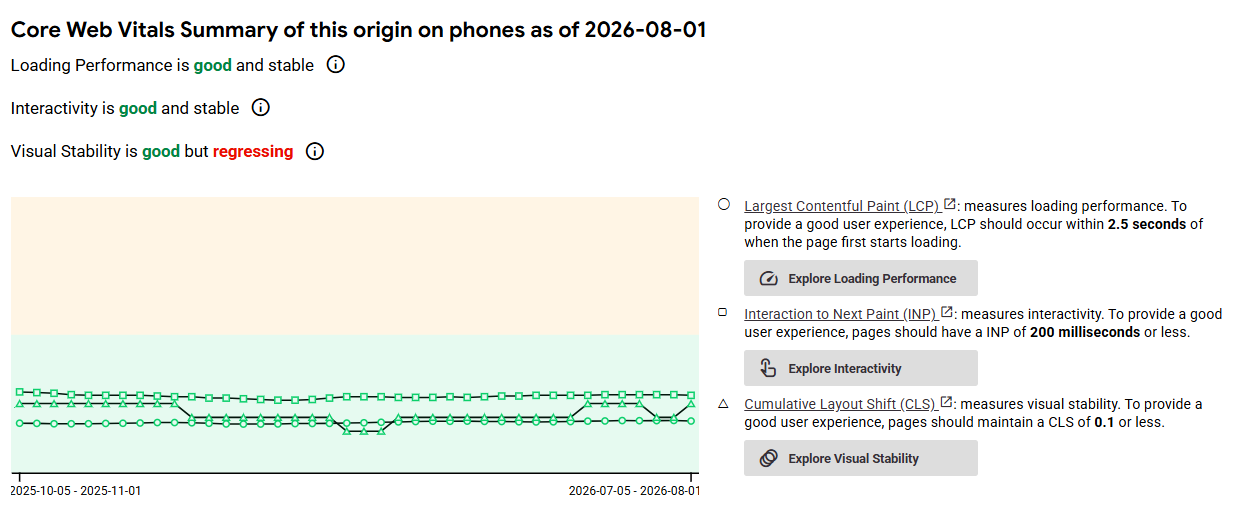
If you are comfortable with the fundamentals of core web vitals, field data and lab data, then I suggest downloading the devtools MCP and configuring it with Claude Code.
You can generate excellent lab vs field comparisons and thorough investigations into each metric, including CrUX data if you have a Google Cloud account.
Miscellaneous
Miscellaneous really doesn’t do justice to some very important topics, but without this post spiralling further of control I’m going to cover them in a couple of sentences.
We haven’t covered international SEO, auditing hreflang tags (although this excellent tool from Chris Lever is absolutely the best for it), but it isn’t a requirement for everyone.
Do you create a unique, internationalised experience on different versions of your site?
Do you auto-redirect users based on their location (please don’t do this, prompt, don’t auto-redirect)?
Do you publish content unique to that region?
Is the path to conversion appropriately internationalised?
This really isn’t comprehensive, but it’s a pretty decent start.
And as bot management continues to grow in importance, you really want to assess your robots.txt and CDN-level blocking. Is it doing what you want it to? Is it setting your users up to have the best possible experience? Is it positioning your site in a position of strength, not weakness?
If you’re blocking training data bots, just make sure you understand the knock-on effects. Ditto if you allow them.
Content
Content has to stand out. It has to be unique, or at least have unique elements and it shouldn’t be created solely for SEO purposes. Content should be created with your audience in mind.
We can audit some of these things in a relatively straightforward manner. Others require a little more nuance and actual thinking. You can’t just automate everything.
Fundamentals
I have written about how to create great content and get it found at length. These content tenets should be applied ubiquitously.
It answers the question
Entity-first headlines and opening paragraphs
Well structured, with relevant, nested subheadings
Short, snappy paragraphs, written in a readable manner (you can use a free online readability checker, although I wouldn’t recommend sharing this with the writer)
Bullets and tables to break the content up with structured data (not schema)
Clickable, unique images (typically with people in them)
Unique elements (data, stories, video or visuals and real, lived experiences are all good examples of this)
Relevant, topical internal links
Created (or updated) at the right time
An appropriate level of freshness
You can score freshness using this distance calculator or - if you’re lucky enough to work on a site with well structured sitemaps - this freshness checker.
Measurement at scale
Content popularity is measurable at scale. Organic traffic, branded search, engagement, backlinks and mentions can all (broadly) be measured by subfolder or topic. Particularly if you have access to some third party data from somewhere like Similarweb.
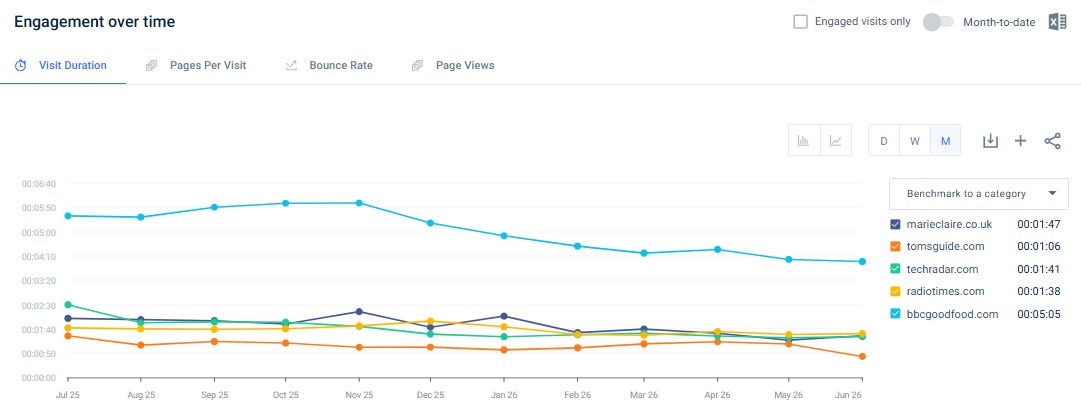
This can be applied sitewide or at a page level. There are obvious limitations here, but it’s a very useful starting point and can help identify areas of the site with declining engagement and potentially weaker content.
Query counting
This is, I think, one of the most under-utilised and exceptionally useful tools in an SEO’s arsenal. Particularly when you are working on such large sites, sometimes publishing hundreds of articles per day.
On said chunky sites, you’re looking for patterns. Patterns that indicate whether your content is valued by users and search engines. Query counting exposes how search engines are evaluating your site over time.
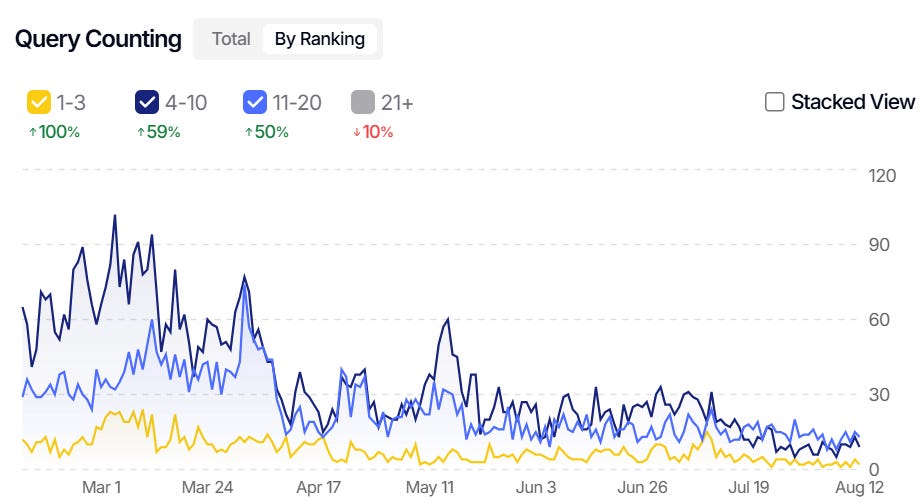
If you split your Search Console account into multiple properties (as you should), you get access to a treasure trove of data with brilliant tools like SEO Gets (where this screenshot was taken) or SEO Stack. SEO Gets is a slightly more budget-friendly option, SEO Stack is more all-singing all-dancing.
Both are absolutely brilliant.
Whilst these tools have so many brilliant options - page indexing, alerts, cannibalisation, GA4 integration, content decay mapping et al - query counting alone is worth the investment. Particularly for publishers who have a suite of evergreen content.
If you segment your site effectively and highlight your branded queries, content clusters, important topics and pages and use the automated alerts within these tools, you can remove so much of the hard work associated with typical content auditing.
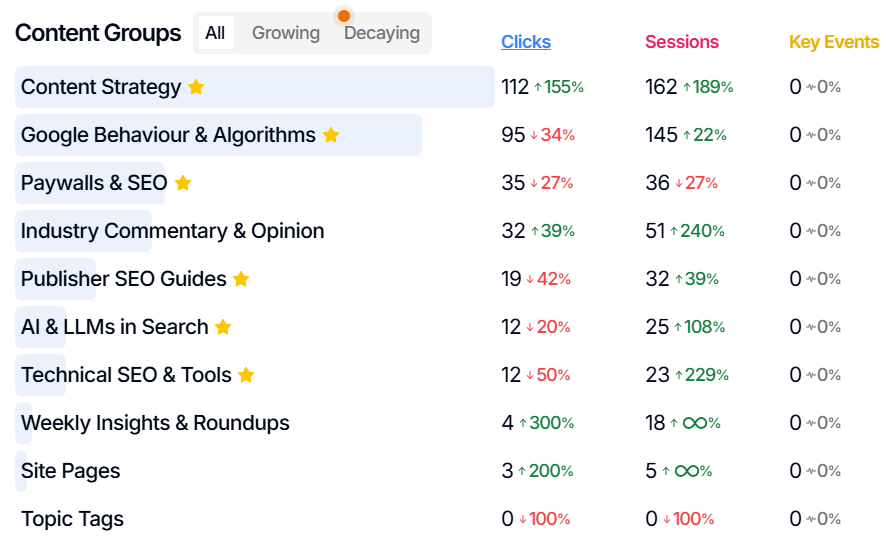
I wouldn’t recommend doing a content deep-dive as part of a first phase SEO audit. But I would recommend identifying areas of the site where you’re seeing out of the ordinary growth or decline. That is how to create a second phase project.
News
All of the above still applies to news, albeit page structure is less important on shorter articles.
Much of what you can do with news as an SEO is helping editorial teams hit some basic standards. And understand how Google ranks news sites.
We know that news content needs to be right on first pass when it goes out into the wild. We know that people broadly search by using entities. People, places, organisations et al. If nothing else, headlines and images need to be on point.
And you want to establish your Top Stories presence, preferably compared to the competition. I like to know how your publishing volume compares to the competition in terms of articles by topic, live blog, video et al.
And that your most important articles are linked to from the homepage, accessible via a Google News Sitemap and have reliable authorship presence.
News checklist
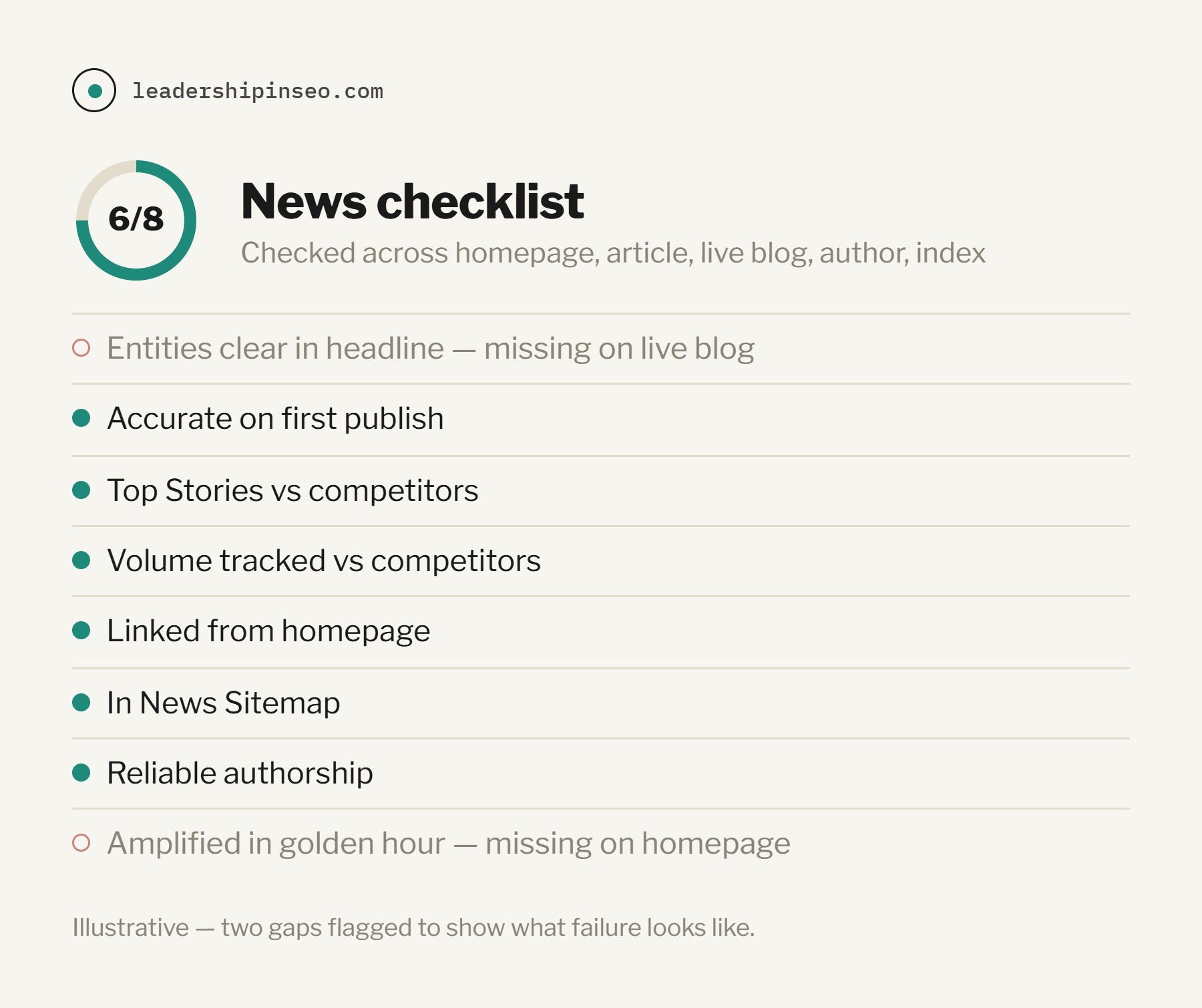
For your most important content and content most likely to get picked up in Google Discover, make sure you amplify it early. Pushed on branded and journalist social channels, on the homepage, in email newsletters. Make it outperform the expected engagement.
This is called The Golden Hour. I would add amplification to any checklist.
Evergreen
Google may have some measurable ways of ‘scoring’ evergreen content and I have written about how I think you should do evergreen content in the AI era.
Most traditional, more commoditised, keyword-led evergreen content isn't as valuable as it once was. So we need to really establish its importance in the ecosystem. Is it worth keeping and renewing?
If you can determine this content sits out of scope and isn’t hitting key micro-conversions (registrations, return visits, engagement etc), kill it. Publisher sites are so sprawling that content pruning is never a bad idea. Particularly if the content sits outside of your core proposition.
Evergreen content checklist
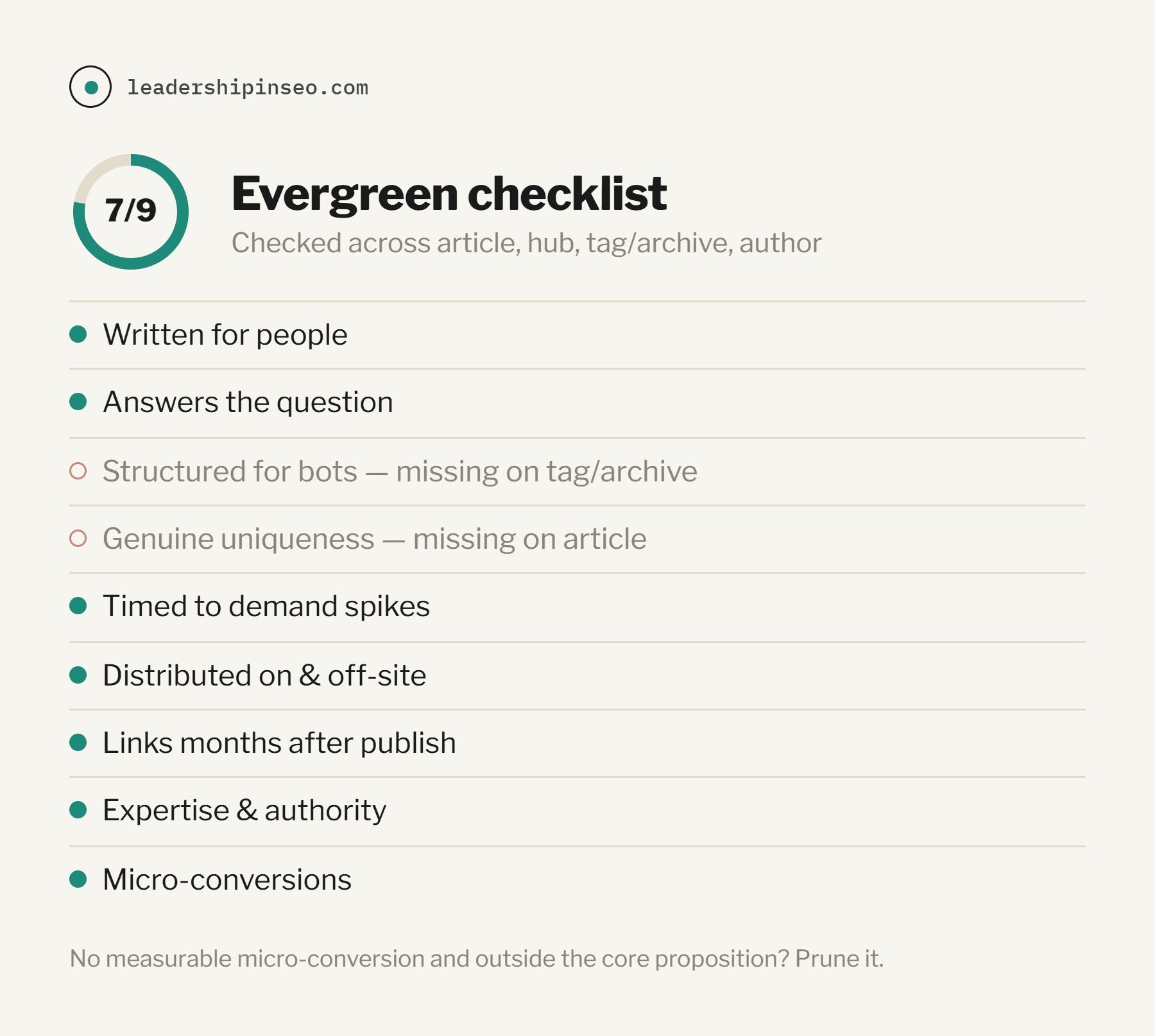
Evergreen content must be written for people and answer the question. You cannot survive without uniqueness or legitimate expertise and it must be structured effectively for people and bots.
In terms of assessing success, it needs to continue to attract links and quality traffic months after publication. Whilst I’m not for updating a page every week, you should time updates to spikes in demand and distribute accordingly.
Aleyda has a brilliant checklist for the types of content to prioritise and de-prioritise, which align almost perfectly with the effort required to create something brilliant and click resilience in a zero click world. I think it ties in very nicely with quality evergreen content.
Google Discover
What works well in Discover tends to work well in search. I’ve written about how Google Discover works and how to analyse it at scale, which might be good places to start here.
Whilst Discover surfaces news and evergreen content, the clickless-sphere is becoming less publisher-friendly. Your content really has to cut through for it to work - ideally you’d be prioritising journalist-led, people first content in video format too. The platform is still an enormous driver of traffic.
Discover checklist
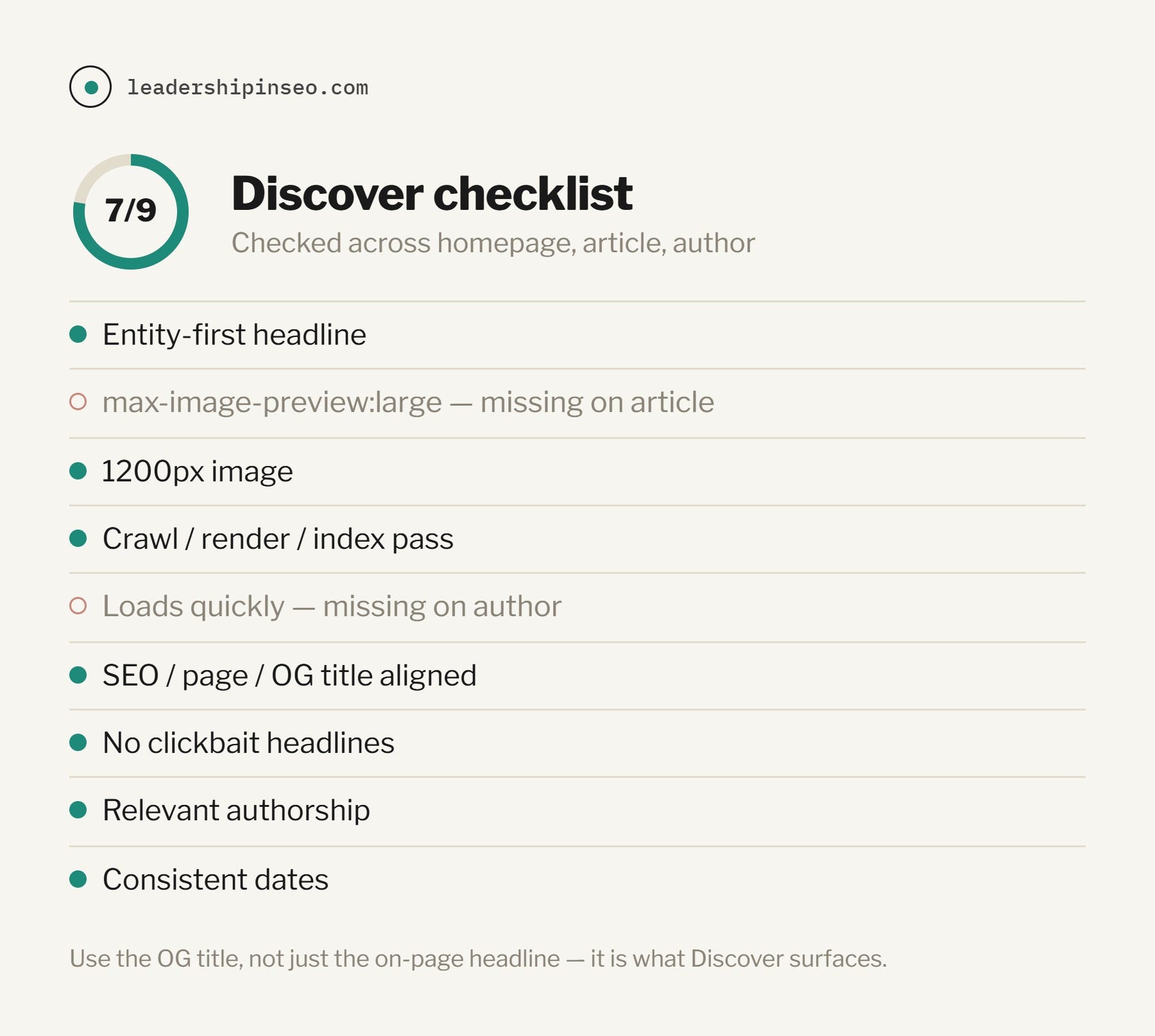
The basic principles for Discover success are the same.
Clickable content that does what it says on the tin. A fast-loading experience, with content that is easy to ‘read’ for people and bots. The image and headline are more important - the max-image-preview has to be set to large and the image must be 1200px wide.
The OG headline gets picked up in Discover and as the social headline it has the chance to be more evocative and engaging. Use it. Don’t just rely on the SEO and on-page headlines.
Really consider the value you’re going to get from Google Discover. You can absolutely generate reach and you will get far more traffic as a paywalled subscriber if you open the surface up. But is that what you need?
EEAT
I wrote a very long article about what good EEAT looks like for publishers and I don’t see any reason to deviate from it. The only updates are to include more entity optimisation and analysis work as part of the audit - which has morphed into its own section.
Contrary to popular belief, it is not a ranking factor. EEAT is more of a qualitative measure of page and site quality. Unless you are a publisher heavily focused on really YMYL topics, this is unlikely to directly move the needle.
But it’s a qualitative measure used by Google’s human SERP reviewers and a core part of Google’s Quality Rater Guidelines. Whilst it has its flaws and detractors, it is still very useful for publishers.
“Trust in news has fallen in 29 of our 48 markets this year, resulting in a drop overall to the lowest level we have recorded since we started to measure trust in 2015 (37%).”
Part of the beauty of EEAT is that the majority of the non-negotiables rarely require significant development work. In an era where consistency matters and users consume your brand away from your own site, you need to own the conversation while being a trustworthy source as best you can.
I suggest breaking it into five key sections:
Links and mentions
Sitewide
Desk-level
Page-level
Off-site
Links and mentions
The value of a backlink has steadily declined as SEOs got better at playing the system. But they’re still hugely important - although not something I pay much attention to. Particularly for larger publishers.
If your brand (personal or professional) makes a positive impact in the industry, you should monitor where and when you’re picked up. Who is talking about you, your product, your brand? Why? Are you making the right impact?
To me, backlinks and mentions are byproducts of doing great things. But you still need to know if they are a limiting factor. If you’re a smaller brand trying to cut through the noise, I suspect you need to invest in digital PR and brand-building campaigns and opportunities.
To assess both, I would do two things:
1. Review backlinks at a subfolder-level
Keep it really simple. Compare your backlink acquisition at a subfolder-level against your core competition.
How do these track over time?
Are you outperforming the competition?
Are you generating links from quality sources?
2. Use a tool like Alertmouse for mention tracking
Setup brand tracking in Alertmouse for you and your competition.
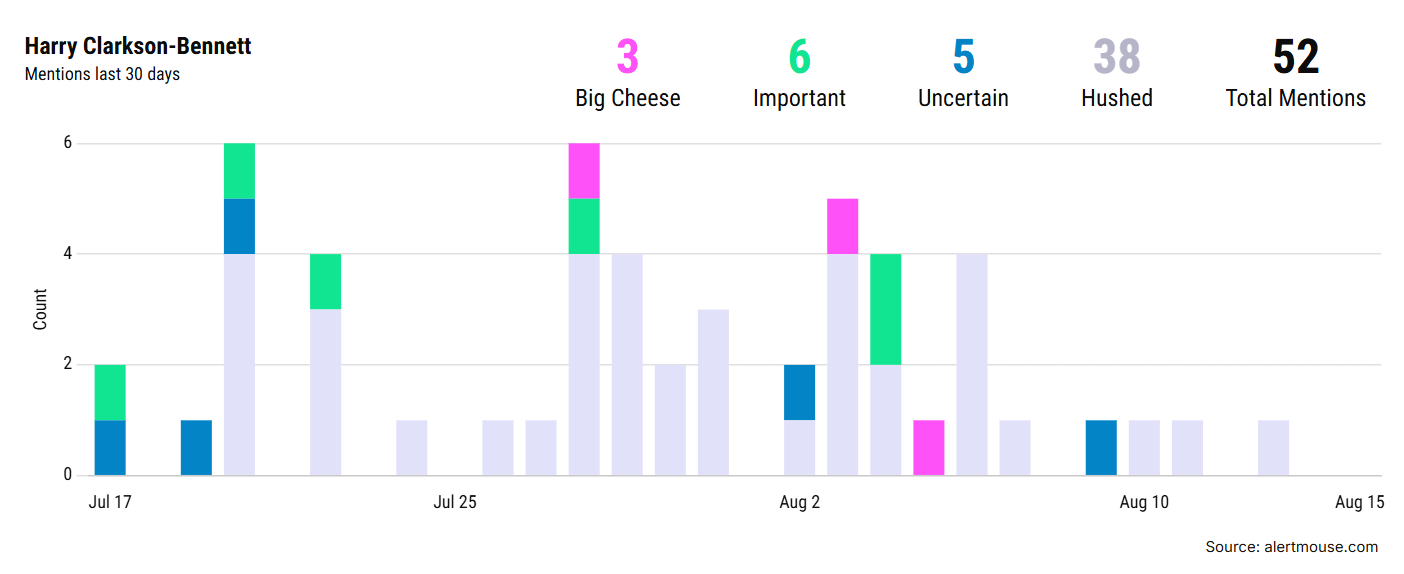
Monitor where these mentions come from
Keep an eye on the competition
Look at the content that is performing in the industry, replicate it in your own style if you have something to add
Reverse engineer how the best in class are generating buzz
I think it’s much harder to use links to boost performance now. As time goes on I suspect links will continue to reduce in value.
I would rather spend time working on things that will get shared, but as a brand you should help wider teams understand what is having an impact.
Sitewide
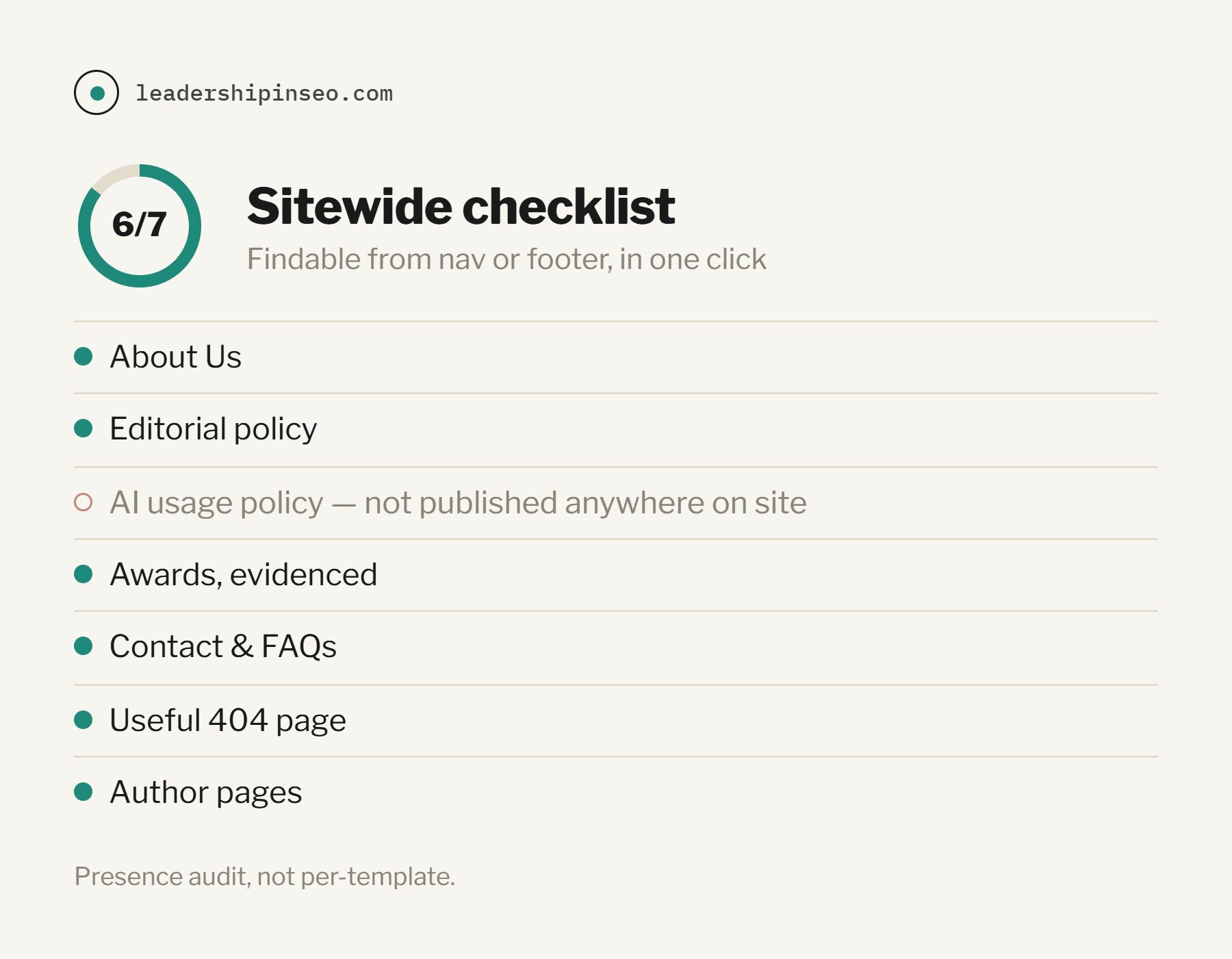
Sitewide, we want to ensure the fundamentals are in place and easily navigable for users. Not everything has to be in the primary navigation, but I would suggest core information like the help centre and key about us and contact us pages are positioned reasonably prominently.
Two easy ways to identify ways this could be improved:
Use your site search data to see if an inordinate number of people have to search to find what they are looking for
Assess your best in-class competitors to see how they approach things
Hell, if you’re feeling brave, you could even ask your community or customer service team to see what your users most common problems are. Although you might be opening a can of worms.
Desk-level
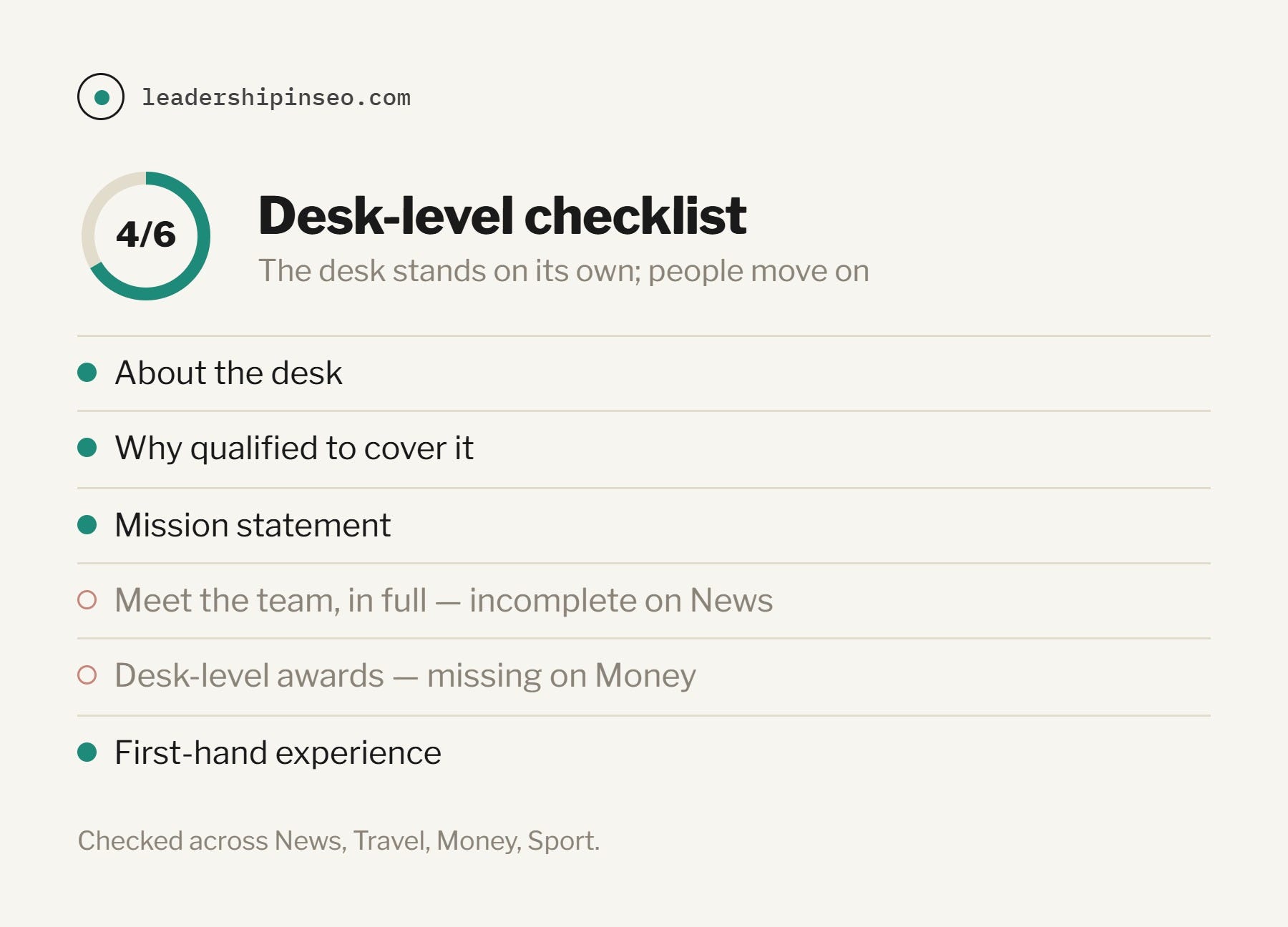
As nice as it would be for sitewide signals to solve everything, for larger publishers this is rarely the case. We need to see real people present on the site. We want to build their profiles in newsletters and encourage the right behaviours in the newsroom to turn journalists into figures of influence.
To do that we need pages that show the team, mission statements that show what the desk is there to do and who they’re there to help. More so than ever, people want to know who these people are and why they should be trusted.
Page-level
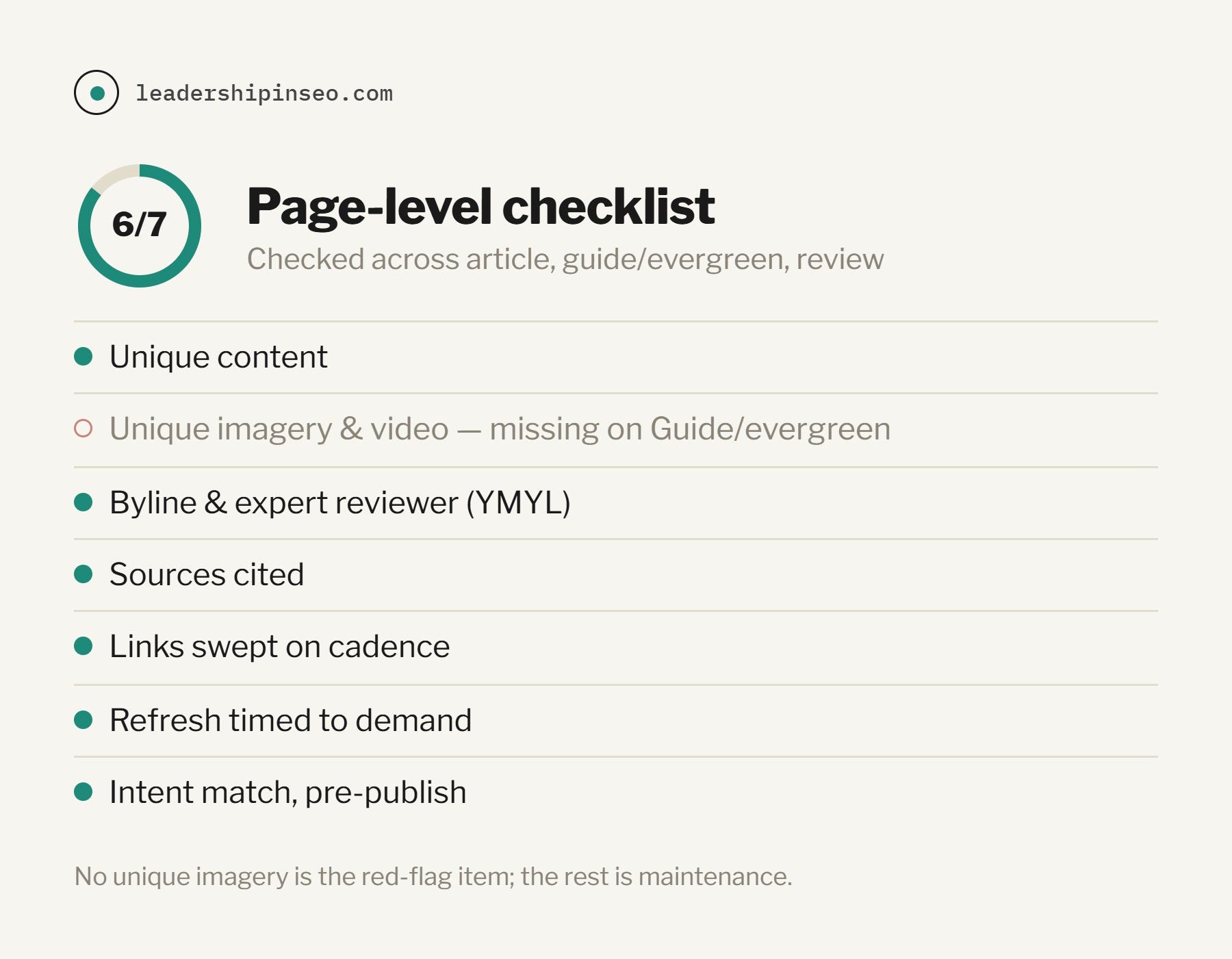
Now we’ve covered off the sitewide and desk-level factors we want to think about things at a page level. Your page needs to demonstrate trust and credibility. It has to be good enough to encourage returning users and to move users from the active to owned discovery.
As is the case with high-quality content, we need to see real authorship, uniqueness, real effort (ContentEffort is a proven scoring component in the algorithm), accurate and up-to-date.
Google uses consensus scoring to decide which pages to rank for certain topics. If the question at hand has a proven answer, you cannot deviate from that and expect to rank.
However, there are many search terms which don't have an objectively "correct" answer, and Google therefore may seek to get a mix of views.
Off-site
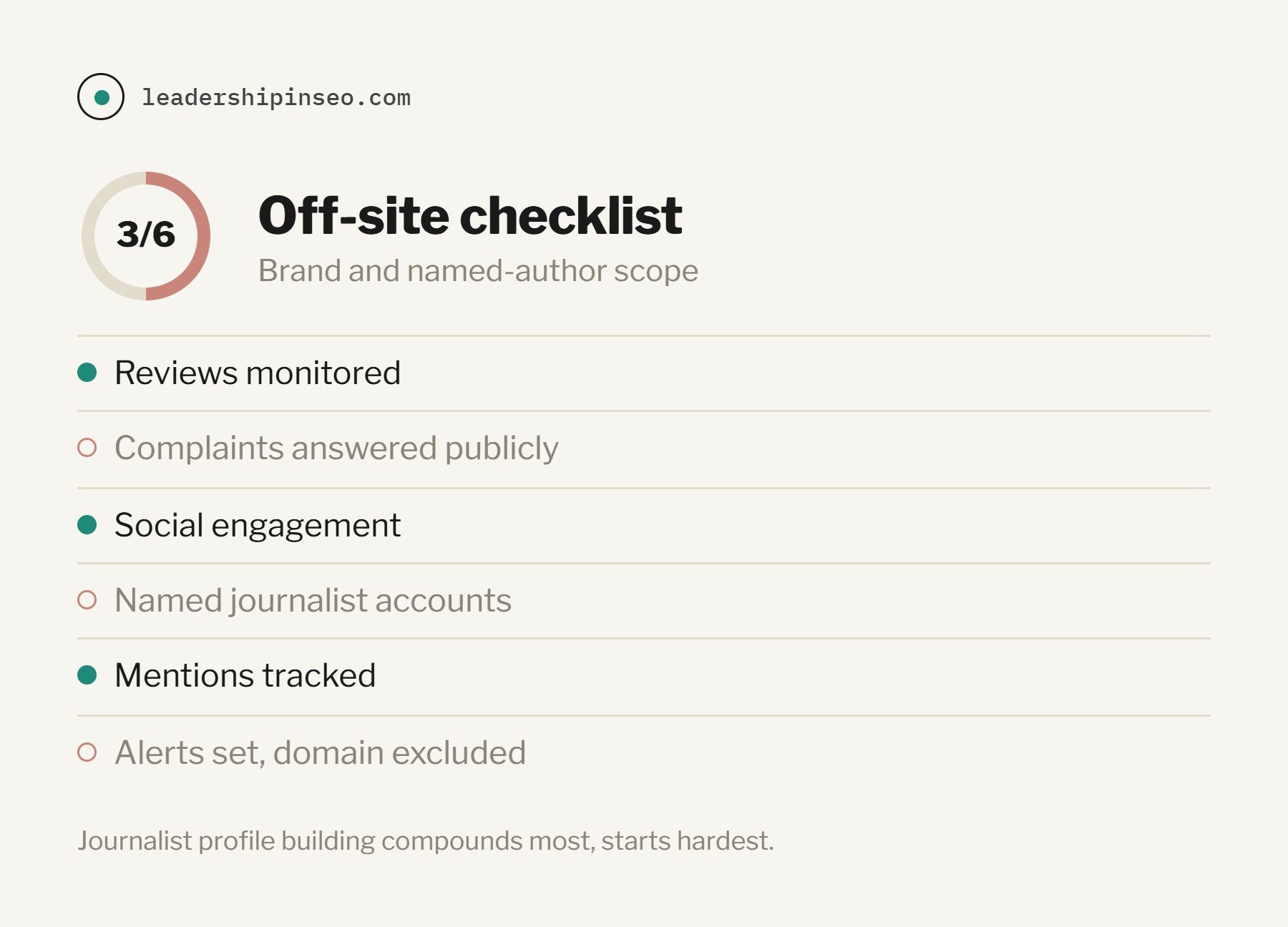
According to this Seer Interactive x Trustpilot study, brands without a Trustpilot review profile have a median AI citation rate of 1%, while brands with a robust profile saw a citation rate of 75%.
Even brands with a basic profile had a 53.5% citation rate. Mentions are the currency of the web and a robust off-site presence is an essential component of EEAT.
Publishers have notoriously awful reviews - I think this is primarily due to especially bad customer service and subscription payments that are very hard to cancel. You can work with said customer service team to even encourage positive reviews, if they exist.
This is all about creating a high-quality product that people become fans of (as part of owned discovery) and talk about in glowing terms.
Worth remembering that algorithms are not applied ubiquitously. Certain topics have more stringent rules and higher levels of rigour - it is precisely what YMYL was invented for. To try to provide more trustworthy results for things that really impact people’s lives.
So if you exist in a more health or financial-based field, the EEAT section is of greater importance than someone who operates in the entertainment space.
Entity Consistency
Entity SEO has been around as a construct for some time, but has never been more important. The best practitioners have been considering it for more than a few years. But for the rest of us mere mortals, the idea has only recently taken hold.
The idea that your brand has to exist beyond search - that you need a presence on other channels - has been corroborated by Google’s latest updates to Search Console. Even if it is just a big distraction tactic.
Ditto your authors.
Bigger presence means bigger distribution. It reduces your reliance on search whilst simultaneously increasing your presence in it.
But presence is only a part of it. Accuracy and consistency are just as important. The information about your brand needs to be corroborated across first and key third party sources. You need to control the controllables.
I would break it into three parts:
On-site
Owned
Earned
The combination of these three things resolves your online identity. Or lack of it. Tools like Waikay can be really valuable here, ditto the Knowledge Graph Explorer.
On-site
Your on-site presence is the definitive statement of your identity. Everything you say and have said matters. This correlates strongly with topical authority. The further you diverge from your brand’s core principles and purpose, the less defined you become.
The pages I would review correlate strongly with good EEAT. You want to ensure what you say is accurate, up-to-date and relevant:
About Us
History
Meet the Team
Shipping information
Returns
Payments
Editorial policies
Products
Pricing
Contact
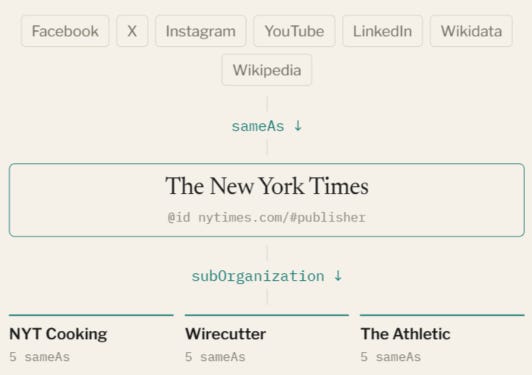
What we’re trying to establish is whether we are THE definitive source for information about our brand. We should use Organization schema, SameAs and alternateName properties to identify other brand names, social accounts, Wikipedia pages et al. All to remove ambiguity and strengthen your knowledge graph presence. Do the same with author pages and schema too. Make these rich and showcase why you’re a trustworthy source.
Trained human raters evaluate pages based on a number of these principles. Accuracy, reliability and trustworthiness. Consistency is auditable. Tear your own skin off boring, but auditable.
Owned properties
Create a spreadsheet with every owned property your brand has. YouTube, Instagram, podcast platforms, websites, review websites, your writers, GMB profile - the whole nine yards.
Then make a checklist including checkboxes for your NAP (Name, Address, Phone Number - yes, like local SEO), website link, owner, pricing, products, other platforms - whatever information you list, make sure it is correct.
Make sure, where applicable, you have claimed all of your properties in search. Your GMB profile, your knowledge panel, your author’s knowledge panels. Use them to create a singular, powerful entity.
Earned
It’s very difficult to audit your earned properties - mentions, citations, Wikipedia pages, Crunchbase pages et al. Particularly when you consider the scale that comes with larger publishers. Clearly trying to alter every erroneous claim isn’t going to be feasible.
Focus your time on the most important mentions, sources and citations. Properties that genuinely influence people’s decisions.
Obviously - and most importantly - create a program of work that genuinely influences people and earns authoritative mentions and citations where your audience spend time.
Again, I think the best output here is a checklist that highlights how effectively and consistently you’re cited vs your competition on the platforms that matter. And tracking your branded search volume (+ topic) is a great way of assessing how you are viewed by people and whether this is having the desired impact.
That’s it
Well done for making it this far. I appreciate this is a lengthy post and one I hope has been useful. Obviously, or I wouldn’t have written it.
It’s not completely conclusive, but does marry together more traditional SEO - that is still foundational to the way discoverability and the internet actually work - with newer concepts around trust and entity consistency.
Hopefully with some tangible ways you can audit and implement them on your site. Of course, I run SEO audits for publishers and content producing sites. So if I can help, send me a note here or on LinkedIn. You know where to find me.