


AI is strangely simple. And we’re overcomplicating it.
In focusing on citation tactics and cheap visibility tricks, we’re missing the bigger picture. As an industry, we’ve got away with piss poor content for years. Updating the same ‘best spoons’ article three times a week because some other idiot is doing exactly the same thing.
The utensil, not the pub. That’s some content I could get behind. Write that down.
There’s nothing inherently wrong with it. It’s just too SEO-y. We’re missing a much bigger opportunity by framing it through a really narrow lens.
I don’t have the energy or the wherewithal to play catch-up every year or two. So I think of AI search as the ultimate synthesis of your marketing efforts.
Your positioning, reputation, expertise, content and presence across the internet are all potential inputs into how AI systems understand and represent you.
It’s not just about your website anymore.
I’ve spent a lot of time recently working on AI search, information retrieval, audience research and discoverability strategies. The more I do, the more convinced I become that we need to approach this as marketers, not SEOs.
Here’s how I’m doing it.
TL;DR
AI search is a marketing challenge, not just an SEO one. It synthesises your wider online presence, positioning, reputation and influence.
Start with your audience, not prompts or citations. Understand who matters, what they care about, where they spend time and who influences them. Then build something worth discovering.
Get your foundations right, then market properly. Technical accessibility, entity management and on-site clarity matter. But your off-site presence is more important.
Measure business impact, not just AI visibility. Track incremental growth in demand, engagement and commercial outcomes. Build a brand worth recommending.
If you want to work with me, see my approach to AI search and modern information retrieval mechanics on my consulting site: get-tomorrow.com
1. Understand the technology.
But don’t build your entire ‘marketing’ strategy around it. I use marketing in the loosest possible sense of the word.
If you’re in dire need of a refresher, here’s a few parts on the fundamentals of modern information retrieval:
Disambiguation - how systems distinguish between people, organisations, places and concepts.
Training data - how information contributes to the knowledge and capabilities of models.
Vectorisation - how information can be represented mathematically to identify semantic relationships.
Information Retrieval - further exploration of modern information retrieval.
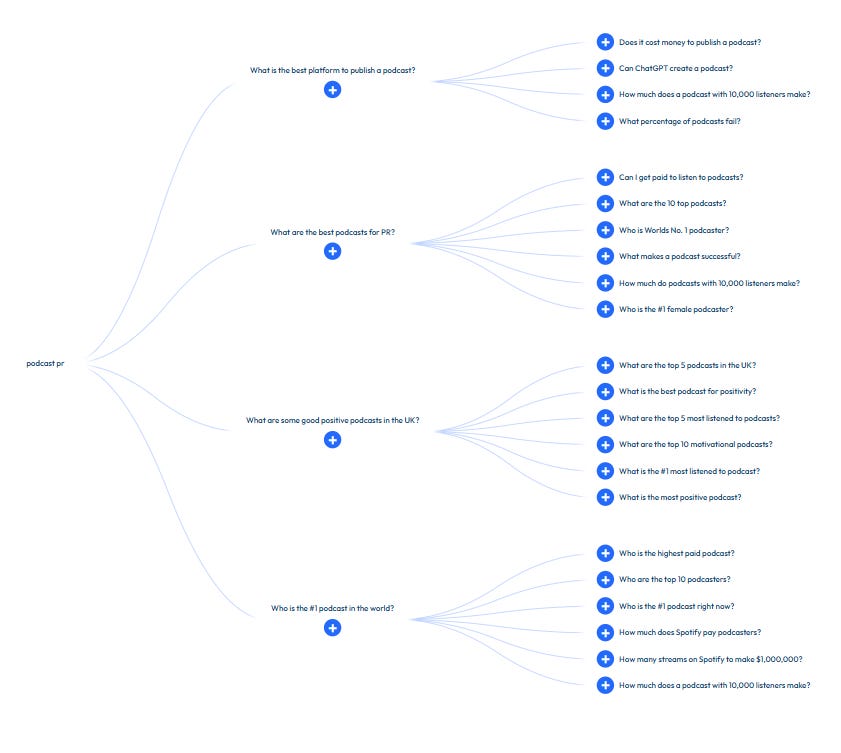
There’s one other concept I haven’t written about in detail - query fan-out. Not because it’s not important, more just because a) it’s pretty dull and b) it isn’t a new concept for SEOs. We’ve been using tools like AlsoAsked for years to understand related questions, adjacent information needs and the wider context surrounding a search.
But we also need to distinguish between three things:
What a model has ‘learned’ during training - its parametric memory
What an AI system retrieves when answering a question.
What that system ultimately says about you.
They’re related, but they aren’t interchangeable. Being crawled doesn’t guarantee inclusion in training data. Being retrieved doesn’t guarantee a citation. And a citation doesn’t guarantee commercial value.
Blah, blah, blah.
Understanding these mechanisms is important - mainly just so you can answer the braindead questions people ask you about AI. Building your entire marketing strategy around their current implementation is the action of a halfwit.
Models, retrieval systems and interfaces will change. - an owned audience is a considerably more durable investment. So fucking build one.
2. Actually being audience-first
This is the biggest change I’ve made to my approach. Not just for AI search, for traditional SEO.
I don’t begin by asking which prompts a brand should appear in. Or how much search volume a keyword or even topic has. Mainly because my trust in search volume and all forms of visibility is at rock bottom.
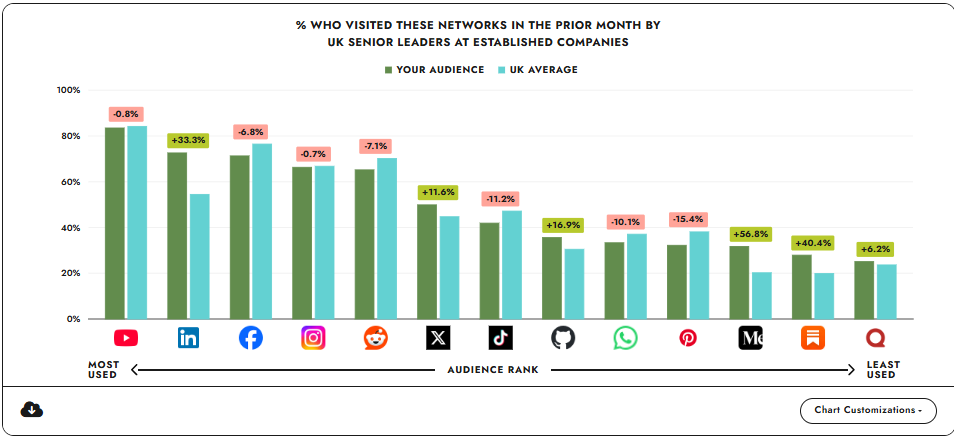
So I use SparkToro to investigate where audiences spend time, which websites they visit, who influences them and which platforms they’re disproportionately likely to use compared with the wider population.
I combine that with traditional search research, AI search behaviour and an assessment of the brand’s existing positioning. You don’t need to overcomplicate this - ask a number of different LLMs about insert brand and record the responses.
I want to answer some relatively straightforward questions:
Who are we trying to influence, and what matters to them?
Where do they spend their time and who do they trust?
Which subjects are they interested in?
Where are we already visible, and where are we absent?
Where should we spend our marketing budget to reach them?
This research should inform two things.
First, our owned platforms. We use what we’ve learned to improve the way we position ourselves, the services we offer, the language we use and the content we create.
Let’s try to make things under our control as human and well targeted as possible.
Second, our wider marketing strategy. We identify the publications, communities, creators, platforms and people capable of influencing that audience, and decide how to reach them.
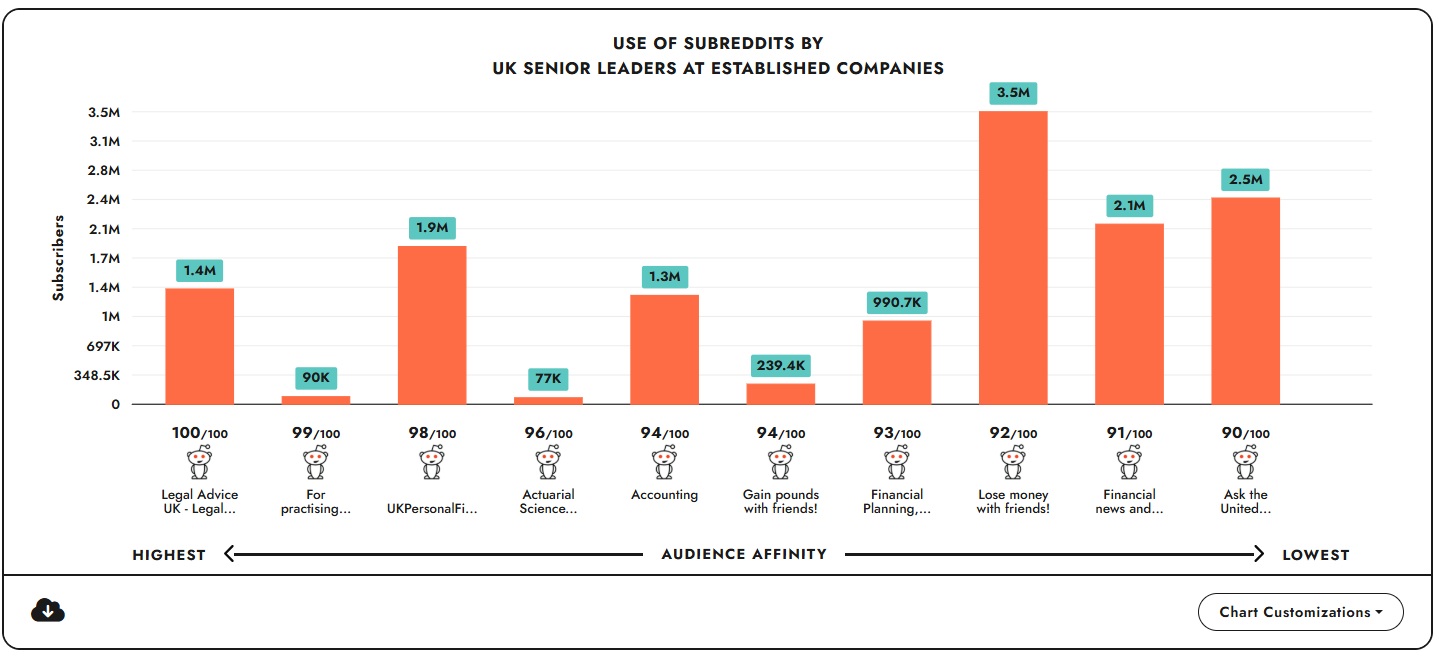
You need to know this. Not because it might get your brand mentioned as part of the training data. But because this is where you should be marketing.
Made up prompt data is out. Real, human-led marketing is in. If we want SEO to be taken seriously, this is the proper evolution.
The goal isn’t to manufacture mentions for an AI model. It’s to build a brand people want to discover, engage with and recommend.
If those activities also increase your representation in AI systems, wonderful. But that’s a delicious byproduct, not the reason for doing them.
3. Get your own house in order
While audience research informs the wider strategy, your website needs to be accessible, understandable and representative of who you are. That is something reasonably competent SEOs can lead.
I approach this in two parts.
Technical foundations and bot management
Can the relevant search and AI crawlers access your content? Can they render it? Are you inadvertently blocking systems you want to reach?
This means reviewing bot management, robots directives, rendering, indexability, internal linking, site architecture and the usual technical SEO fundamentals.
A traditional SEO-type audit with a few improvements.
One that understands that not all AI bots serve the same purpose. Training crawlers, search crawlers and user-triggered retrieval systems can have different access requirements and commercial implications.
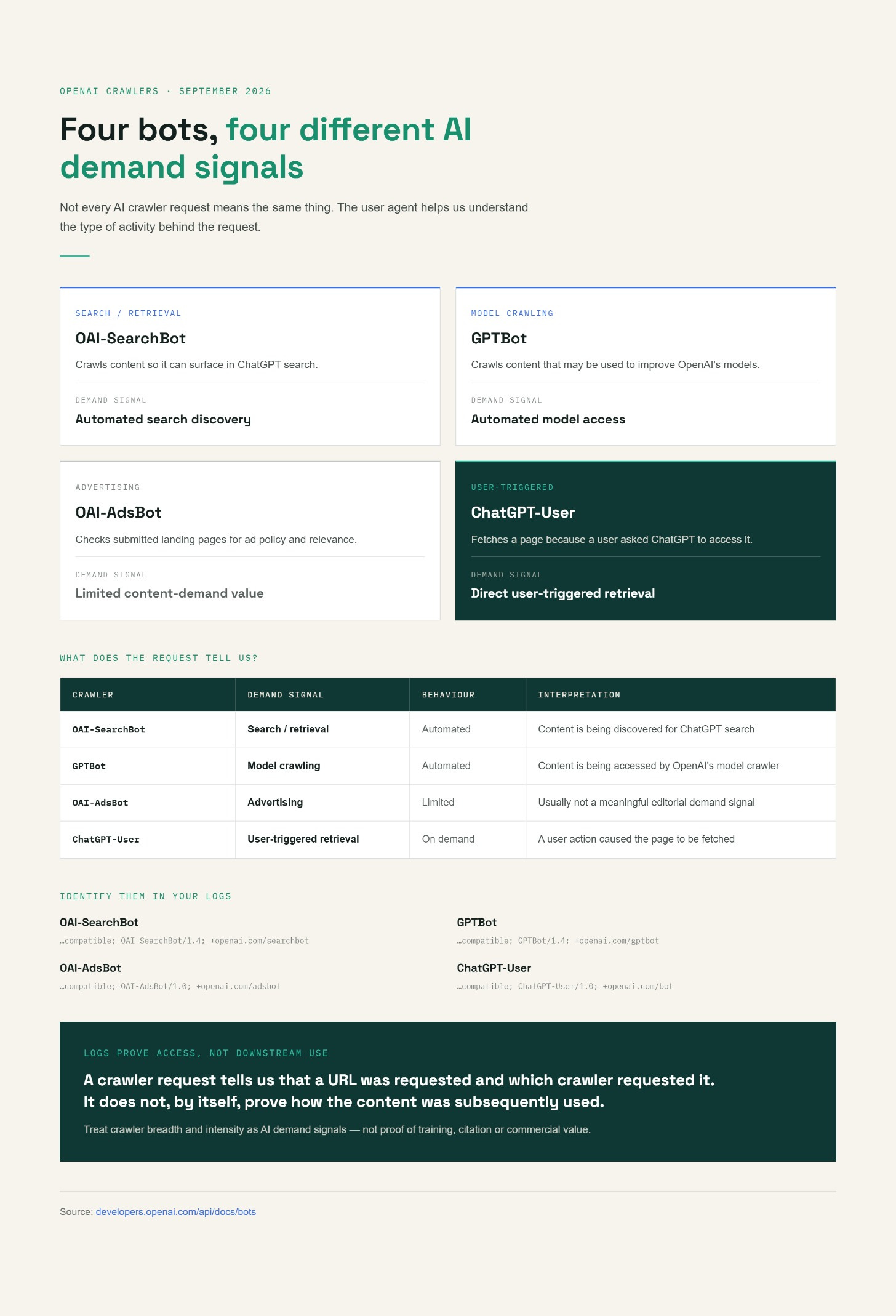
Especially important if you’re working for - or with - a publisher. Someone whose business may depend on you understanding the wider context.
Most large publishers block AI crawlers, sometimes almost indiscriminately, under the banner of copyright protection. There may be very good commercial reasons for doing so. But those decisions fundamentally change your discoverability strategy.
If you’re restricting access to your content, you need to understand what you’re giving up, what you’re protecting and where the value might exist instead.
Perhaps that’s content licensing, direct audience relationships or proprietary products.
The role of the SEO changes considerably in an environment where you’re not maximising access. You’re helping the business understand the trade-offs between visibility, intellectual property and commercial value.
It’s like a paywall. You’re restricting reach for commercial purposes. It’s the correct move if played properly.
See Cyrus Shepherd’s excellent test to understand how much search traffic was truly influenced by Google’s AI proposition.
Entity management
This is where I think modern information retrieval methods and SEO intersect perfectly. I’ve written about how to approach this in Entities Are the Foundation of Modern SEO.
First, establish a consistent identity across the properties you control.
Then make explicit who you are, what you do and how your expertise and relationships should be understood.
Support those claims with evidence: credentials, experience, original work, case studies and demonstrable expertise.
Then earn corroboration from the sewage ridden wider internet.
Your off-site presence should support and extend what you say about yourself. Ideally, it should also introduce you to audiences you couldn’t reach independently.
Finally, monitor how that identity and those relationships evolve. I use Alertmouse.
This framework is relatively simple:
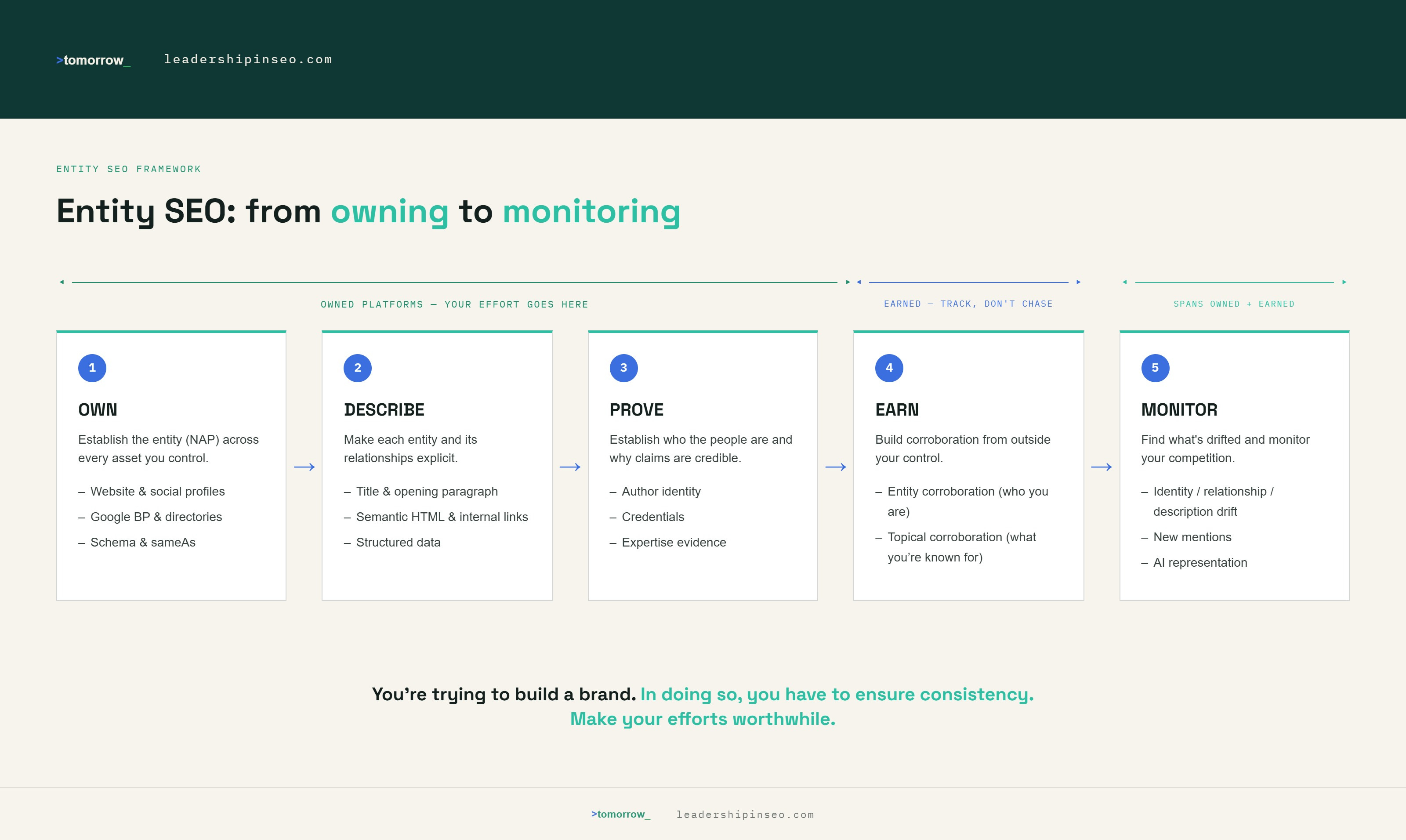
This isn’t about adding some structured data and hoping ChatGPT tries to hump your leg. Spoiler; it won’t.
It’s about making sure that your owned presence accurately represents your positioning and that the wider internet provides credible, independent evidence to support it.
Controlling the controllables.
4. Build influence where it matters
So, we know who we are. We’ve represented ourselves properly. Now we have to rely on *shudders* other people to corroborate this message.
We have to build an off-site presence.
We’re talking actual, real marketing (not SEO). PR, partnerships, content and audience development.
If the people you’re trying to reach spend their time reading particular publications, following particular experts or participating in particular communities, those are the places worth investing in.
Bollocks to a citation. Your audience is there. You know, people you could actually sell something to.
That might mean publishing original research, collaborating with influential people, appearing on podcasts, creating genuinely useful resources or contributing expertise to relevant publications.
Some of those activities will generate links. Others will generate mentions, relationships, conversations and brand demand - a real representation of site quality in Google.
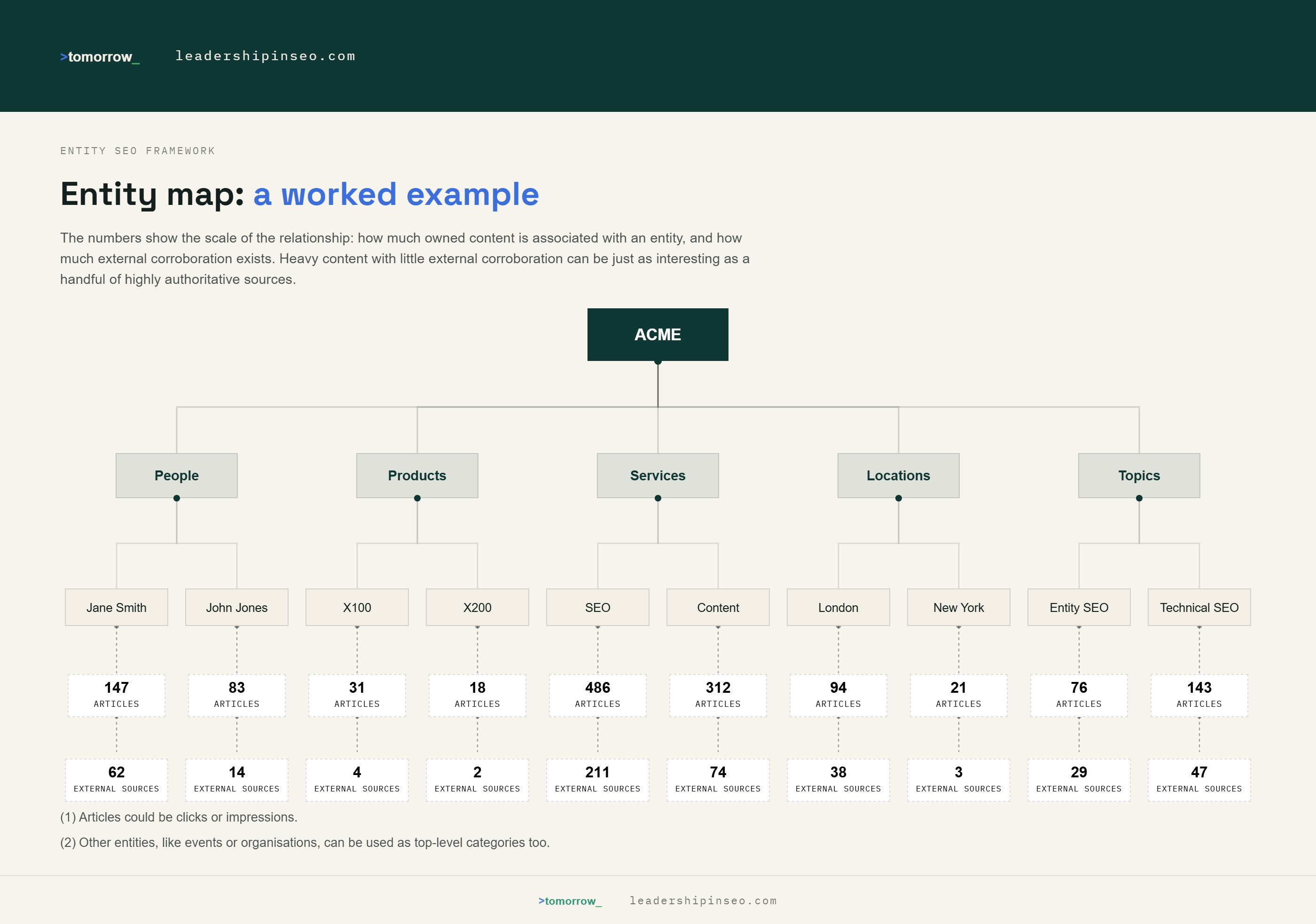
The more consistently you’re associated with the right subjects, people and organisations, the stronger your wider digital presence can become. That is, in essence, how training data and entity relationships work.
If you’re lucky, some of that evidence may eventually influence how AI systems represent you.
But you won’t care, because you’ll have been making sales by marketing to actual customers.
5. Try things
Modern methods of information retrieval across SEO and AI search share many, if not all of the same fundamentals.
Crawling, retrieval and accessibility
Clear targeting
Well structured content
Uniqueness (maybe a reason to be included is a better turn of phrase here)
Arguably AI search has a longer-tail to it. But it’s not sustainable, nor sensible, to create a page for every possible thought your audience may have. To perpetuate a false Henry Ford quote:
"If I had asked people what they wanted, they would have said faster horses"
H. Ford, Never
So you need to strike a balance. No one cares about visibility without impact. At least not for long.
There is room to try and test things. Good things. Things real people will care about.
People like Jan-Willem Bobbink and Dan Petrovic highlight some really brilliant things you can test that are eminently sensible for SEO and AI search. Surprise, surprise, they work for people too. It’s marketing.
Let me give you an example. Maybe more accurately, let me steal one of Jan’s:
“I spent the last three weeks on SEO / GEO work for B2B clients, and the changes that made the biggest difference were mostly about information that was missing or hard to find. Buyers run into the same problems on these sites, so you can usually get these fixes approved without having to explain SEO to anyone.”
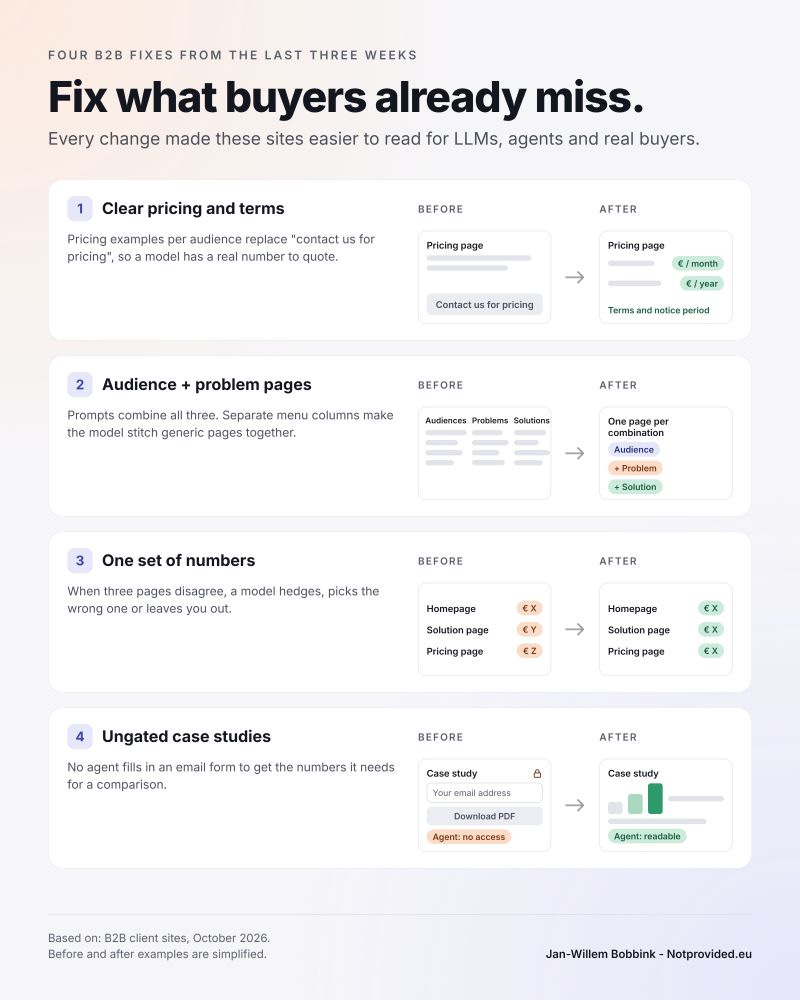
Being explicit, consistent and accurate is not an AI hack. It’s just pretty fucking sensible.
Adding pricing pages, case studies and telling people why you are the best in the business are always good ideas. Even if your pricing pages just say something like prices starting at x, that is a better way of finding the right audience.
And if you want to feature in AI responses, for god’s sake don’t hide your case studies. You need to provide a clear reason for your inclusion. Hard if your best work is hidden.
Statements like "Client Y saw a 30% improvement in deliverability metrics" can noticeably improve your citation rate because a model is literally looking for a reason to include you. You need to give them one. Just as you would a person.
Experience. Expertise. Authority. Trust. Not so fucking stupid after all.
6. Measure your ‘visibility’ but understand its limitations
Measurement’s been broken for a decade anyway. It’s just nice for the C-suite to have numbers to report on - even if they’re complete hokum.
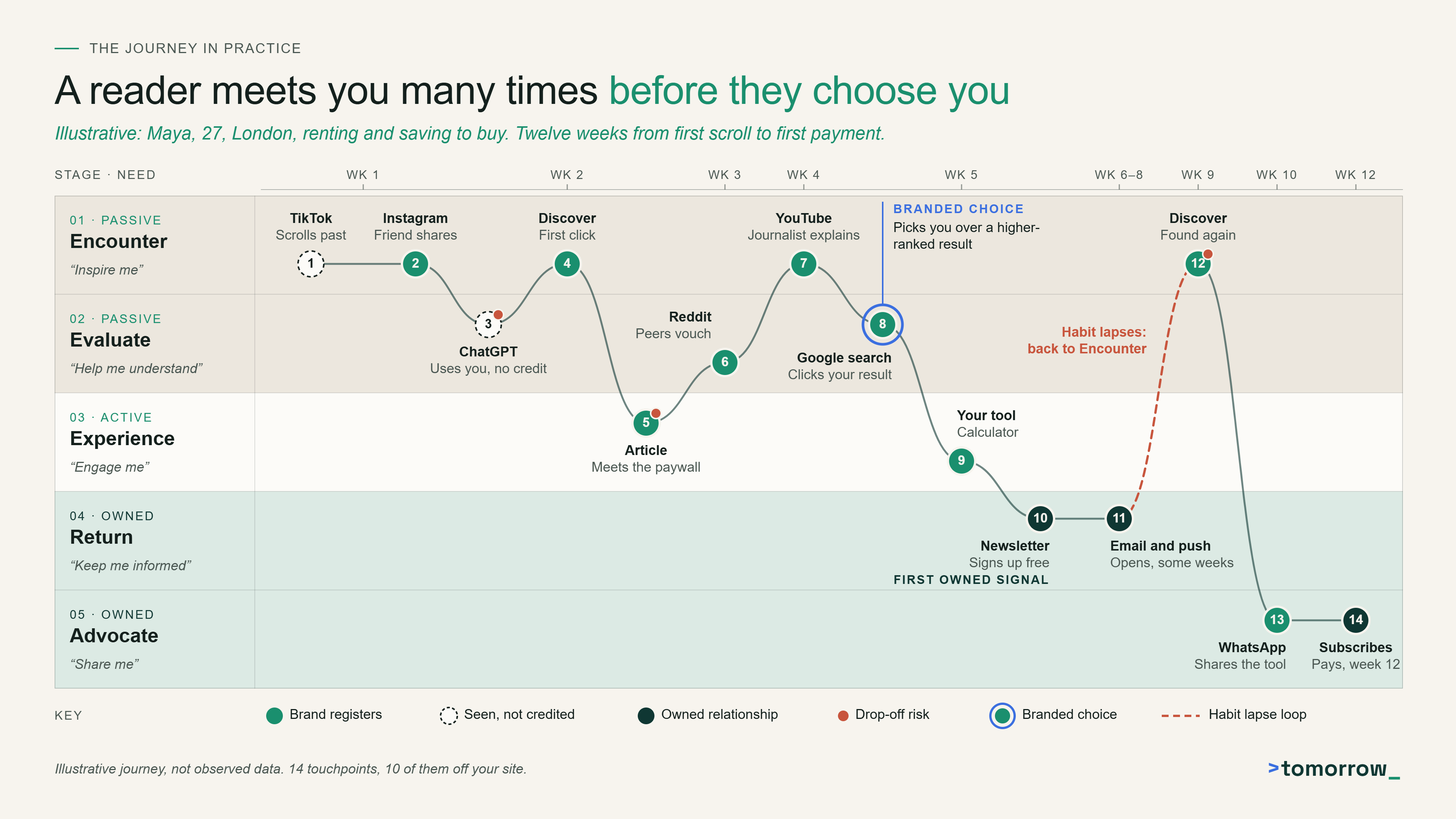
AI visibility's not much better. A hugely flawed metric given the personalisation, lack of prompt data and completely individual prompts. But it’s better than nothing. Indicative at best, but you need to use something.
People still want to know how they’re represented in AI systems. And so they should - it’s a valuable channel. My preference is to establish a representative set of prompts across four areas:
Branded: Questions directly about you, your organisation, products or services. These are particularly useful for finding outdated, inaccurate or misaligned information influencing AI responses. You might discover an old service page or third-party profile is causing a system to describe your business completely incorrectly. Accuracy matters.
Existing positioning: Subjects and categories where you already have authority.
Desired positioning: Subjects and categories you want to become associated with.
Wider market: Relevant topics where competitors or alternative providers might be recommended.
Track these consistently, across the systems that matter to your audience.
Look at whether you’re mentioned, how you’re described, which competitors appear and which sources are being used. Find out when you start to appear for certain terms and see if it matches your positioning.
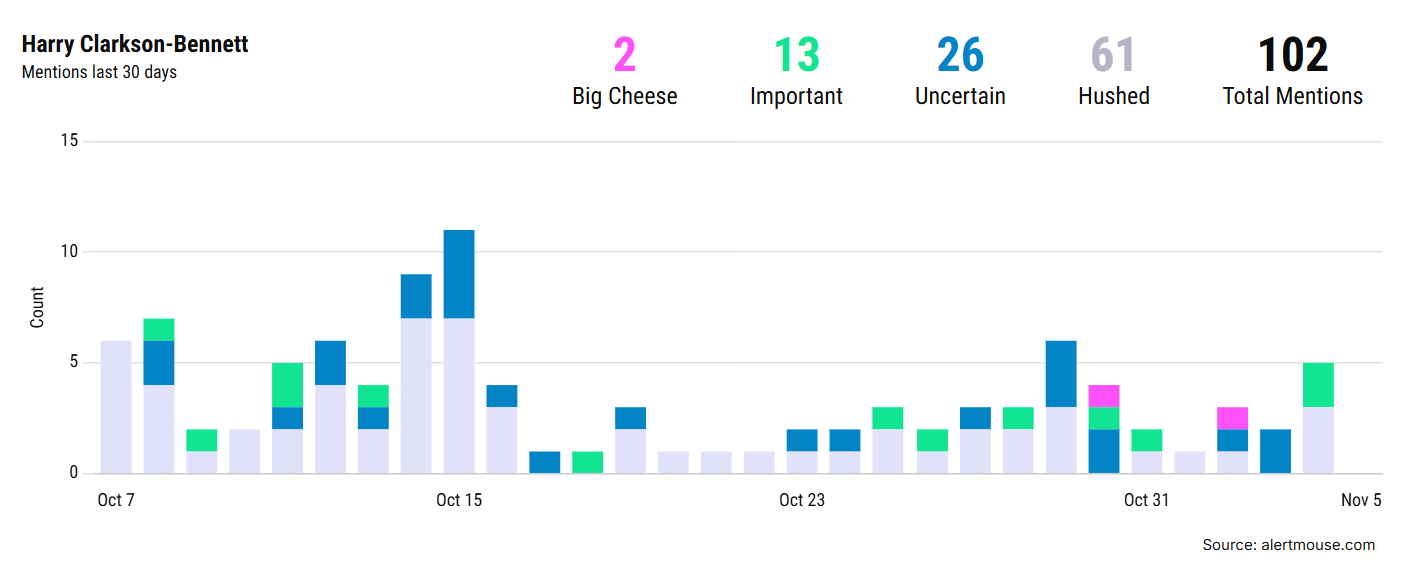
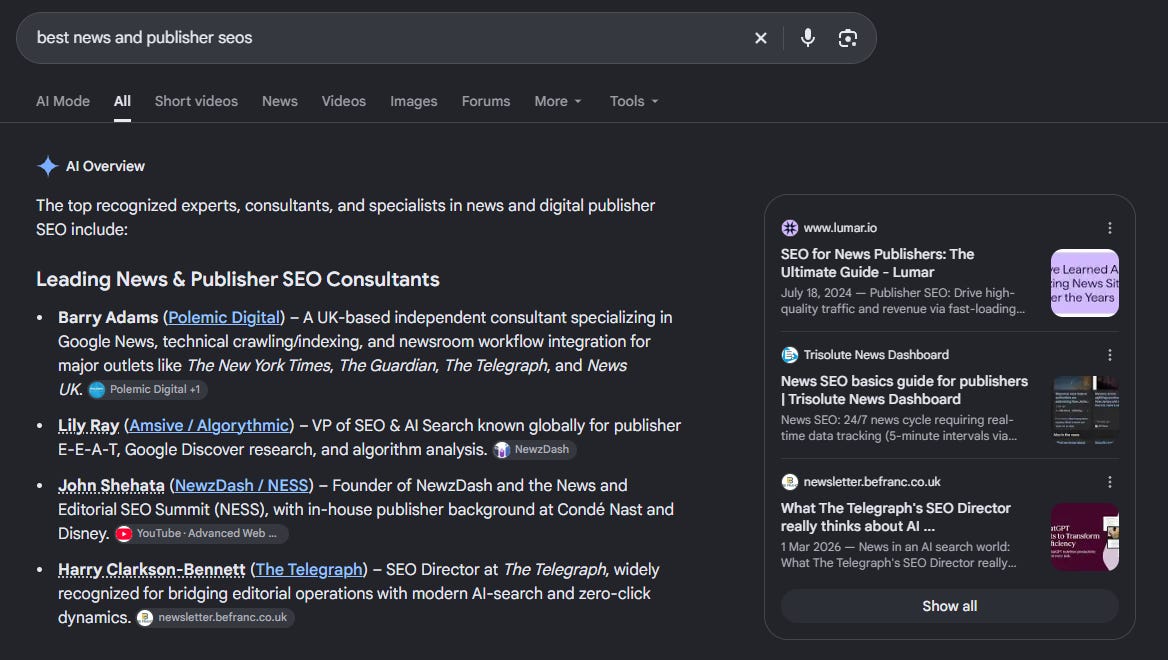
I appear in AI recommendations around news SEO expertise despite having done nothing specifically to optimise for AI search.
What I have done is spend years working in the industry, publishing, building relationships, contributing expertise and establishing a reasonably clear on-site and off-site identity.
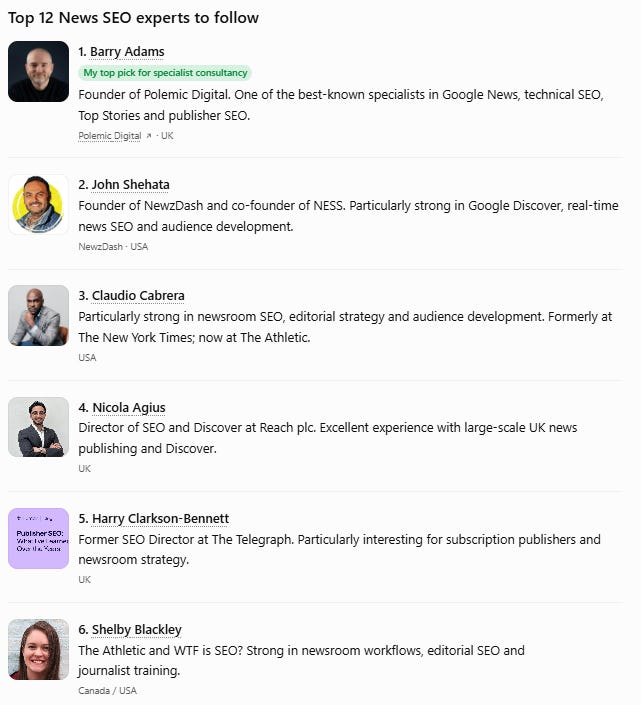
I guarantee you, if you ask Barry Adams, he’ll tell you he’s done nothing special for AI either. If he doesn’t tell you to fuck off first.
I’ve written what I think are high-quality articles on third party websites and podcasts, featured in round ups and built my own distribution platform. It just also happens to work for featuring in AI systems.
7. Measure the incremental impact
AI systems don’t necessarily need to send you traffic to influence commercial outcomes. Which is a good thing, because ChatGPT sends less than 1% of Google’s traffic.
Similarweb’s research found that users who received a brand recommendation in ChatGPT were 2.5 times more likely to visit that brand’s website within the following seven days than users who were recommended a competitor.
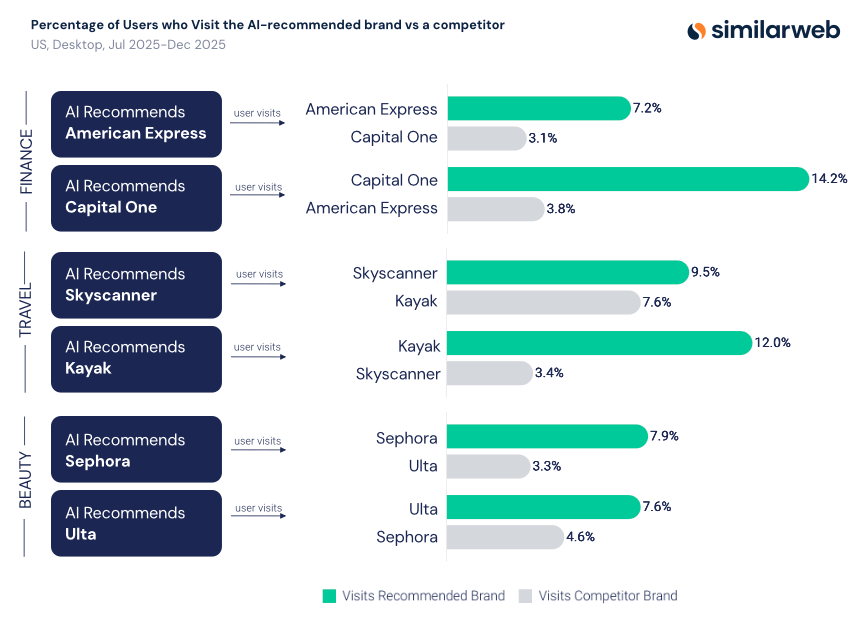
Much of that activity happened through subsequent branded searches rather than direct AI referrals. One of those measures of site quality that should be monitored.
AI search can and does function as a brand discovery and consideration channel. I think referral traffic is, at best, a secondary measure of success from LLMs. Whilst they’ve engineered the exit out, you cannot deny the reach these systems have.
Unfortunately our attribution systems can’t cope with ‘I saw it here once.’ We need to focus on incremental change. The outcomes attributable to marketing.
Establish a baseline. Run a campaign. Measure changes in branded demand, direct visits, conversions, leads and commercial outcomes. Compare with appropriate benchmarks or control groups where possible.
Then test something else.
Keep tracking AI visibility, referrals and citations, but use them as supporting indicators.
Our objective is to establish whether said marketing activity is creating additional business value, not whether ChatGPT has linked to your homepage.
Publishers are an exception
For businesses whose models depend on monetising information and attracting a click, AI search presents a very different challenge.
They are monetising other people’s work for their own ill-gotten gain. That is an irrefutable commercial dilemma. Hence all the protectionism. So we need to establish what that cost is and try to find alternative methods of monetisation.
In The Generative AI Report Sucks - Let’s Make It Brilliant, I outlined how publishers can combine AI visibility data with traffic dependency, commercial value, audience resilience and server logs.
If we can establish:
Where AI creates commercial exposure
Where content is defensible
Where new opportunities might exist
We can go some way to solving actual business problems.
8. Think commercially
Always, always, always a good thing to do. Regardless of your job.
This opportunity is no different, especially for organisations (like publishers) with substantial authority across particular subjects. They have influence within the wider information ecosystem.
That influence can have commercial value.
Publishers Should Think About AI Visibility. Content licensing, data partnerships, research collaborations and other commercial arrangements offer opportunities to monetise expertise and proprietary information.
But this needs careful handling.
Selling links or undisclosed editorial influence is not a sustainable AI strategy. It introduces reputational, editorial and search-policy risks.
The more sustainable opportunity is to understand the value of your existing content, expertise, audience and distribution - and build legitimate commercial products around those assets.
Lots of companies are selling or actively considering selling their archived assets or data to AI companies:
For publishers in particular, this is an opportunity to rethink the value they create beyond the click. See the Daily Mail’s approach to GEO monetisation here.
If you’re more on the glass half full side, you’ll be able to sniff out commercial opportunities. Ideally ones that don’t ruin the brand or fall foul of Google’s link payment guidelines.
General advice - if something smells a bit off, it probably is. Shit is as shit does my friend. Whether you tread in that shit in a month or a year, I can’t tell you. But when you do, it’s extremely difficult to clean.
9. Who should actually own AI discoverability?
If you’re a business looking to take this seriously, there’s an organisational question you need to answer.
Who is responsible for all of this?
Because as great as we can be, it shouldn’t just be your SEO.
This touches technical infrastructure, audience research, brand positioning, content, PR, distribution, commercial partnerships and measurement. That requires someone who understands the entire ecosystem and, crucially, how to influence people.
Nobody is an expert at all of these things. They’re too different. Too complex.
For larger businesses, I’d be thinking about a Head of Marketing or Head of Discoverability with responsibility for coordinating these activities. Someone who at least knows the basics of each and can herd a clowder of cats.
They need the authority to bring different teams together, allocate resources, challenge existing assumptions and measure outcomes against business objectives.
There’s a reason SEOs rarely graduate to marketing lead positions. We don’t understand wider marketing because we’ve rarely had to. SEO was always the best channel… According to wonky data anyway.
AI search gives us a very good reason to change that.
And for anyone working in SEO, I think there are three particularly interesting directions.
You can lean into the technical side: crawling, retrieval, infrastructure and data.
You can lean into building: creating tools, systems and products that help businesses understand and improve their discoverability.
Or you can lean into marketing: audience research, positioning, reputation, content strategy and distribution.
All three have tremendous value. Limiting yourself to SEO, particularly as a collection of search-engine or LLM-specific tactics, is increasingly short-sighted.
Discoverability has been changing for a decade. We need to think much more broadly about how audiences discover and engage with content. The opportunity is to bring those disciplines together.
A little rebrand and refocus on what you want from your career may be the best thing you ever do.
And finally
Anyway, that’s it.
Stop trying to engineer your way into an AI response. Build a brand worth recommending, an audience worth owning and a business that benefits whether the citation comes or not.
Enjoy yourself. This will be a better era for marketers and marketing. Your competition are lazy and inept. They’re just faster.